

Entering a new agricultural market requires more than identifying demand. Companies must understand which crops have commercial potential, where farmers are concentrated, how products reach them, what competitors offer, and whether local economics support sustainable growth. A structured market-entry assessment helps companies prioritize opportunities before committing capital, distribution resources, and operating capacity.
Recent statistics demonstrate the scale of agricultural markets. FAO estimates show that fertilizer use reached approximately 197 million tonnes of nutrients globally in 2024, up 7% from 2015, reflecting continued demand for productivity-enhancing inputs.
These trends create opportunities for agribusinesses, agricultural-input manufacturers, food companies, agri-tech providers, investors, and distributors evaluating geographic expansion.
A market-entry assessment helps identify attractive crop segments, farmer groups, channel structures, competitive dynamics, pricing conditions, and investment economics before entering a new market.
Identifying the Most Attractive Agricultural Markets
Agricultural markets differ significantly in growth potential, driven by crop economics, farmer demand, channel maturity, and competitive dynamics. The FAO reports that global cereal production reached approximately 3.1 billion tonnes in 2024, while the harvested area of primary crops expanded to 1.5 billion hectares, highlighting continued agricultural growth.
Evaluating factors such as crop mix, farmer concentration, input adoption, and investment economics helps organizations identify attractive markets and prioritize expansion opportunities with the strongest commercial potential.
Evaluating Expansion Potential Across Agricultural Markets
Identifying attractive agricultural markets is only the first step. Successful expansion requires a deeper understanding of the factors that influence commercial viability, market accessibility, and long-term growth potential:
- Crop Potential: Evaluate crop acreage, production trends, and input requirements to identify demand opportunities.
- Farmer Concentration: Assess farmer density, purchasing power, and adoption behavior within target regions.
- Channel Maturity: Analyze distributor networks, retailer presence, and product accessibility across the market.
A comprehensive evaluation of these factors helps organizations prioritize expansion opportunities that align with their capabilities, reduce entry risks, and support sustainable commercial growth.
Prioritizing Expansion Opportunities Across Agricultural Markets
Identifying attractive markets is only part of the expansion process. At Nexdigm, market-entry decisions are evaluated through both commercial and operational lens to determine which opportunities align with an organization’s product portfolio and long-term growth strategy.
By assessing market potential alongside channel readiness, competitive dynamics, and economic feasibility, Nexdigm helps businesses prioritize expansion opportunities that offer the strongest prospects for sustainable growth, scalability, and competitive advantage.
Nexdigm’s Agricultural Market Entry Assessment Approach
To support informed expansion decisions, Nexdigm’s Agriculture Market Entry Strategy Consulting approach applies a structured framework to evaluate market attractiveness, commercial viability, and operational feasibility. This involves assessment of the following areas:
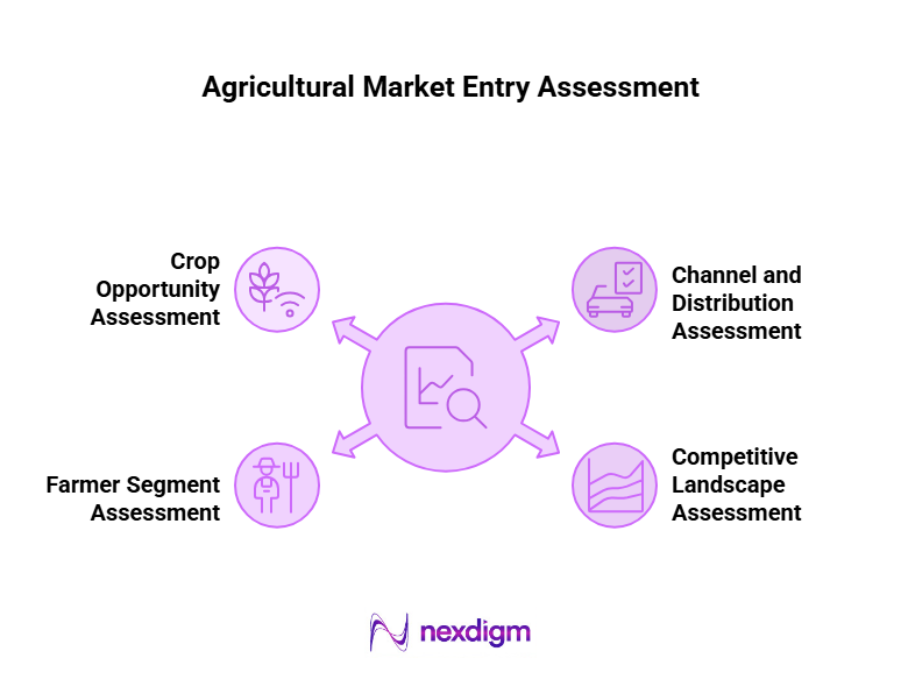
- Crop Opportunity Assessment: Analyze crop acreage, production trends, seasonality, and input demand to identify attractive market segments.
- Farmer Segment Assessment: Evaluate farmer concentration, purchasing behavior, adoption patterns, and income profiles to understand demand potential.
- Channel and Distribution Assessment: Assess distributor networks, retail reach, market access, and supply-chain efficiency to determine route-to-market effectiveness.
- Competitive Landscape Assessment: Examine competitor presence, product portfolios, pricing strategies, and market positioning to identify differentiation opportunities.
Through this framework, Nexdigm helps organizations make informed expansion decisions, prioritize high-potential markets, and develop scalable market-entry strategies that support long-term commercial success and sustainable growth.
Nexdigm’s Agriculture Market Assessment Driving Sustainable Growth
A successful market-entry strategy extends beyond entering new geographies. Through its assessment framework, Nexdigm helps organizations translate market insights into actionable growth strategies that supports their sustainable growth by focusing on:
- Prioritizing High-Potential Markets: Nexdigm helps identify markets with favorable crop economics, strong farmer demand, established distribution networks, and attractive growth prospects, enabling organizations to focus resources on opportunities with the highest likelihood of commercial success.
- Optimizing Expansion Investments: By evaluating market size, competitive intensity, and investment requirements, Nexdigm enables businesses to allocate capital efficiently, minimize expansion risks, and maximize returns from market-entry initiatives.
- Strengthening Market Positioning: Understanding local farmer needs, purchasing behavior, and competitive offerings helps organizations develop differentiated value propositions that improve customer acceptance and strengthen market presence.
- Building Scalable Distribution Models: Nexdigm assesses channel structures, distributor capabilities, and route-to-market strategies to establish distribution models that support efficient market penetration and long-term operational scalability.
This approach supports sustainable growth, reduces expansion risks, and helps businesses establish a strong and competitive presence in target agricultural markets.
Nexdigm’s Agriculture Market Assessment in Strengthening Competitive Presence
Establishing a presence in a new agricultural market requires more than market access. Organizations must understand competitive dynamics, farmer preferences, channel structures, and local economics to build a sustainable advantage.
Through its assessment approach, Nexdigm helps businesses identify differentiators, refine market-entry strategies, and position their products effectively. This enables organizations to strengthen market relevance, increase customer acceptance, and establish a strong and competitive presence in target agricultural market.
Nexdigm’s Case
An international agribusiness company engaged Nexdigm to evaluate entry into a new agricultural market across crop potential, farmer segments, distribution channels, competition, and unit economics. The assessment identified 11 priority opportunities, and improved market-entry prioritization by 32%, supporting channel planning, investment allocation, and faster commercial expansion.
To take the next step, simply visit our Request a Consultation page and share your requirements with us.
Harsh Mittal
+91-8422857704