

Moving from agricultural opportunity assessment to commercial launch requires a structured approach that connects market demand with crops, farmer segments, distribution channels, pricing, partnerships, and operating economics. Companies must translate market intelligence into an actionable entry model that can scale while managing seasonal demand, fragmented supply chains, regulatory requirements, and local competition.
Recent statistics demonstrate the scale of agricultural markets. The World Bank reports that agriculture accounts for approximately 4% of global GDP and employs more than 25% of the global workforce, highlighting the sector’s commercial and economic importance.
These dynamics create opportunities for agribusinesses, agri-input manufacturers, food companies, agri-tech providers, distributors, and investors. For this, a scalable entry plan helps convert market opportunities into prioritized products, partnerships, launch milestones, and commercially viable growth strategies.
Navigating the Realities of Agricultural Market Entry
Agricultural market entry is shaped by factors that extend beyond demand potential. Seasonal purchasing cycles, fragmented farmer networks, evolving regulations, distribution challenges, and localized competition can significantly influence commercial success. At the same time, expanding agricultural production continues to create new growth opportunities. According to the FAO, the global harvested area of primary crops reached approximately 1.5 billion hectares in 2024, up by 197 million hectares since 2010, while global oil crop production increased by 50% over the same period.
These trends highlight the importance of balancing market opportunity with execution readiness. Organizations that effectively align market insights, channel strategies, partnerships, and operating economics are better positioned to achieve successful launches and sustainable growth in agricultural markets.
Why Agricultural Market Entry Matters
Agricultural markets present significant opportunities for growth, but success depends on selecting the right markets and executing effectively. With expanding crop production, increasing demand for productivity-enhancing solutions, and evolving agricultural value chains, organizations have an opportunity to reach new farmer segments and strengthen their market presence. However, achieving sustainable growth requires balancing market potential with operational readiness, channel effectiveness, competitive positioning, and commercial viability.
Nexdigm’s Approach to Scalable Agriculture Market Entry
Successfully entering an agricultural market requires more than identifying demand opportunities. Organizations must determine how products, channels, partnerships, pricing, and operational capabilities come together to support a successful commercial launch.
Through its assessment-led approach, Nexdigm helps businesses translate market intelligence into practical market-entry strategies that align with local market conditions and long-term growth objectives.
Nexdigm’s Agriculture Market Entry Strategy Services
Turning market opportunities into successful commercial launches requires a structured and localized approach. Through its Agriculture Market Entry Strategy Services, Nexdigm helps organizations by evaluating the following areas:
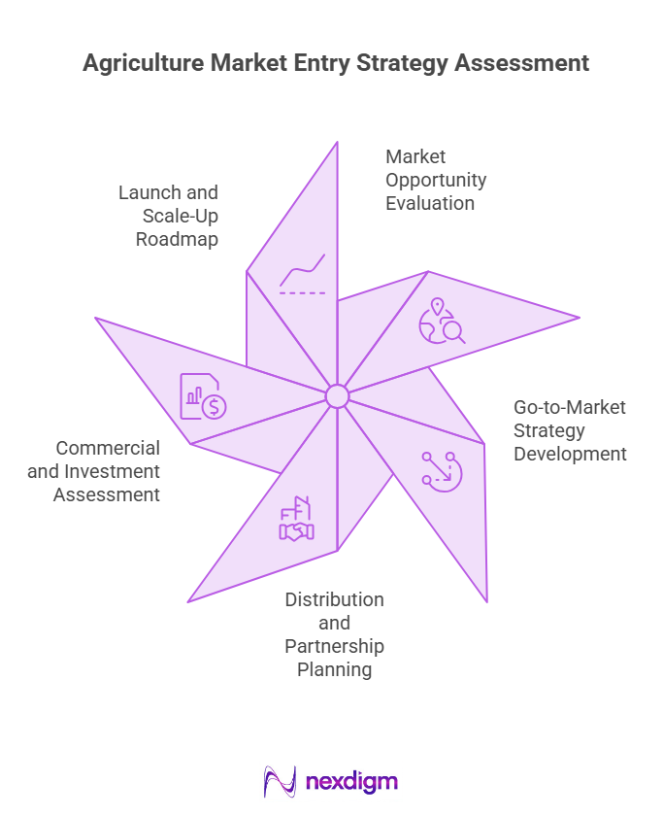
- Market Opportunity Evaluation: Assess market size, crop potential, farmer demand, and growth prospects to identify attractive expansion opportunities.
- Go-to-Market Strategy Development: Design market-entry approaches that align products, pricing, channels, and customer requirements.
- Distribution and Partnership Planning: Identify effective channel partners, distributors, and ecosystem stakeholders to support market penetration.
- Commercial and Investment Assessment: Evaluate profitability, investment requirements, and operating economics to support informed decision-making.
- Launch and Scale-Up Roadmap: Develop phased market-entry plans with clear milestones, execution priorities, and growth objectives.
This structured approach supports scalable growth, reduces expansion risks, and enables businesses to build a sustainable and competitive presence in agricultural markets.
How Nexdigm’s Market Entry Strategy Manages Risks Across Agriculture Markets
Entering a new agricultural market involves navigating uncertainties related to demand, competition, distribution, regulations, and commercial viability. Through its Strategic Assessment, Nexdigm helps organizations with:
- Reducing Market Selection Risks: Nexdigm evaluates crop potential, farmer demographics, market demand, and growth prospects to help organizations prioritize markets with the strongest commercial opportunities.
- Managing Competitive Risks: By assessing competitor presence, product offerings, pricing strategies, and market positioning, Nexdigm helps businesses develop differentiated and sustainable market-entry approaches.
- Mitigating Channel and Distribution Risks: Nexdigm analyzes distributor capabilities, channel structures, and market-access dynamics to strengthen product availability and route-to-market effectiveness.
- Addressing Commercial and Investment Risks: Through a review of pricing conditions, profitability potential, operating costs, and investment requirements, organizations can make better-informed expansion decisions.
Insights from this market entry strategy helps organizations manage risks across markets, improve expansion readiness, and establish a stronger foundation for sustainable growth and long-term commercial success.
Nexdigm’s Agriculture Market Entry Strategy: Supporting Successful Market Execution
A well-designed market-entry strategy must translate insights into action. Beyond managing risks, Nexdigm helps organizations accelerate market acceptance across agricultural markets by offering the following benefits:
- Aligning Products with Market Needs: Ensure product offerings address local crop requirements, farmer preferences, and purchasing behavior to improve adoption potential.
- Building Effective Go-to-Market Models: Develop channel and distribution strategies that maximize reach while supporting efficient market penetration.
- Strengthening Partnership Networks: Identify and engage distributors, retailers, agri-tech providers, and ecosystem partners that can support long-term growth.
This approach improves launch effectiveness, strengthens market acceptance, and creates a scalable foundation for long-term success in agricultural markets.
Nexdigm’s Case
An international agribusiness company engaged Nexdigm to translate a market opportunity assessment into a scalable commercial launch plan. The study prioritized 13 launch initiatives, and reduced market-entry planning time by 34%, supporting channel activation, partner selection, investment allocation, and faster commercialization across targeted agricultural segments.
To take the next step, simply visit our Request a Consultation page and share your requirements with us.
Harsh Mittal
+91-8422857704