

Agriculture price elasticity analysis helps agribusinesses understand how price changes influence demand for seeds, fertilizers, crop protection products, machinery, and agricultural commodities. Through structured Pricing Analysis Services, companies can measure customer sensitivity, forecast volume shifts, identify optimal price points, and evaluate substitution risks across markets.
These insights support differentiated pricing by product category, region, season, and customer segment. Effective elasticity analysis also improves revenue planning, promotional design, portfolio management, and margin protection. By linking price movements with purchasing behavior and market conditions, businesses can strengthen competitiveness, improve demand forecasting, and make informed pricing decisions across the agricultural value chain.
An illustrative 5% improvement in elasticity estimation can sharpen agricultural pricing decisions. Pricing Analysis Services evaluate demand sensitivity across inputs, equipment, and commodities, helping businesses optimize price points, reduce volume risk, improve forecasts, protect margins, and strengthen revenue performance sustainably.
Pricing Analysis for Demand Sensitivity Across Agricultural Markets
Pricing analysis measures how farmers, distributors, and buyers respond to price changes, helping agribusinesses protect demand, optimize revenue, strengthen forecasting, and develop market-specific strategies across inputs, equipment, and commodities. Core steps of pricing analysis are:
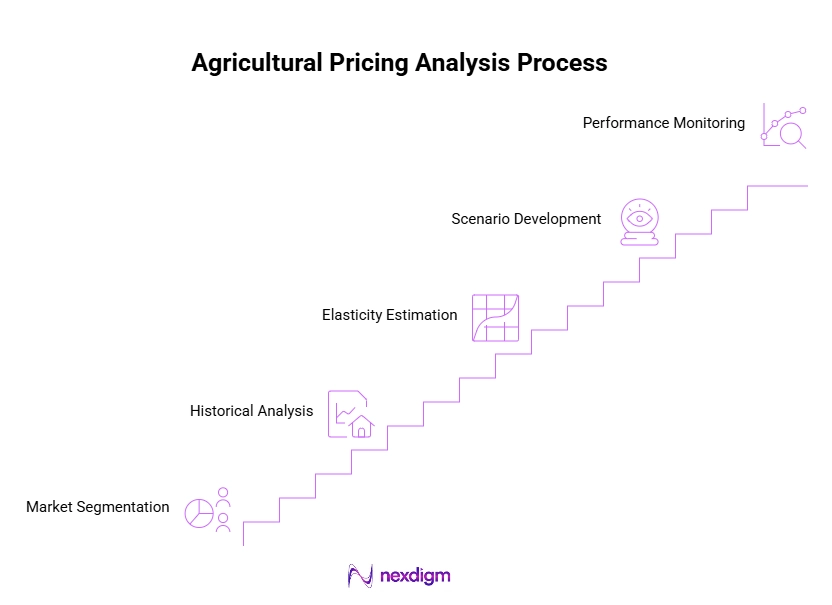
Step 1: Market and Product Segmentation
Classify customers by region, farm size, crop type, purchasing power, and product category to identify distinct demand patterns and pricing sensitivity levels.
Step 2: Historical Price and Volume Analysis
Examine past prices, sales volumes, promotions, seasonal demand, and competitor movements to understand how purchasing behavior changes across different agricultural market conditions.
Step 3: Price Elasticity Estimation
Measure demand responses to price variations for inputs, machinery, and commodities, identifying elastic and inelastic segments that require differentiated pricing approaches.
Step 4: Pricing Scenario Development
Model alternative price points, discounts, and market conditions to estimate revenue, volume, margin, and customer retention outcomes before implementing strategic pricing changes.
Step 5: Performance Monitoring and Refinement
Track sales, margins, customer responses, competitor actions, and market conditions after implementation to refine elasticity assumptions and improve future pricing decisions.
Nexdigm’s Strategic Support for Demand-Responsive Agricultural Pricing
Nexdigm’s Pricing Analysis Services help agribusinesses optimize demand-responsive pricing through agriculture price elasticity analysis, pricing intelligence, competitive pricing analysis, market price benchmarking, demand forecasting, and value-based pricing strategies. By combining customer demand sensitivity, competitor pricing, regional market dynamics, and purchasing behavior insights, Nexdigm enables organizations to refine pricing decisions, maximize revenue, protect margins, improve market responsiveness, and achieve sustainable growth across agricultural inputs, equipment, and commodity markets.
Nexdigm’s Elasticity-Led Pricing Model for Agricultural Markets
Nexdigm’s elasticity-led pricing model evaluates demand sensitivity, customer behavior, market conditions, and product value to optimize agricultural prices, protect margins, improve volumes, and support sustainable growth across diverse segments. Data Driven types followed by Nexdigm’s experts are:
Type 1: Own-Price Elasticity Pricing
This approach measures how demand changes when a product’s price shifts, helping businesses identify optimal price points and protect revenue across agricultural categories.
Type 2: Cross-Price Elasticity Pricing
Nexdigm evaluates how competitor or substitute price changes influence demand, supporting stronger positioning, portfolio differentiation, and informed responses across interconnected agricultural markets.
Type 3: Income Elasticity Pricing
Customer income, farm profitability, purchasing power, and economic conditions are analyzed to align prices with affordability and demand potential across different buyer segments.
Type 4: Seasonal Elasticity Pricing
Pricing adjusts to planting cycles, harvest periods, weather conditions, inventory availability, and seasonal demand, improving responsiveness, volume planning, and agricultural market performance.
Type 5: Segment-Based Elasticity Pricing
Products and customers are grouped by region, crop, farm size, channel, and sensitivity, enabling differentiated pricing and stronger margin management across markets.
Nexdigm’s Case
In an engagement, Nexdigm helped an agribusiness optimize pricing using demand elasticity insights across multiple product categories. The initiative improved price realization by 10%, increased forecast accuracy by 13%, and strengthened contribution margins by 8%, enabling more profitable, demand-responsive pricing decisions.
To take the next step, simply visit our Request a Consultation page and share your requirements with us.
Harsh Mittal
+91-8422857704