

Agriculture pricing optimization modeling helps agribusinesses balance sales volume, customer adoption, revenue growth, and margin expansion across diverse agricultural markets. Through structured Pricing Analysis Services, companies can evaluate price elasticity, demand sensitivity, production costs, competitive benchmarks, customer value, and regional purchasing behavior. Advanced models simulate alternative pricing scenarios to identify price points that maximize profitability without weakening market demand.
These insights support portfolio pricing, discount management, channel strategy, value-based pricing, and revenue forecasting. By aligning pricing decisions with commercial objectives and market realities, agribusinesses can improve price realization, protect margins, expand volumes, strengthen competitiveness, and achieve sustainable long-term growth.
An illustrative 8% improvement in pricing model accuracy can strengthen volume and margin outcomes. Pricing Analysis Services evaluate elasticity, costs, demand, and competitive benchmarks, helping agribusinesses optimize price points, expand sales volumes, improve realization, protect margins, and sustain profitable growth.
Agriculture Price Optimization Models for Profitable Market Growth
Agriculture price optimization models combine demand, costs, customer value, competition, and market conditions to identify profitable price points, expand sales volumes, protect margins, and support sustainable agribusiness growth. Core benefits of pricing analysis are:
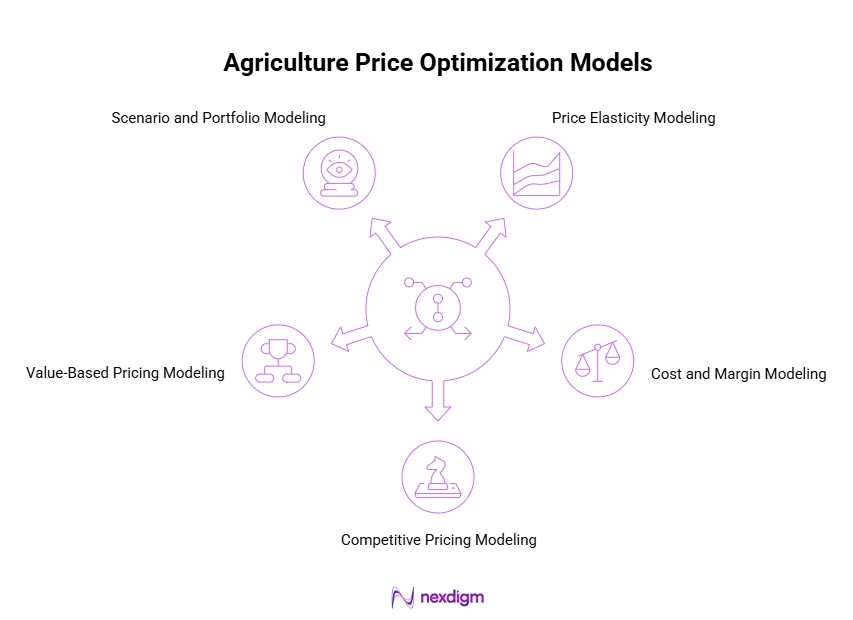
- Price Elasticity Modeling: Measures how customer demand changes at different price levels across products and segments. Benefits include optimized pricing, reduced volume risk, stronger forecasting, and improved profitability.
- Cost and Margin Modeling: Evaluates production, logistics, distribution, promotion, and service costs against targeted returns. Benefits include reliable cost recovery, margin protection, financial visibility, and disciplined pricing decisions.
- Competitive Pricing Modeling: Compares competitor prices, product features, discounts, channel offers, and market positioning. Benefits include responsive price adjustments, stronger differentiation, reduced substitution risk, and improved competitiveness.
- Value-Based Pricing Modeling: Links prices with productivity gains, quality, reliability, efficiency, and customer returns. Benefits include premium justification, stronger value communication, greater purchase confidence, and higher price realization.
- Scenario and Portfolio Modeling: Simulates pricing outcomes across demand, costs, products, regions, and customer segments. Benefits include balanced portfolio growth, faster decisions, revenue optimization, and sustainable margin expansion.
Nexdigm’s Pricing Analysis Services for Profitable Agricultural Markets
Nexdigm’s Pricing Analysis Services help agribusinesses achieve profitable growth through agriculture pricing optimization modeling, price optimization strategies, pricing intelligence, price elasticity analysis, competitive pricing analysis, and value-based pricing. By assessing demand patterns, production costs, customer value, competitor pricing, and regional market dynamics, Nexdigm enables organizations to optimize price points, increase price realization, balance volume with margins, improve commercial performance, and drive sustainable profitability across agricultural markets.
Nexdigm’s Strategic Blueprint for Profitable Agricultural Pricing
Nexdigm’s strategic blueprint integrates market intelligence, demand analysis, competitive benchmarking, cost structures, and customer value to optimize agricultural prices, balance growth with margins, and strengthen sustainable profitability across markets globally. Data Driven steps followed by Nexdigm’s experts are:
Step 1: Assess Market Demand
Assess market demand, customer segments, crop cycles, and regional purchasing behavior to identify pricing opportunities, affordability thresholds, and growth potential.
Step 2: Benchmark Competitive Pricing
Benchmark competitor prices, product features, discounts, channel margins, and value propositions to reveal positioning gaps and support evidence-based pricing decisions.
Step 3: Evaluate Costs and Margins
Analyze production, logistics, distribution, and service costs alongside target margins to establish financially sustainable price floors and protect profitability consistently.
Step 4: Model Pricing Scenarios
Model price elasticity, demand responses, and scenario outcomes across products and regions to balance volume growth, revenue realization, and margin expansion.
Step 5: Monitor and Refine Performance
Monitor sales, margins, market share, customer feedback, and competitor actions to refine pricing continuously and sustain long-term commercial performance growth.
Nexdigm’s Case
In an illustrative engagement, Nexdigm helped an agribusiness implement a strategic pricing optimization model. The initiative increased price realization by 12%, improved sales volumes by 9%, and enhanced operating margins by 10%, delivering stronger profitability and sustainable commercial growth.
To take the next step, simply visit our Request a Consultation page and share your requirements with us.
Harsh Mittal
+91-8422857704