

Agricultural procurement decisions are often made using information that is incomplete, fragmented or limited to existing supplier relationships. Purchase records reveal what an organisation has bought and at what price, but they do not necessarily explain whether those prices are competitive, whether alternative suppliers are available or how market conditions may affect future sourcing.
This limitation becomes more significant in agriculture because procurement spans multiple categories and supplier markets. Fertilizers, seeds, agrochemicals, machinery, irrigation equipment, animal feed and agricultural commodities each have different cost drivers, supply structures and risk factors.
A supplier may offer attractive pricing but have limited production capacity. Another may provide consistent quality but operate in a region exposed to transportation constraints. A third may be commercially competitive today but depend heavily on imported raw materials.
Procurement teams need more than transaction data to evaluate these trade-offs. Agriculture procurement research services provide external market intelligence that can help organisations understand supplier landscapes, compare commercial conditions and make more informed sourcing decisions.
Why Internal Procurement Data Is Not Enough
Purchase prices do not explain market competitiveness
An organisation may know that it purchased fertilizer, seeds or crop protection products at a particular price. However, without external benchmarking, it may not know whether the price reflects current market conditions or a weaker negotiating position.
Price differences can arise from product specifications, regional distribution costs, order quantities, supplier margins and contract terms. Historical purchase prices alone cannot establish whether a supplier remains commercially competitive.
Market research helps place internal transaction data within a broader supplier and category context.
Existing supplier networks can restrict sourcing visibility
Procurement teams frequently rely on established suppliers because of familiarity, delivery history and operational convenience. These relationships may be valuable, but they can also limit awareness of alternative manufacturers, regional distributors and emerging market participants.
A supplier landscape that has not been reviewed recently may no longer reflect the available sourcing options. New manufacturers may have entered the market, distribution networks may have expanded or existing suppliers may have changed their commercial positioning.
Without periodic supplier mapping, organisations risk continuing with a sourcing model that is no longer competitive.
Market concentration creates hidden dependencies
Supplier concentration is not always obvious from procurement records. Several distributors may source products from the same manufacturer, creating a common upstream dependency.
Similarly, a category may appear to have many available suppliers while actual production capacity is concentrated among a small number of companies.
This can create exposure to production disruptions, raw material shortages, import restrictions and changes in supplier allocation.
External supplier intelligence helps buyers understand the structure of the market rather than simply counting the vendors in their procurement database.
Supplier risk is difficult to assess without external context
Internal performance records can reveal late deliveries, quality complaints or contractual issues. However, they may not provide visibility into a supplier’s wider market position, geographic exposure, manufacturing dependencies or competitive environment.
A supplier operating in a region affected by infrastructure constraints may face delivery risks that are not yet reflected in its transaction history. Similarly, a manufacturer dependent on imported raw materials may be exposed to cost volatility even when current prices remain stable.
Procurement research can help identify these external risk factors before they affect supply continuity.
Regional and product differences complicate sourcing decisions
Agricultural procurement conditions vary according to crop patterns, regional demand, supplier availability, logistics and product specifications. A sourcing arrangement that works well in one state or market may not be appropriate elsewhere.
National averages can conceal meaningful regional differences, while broad category comparisons can overlook technical distinctions between products.
Research must therefore be specific enough to reflect the actual procurement requirement.
How Supplier Intelligence Improves Procurement Decisions
A structured research exercise combines internal procurement information with external market evidence. The objective is to answer commercial questions that routine purchasing reports cannot resolve.
For example, organisations may need to understand:
- Which suppliers have the production capacity and geographic coverage to meet future requirements?
- How do quoted prices compare across equivalent products and regions?
- Are existing suppliers supported by alternative upstream sources?
- Which categories are exposed to import dependence or concentrated manufacturing capacity?
- What commercial terms are available in the market?
- Which alternative suppliers meet quality, compliance and delivery requirements?
These questions help procurement teams move beyond supplier selection based on familiarity or individual quotations.
From Market Research to Better Sourcing Decisions
Supplier intelligence becomes most useful when it is connected to specific procurement decisions. A market landscape report alone does not create savings or reduce risk. The research must help organisations determine which categories need benchmarking, where supplier diversification is justified and which commercial terms should be renegotiated.
Nexdigm supports organisations through procurement research, supplier mapping, price benchmarking, market assessment and commercial analysis. Its research can help buyers evaluate supplier markets, understand cost drivers and develop sourcing strategies grounded in external market conditions.
This approach can be applied across agricultural inputs, equipment, processing requirements and other procurement categories.
Agriculture Procurement Research Framework
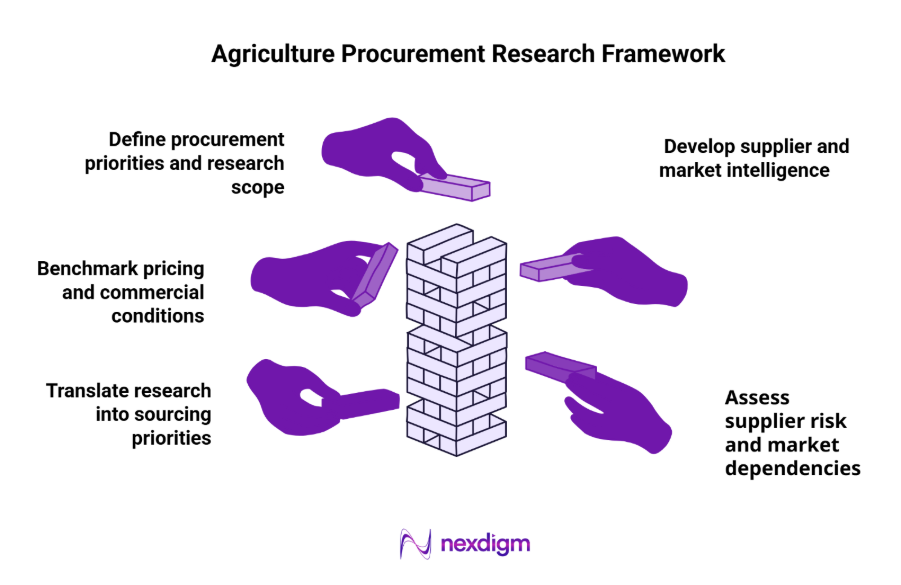
- Define procurement priorities and research scope
Identify the categories, regions, products and supplier markets relevant to the business. Establish whether the primary objective is cost benchmarking, supplier discovery, risk assessment, sourcing diversification or a combination of these requirements. - Develop supplier and market intelligence
Map manufacturers, distributors, importers, regional suppliers and alternative sourcing channels. Examine market presence, production capacity, geographic coverage, product range and competitive positioning. - Benchmark pricing and commercial conditions
Compare prices across equivalent products and specifications. Evaluate freight, discounts, credit periods, minimum order quantities, service commitments and other commercial conditions that influence the effective cost of procurement. - Assess supplier risk and market dependencies
Examine supplier concentration, upstream sourcing exposure, geographic risks, compliance requirements and operational reliability. Identify categories where alternative sources are limited or supplier dependencies could affect continuity. - Translate research into sourcing priorities
Convert market findings into actionable recommendations covering supplier qualification, negotiations, category strategies and diversification. Prioritise opportunities according to commercial impact, implementation feasibility and supply risk.
Nexdigm’s Case Study: Building Supplier Intelligence for Agricultural Procurement
Nexdigm analysed 7 agricultural procurement categories across 5 regions and 26 suppliers. The research identified 4 categories requiring deeper price benchmarking and mapped alternative suppliers to support sourcing diversification and commercial negotiations.
To take the next step, simply visit our Request a Consultation page and share your requirements with us.
Harsh Mittal
+91-8422857704