

Agricultural procurement resilience depends on more than securing regular input supplies. Businesses must also be prepared to respond when suppliers face production constraints, transportation disruptions, market volatility, or seasonal shortages. Recent developments in India highlight the importance of supply preparedness.
As of 2 July 2026, the country had secured 163.35 lakh metric tonnes of fertilizer stocks across major categories. Separately, the Reserve Bank of India reported that public foodgrain stocks held by the Food Corporation of India were more than four times the prescribed buffer requirement at the end of March 2026.
These figures underline the role of inventory planning and supply preparedness. Through agriculture procurement resilience analysis, businesses can evaluate their own sourcing vulnerabilities and strengthen continuity planning.
Procurement Resilience Begins Before a Disruption Occurs
A procurement network may perform reliably under normal conditions but struggle when a critical supplier becomes unavailable or delivery routes are interrupted. Resilience depends on how well businesses understand their dependencies, maintain alternative supply arrangements, and respond to changing conditions. Assessing these capabilities in advance helps organizations prepare for disruptions rather than react only after operations are affected.
Capabilities That Determine Procurement Readiness
Businesses can evaluate procurement resilience through three connected capabilities:
- Backup Supply Availability: Determine whether alternative suppliers can provide critical inputs when primary sourcing arrangements are disrupted.
- Supplier Flexibility: Examine how vendors respond to volume changes, delivery adjustments, and unexpected shifts in procurement requirements.
- Recovery Readiness: Assess how quickly procurement operations can restore normal supply through alternative sourcing, inventory, and logistics arrangements.
Together, these capabilities provide a practical basis for evaluating how well procurement networks can withstand and recover from disruptions.
Why Agricultural Supply Disruptions Require a Coordinated Response
Agricultural supply disruptions can affect multiple procurement activities simultaneously, from input availability and transportation to inventory planning and production schedules. Nexdigm’s industry research helps businesses understand these interconnected dependencies and evaluate factors that may influence supply recovery. This broader perspective supports more coordinated procurement decisions and helps organizations prepare for disruptions across their agricultural supply networks.
How Nexdigm Supports a Coordinated Response to Agricultural Supply Disruptions
Our consulting approach helps agribusinesses strengthen procurement continuity by examining how disruptions across suppliers, sourcing markets, and distribution channels can affect operations. Our agriculture procurement resilience analysis focuses on three key areas:
- Evaluating Backup Sourcing Options: Identify alternative suppliers, sourcing regions, and procurement channels that can help maintain access to critical agricultural inputs when primary sources face disruptions.
- Assessing Supplier and Logistics Flexibility: Examine supplier responsiveness, delivery adaptability, transportation alternatives, and distribution capabilities to understand how quickly procurement arrangements can adjust to changing conditions.
- Identifying Recovery Priorities: Evaluate inventory arrangements, supply lead times, and alternative procurement options to identify recovery constraints and prioritize actions for restoring supply continuity.
By connecting these areas, we help businesses develop a more coordinated approach to disruption preparedness and strengthen resilience across agricultural procurement networks.
A Glimpse into Nexdigm’s Agriculture Procurement Resilience Analysis
Our agriculture procurement resilience analysis brings together supplier intelligence, market research, and procurement assessment to help agribusinesses evaluate their readiness for supply disruptions. Our approach focuses on the following key areas:
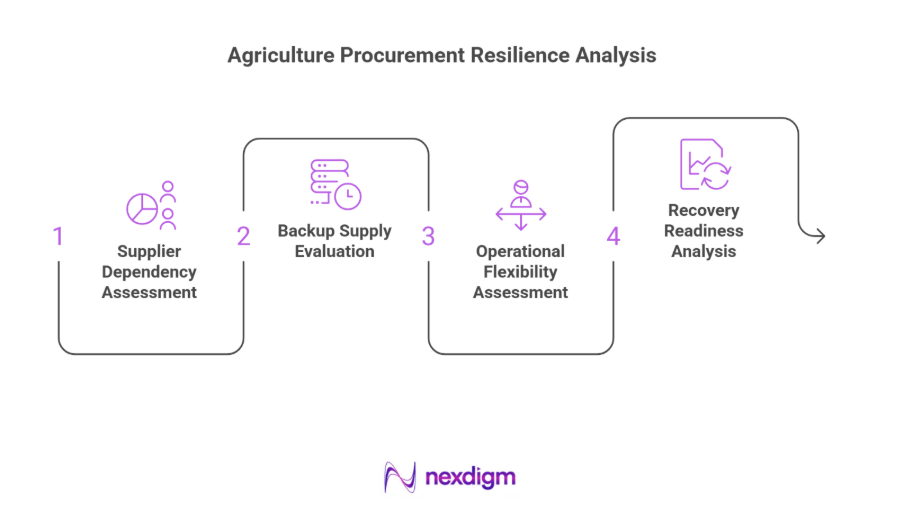
- Supplier Dependency Assessment: Examine reliance on critical suppliers, manufacturers, sourcing regions, and input markets to identify concentration risks.
- Backup Supply Evaluation: Map alternative suppliers and sourcing channels, assessing their product suitability, availability, and capacity to support procurement requirements.
- Operational Flexibility Assessment: Evaluate supplier responsiveness, delivery adaptability, inventory arrangements, and logistics capabilities under changing supply conditions.
- Recovery Readiness Analysis: Examine lead times, alternative procurement routes, and potential recovery constraints to identify areas requiring stronger contingency planning.
By connecting these dimensions, our experts help businesses translate market intelligence into practical priorities for improving procurement continuity and long-term supply resilience.
How Nexdigm’s Analysis Supports Long-term Supply Resilience
Our structured analysis helps agribusinesses move beyond short-term disruption management towards a more resilient procurement model. By identifying supplier dependencies, evaluating alternative sourcing options, and assessing operational recovery capabilities, our experts help businesses anticipate potential vulnerabilities. The findings support better contingency planning, stronger supplier networks, and procurement strategies that can adapt to changing market conditions and evolving agricultural input requirements.
Nexdigm’s Case
An agricultural inputs distributor engaged Nexdigm to assess procurement resilience across four sourcing regions. The assessment covered 27 suppliers and found that 30% of critical input categories lacked dependable backup sources, while 22% faced extended delivery recovery timelines. Based on the findings, the distributor identified 9 potential alternative suppliers for further evaluation and contingency planning.
To take the next step, simply visit our Request a Consultation page and share your requirements with us.
Harsh Mittal
+91-8422857704