

Go-to-market strategies play a vital role in accelerating adoption across competitive agricultural markets by helping businesses position their products effectively, reach the right farmers, and communicate clear value. In agriculture, adoption depends on trust, affordability, distribution access, and proven field performance.
A strong market entry strategy allows companies to understand local farming needs, competitor offerings, pricing expectations, and channel partnerships before launching. An effective Agriculture product go to market strategy also supports awareness, education, demonstrations, and after-sales service, making it easier for farmers to accept new products and technologies in a crowded and competitive market.
Recent data shows why adoption-focused strategies are important. The global smart agriculture market was valued at USD 25.36 billion in 2024 and is projected to reach USD 83.72 billion by 2033, growing at 14.6% CAGR. Similarly, digital agriculture is expected to grow at around 10% annually, showing rising demand for technology-driven farm solutions.
Developing Effective Agriculture Product Go to Market Strategy
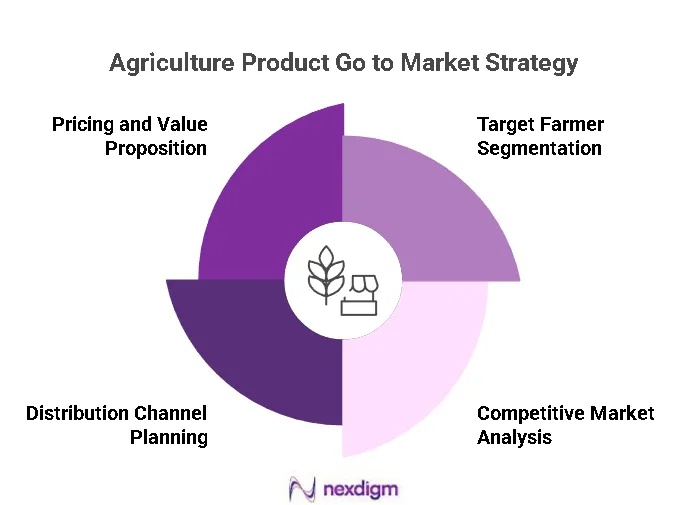
Developing an effective Agriculture Product Go to Market Strategy involves identifying target farmers, analyzing competitors, selecting distribution channels, setting pricing, and building trust through demonstrations, education, and after-sales support:
-
Target Farmer Segmentation
Identify farmer groups by crop type, farm size, location, income level, and technology readiness for focused product positioning.
-
Competitive Market Analysis
Study existing competitors, pricing models, product benefits, dealer networks, and gaps before entering the agricultural market.
-
Distribution Channel Planning
Choose effective channels such as agri-retailers, cooperatives, distributors, digital platforms, and direct farmer networks.
-
Pricing and Value Proposition
Set affordable pricing while clearly showing productivity gains, cost savings, crop improvement, and long-term farmer value.
Nexdigm Optimizes Pricing Strategies for Successful Agricultural Market Entry
Nexdigm optimizes pricing strategies by evaluating market demand, competitor pricing, customer preferences, and regional purchasing power to support successful agricultural market entry. Its data-driven approach helps businesses establish competitive and value-based pricing that balances profitability with affordability. This enables agriculture companies to improve product acceptance, strengthen market positioning, and accelerate adoption across competitive agricultural markets.
How Nexdigm Enhances Product Positioning Across Competitive Agricultural Markets?
Nexdigm enhances product positioning by analyzing farmer needs, competitor offerings, market gaps, and value drivers to create clear differentiation, improve brand relevance, and accelerate adoption in competitive agricultural markets.
-
Farmer Need Analysis
Nexdigm identifies farmer challenges, crop priorities, and buying behavior to position products around practical agricultural value.
-
Competitive Benchmarking
Nexdigm compares competitor products, pricing, claims, and channels to define stronger market differentiation.
-
Value Proposition Development
Nexdigm builds clear value messages highlighting productivity, cost savings, quality improvement, and farmer benefits.
-
Segment-Based Positioning
Nexdigm tailors positioning for crop types, geographies, farm sizes, and customer segments.
Nexdigm’s case:
Nexdigm helped an agri-input company reposition its crop nutrition product in a highly competitive regional market. Through farmer segmentation, competitor benchmarking, and value-based messaging, Nexdigm supported a 28% improvement in product awareness, 22% increase in dealer engagement, and 18% growth in trial adoption within six months.
To take the next step, simply visit our Request a Consultation page and share your requirements with us.
Harsh Mittal
+91-8422857704