

Agricultural businesses are under increasing pressure from rising input costs, volatile commodity prices, supply chain disruptions, and shifting farmer demand. Agriculture revenue pricing optimization enables organizations to maximize profitability through data-driven pricing decisions that balance competitiveness with margin protection. Using comprehensive Pricing Analysis Services, businesses can assess price elasticity, customer willingness to pay, competitive benchmarks, product mix, and regional demand patterns.
These insights support value-based pricing, revenue optimization, portfolio rationalization, and demand forecasting. By aligning pricing strategies with market dynamics and customer value, agribusinesses can strengthen revenue growth, improve price realization, protect margins, and achieve long-term commercial sustainability.
An illustrative 8% improvement in pricing effectiveness can enhance agricultural revenue performance. Pricing Analysis Services assess elasticity, product mix, discounts, channel margins, and regional demand, helping businesses improve price realization, protect margins, optimize portfolios, and sustain profitable growth under pressure.
Pricing Analysis for Agricultural Revenue Growth and Margin Protection
Pricing analysis helps agricultural businesses align prices with market demand, customer value, costs, and competitive conditions, supporting stronger revenue growth, resilient margins, improved decisions, and sustainable commercial performance across portfolios. Core benefits of pricing analysis are:
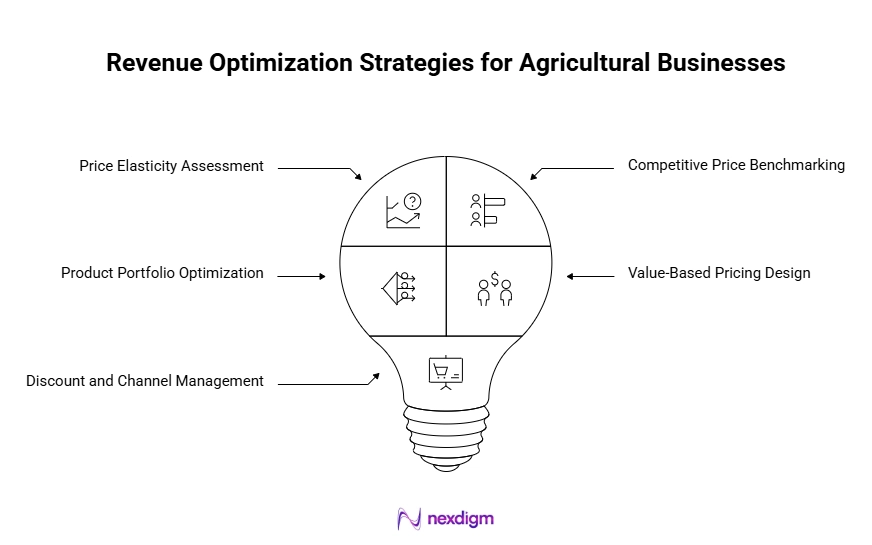
- Price Elasticity Assessment: Measure customer demand responses to price changes across products, regions, and segments. Benefits include optimized price points, reduced volume risk, stronger revenue forecasting, and improved profitability.
- Competitive Price Benchmarking: Compare competitor prices, discounts, specifications, pack sizes, and channel offers. Benefits include sharper market positioning, informed adjustments, reduced substitution risk, and stronger price realization.
- Product Portfolio Optimization: Evaluate revenue, demand, margins, lifecycle stage, and cross-selling potential across agricultural products. Benefits include balanced portfolios, improved resource allocation, stronger growth, and reduced margin dilution.
- Value-Based Pricing Design: Link prices with productivity gains, quality, reliability, efficiency, and customer returns. Benefits include premium justification, stronger value communication, greater purchase confidence, and protected contribution margins.
- Discount and Channel Management: Assess promotional spending, dealer margins, rebates, credit terms, and cost-to-serve. Benefits include controlled discount leakage, stronger channel economics, improved net revenue, and sustainable margin protection.
Nexdigm’s Role in Optimizing Agribusiness Revenue and Profit Margins
Nexdigm’s Pricing Analysis Services enable agribusinesses to maximize revenue and strengthen profit margins through agriculture revenue pricing optimization, pricing intelligence, competitive price benchmarking, value-based pricing, price elasticity analysis, and revenue management strategies. By evaluating customer demand, product portfolios, competitor pricing, regional market trends, and cost structures, Nexdigm helps organizations optimize pricing decisions, improve price realization, protect margins, enhance commercial performance, and achieve sustainable revenue growth across agricultural markets.
Nexdigm’s Agricultural Revenue Pricing Intelligence Blueprint
Nexdigm’s pricing intelligence blueprint combines market demand, customer value, competitive benchmarks, cost structures, and portfolio performance to improve revenue realization, protect margins, strengthen decisions, and support sustainable agribusiness growth. Data Driven types followed by Nexdigm’s experts are:
Type 1: Value-Based Pricing
Prices reflect measurable productivity, quality, efficiency, risk reduction, and customer returns, enabling stronger premium justification, improved realization, and sustainable margin expansion.
Type 2: Competitive Benchmark Pricing
Nexdigm compares competitor prices, discounts, product features, channel offers, and regional positioning to identify pricing gaps and support responsive commercial decisions.
Type 3: Elasticity-Based Pricing
Demand sensitivity is assessed across products, regions, and customer segments to identify optimal price points, reduce volume risks, and improve revenue forecasting.
Type 4: Portfolio-Based Pricing
Products are evaluated by revenue, margin contribution, lifecycle stage, demand potential, and strategic importance, enabling differentiated prices and stronger portfolio profitability.
Type 5: Dynamic Market Pricing
Prices adjust according to input costs, seasonal demand, inventory, competitor actions, and market conditions, supporting timely responses and improved revenue performance.
Nexdigm’s Case
In an illustrative engagement, Nexdigm helped an agribusiness optimize pricing across key product portfolios. The initiative improved price realization by 11%, increased revenue by 14%, and enhanced operating margins by 9%, strengthening long-term commercial performance and profitability.
To take the next step, simply visit our Request a Consultation page and share your requirements with us.
Harsh Mittal
+91-8422857704