

Agricultural sourcing decisions are increasingly influenced by risks that extend beyond supplier pricing and product availability. Input import dependence, regional production variability, transportation constraints, and supplier concentration can all affect procurement continuity.
India’s fertilizer supply illustrates this exposure: during April–January 2025–26, urea imports reached 89.30 lakh metric tonnes, compared with 48.70 lakh tonnes in the corresponding period of 2024–25. Regional weather conditions also remain important, with uneven monsoon rainfall in 2026 raising concerns for rain-fed agricultural production.
In this environment, agriculture sourcing risk evaluation helps businesses identify where vulnerabilities are concentrated, understand their potential procurement implications, and prioritize suppliers and sourcing markets for closer assessment.
Why Agricultural Sourcing Risks Are Difficult to Isolate
Agricultural supply chains connect input manufacturers, farmers, aggregators, processors, traders, and logistics providers across multiple regions. A disruption at one stage can affect availability and costs across the wider network. For example, input shortages may influence production, while regional weather variations can alter crop volumes and supplier delivery commitments. Risk assessment therefore needs to consider interconnected dependencies rather than isolated suppliers.
What Are the Areas That Shape Agricultural Sourcing Exposure
Businesses need to examine different sources of vulnerability to understand how sourcing continuity may be affected.
- Input Dependency: Assess reliance on imported fertilizers, seeds, crop protection products, fuel, and other inputs exposed to supply or price fluctuations.
- Regional Concentration: Examine dependence on specific production clusters, agricultural states, sourcing corridors, and locations exposed to weather or infrastructure disruptions.
- Supplier Network Vulnerability: Identify limited supplier alternatives, capacity constraints, financial exposure, and dependencies on common upstream sources or distribution channels.
Understanding these factors helps businesses recognize where procurement exposure may be concentrated and which dependencies require further investigation.
Nexdigm’s Approach in Locating Vulnerabilities Across the Agricultural Value Chain
Our experts help businesses identify sourcing vulnerabilities by examining dependencies across agricultural inputs, production regions, supplier networks, and distribution channels. Our research connects market-level information with supplier and geographic exposure, creating a structured view of potential risks. This enables organizations to understand where supply dependencies exist and which areas may require closer evaluation.
How Nexdigm Focuses on Areas That Shape Agricultural Sourcing Exposure
Our agriculture sourcing risk evaluation examines five key areas to help businesses understand the nature and concentration of procurement risks:
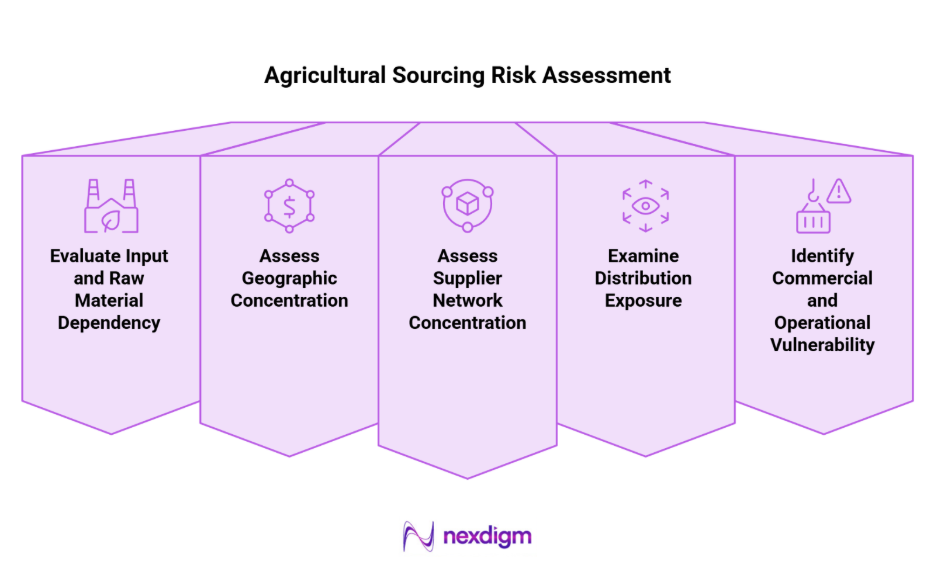
- Input and Raw Material Dependency: We assess reliance on specific agricultural inputs, including fertilizers, seeds, crop protection products, machinery, and fuel, while examining import exposure, availability, and price fluctuations.
- Regional and Geographic Concentration: Our research examines sourcing dependence across agricultural states, production clusters, and regional markets, highlighting exposure to weather variability, infrastructure constraints, and localized supply disruptions.
- Supplier Network Concentration: We evaluate supplier distribution, market presence, upstream dependencies, product portfolios, and alternative sourcing options to identify categories with limited supplier diversity or concentrated supply relationships.
- Trade and Distribution Exposure: We examine import dependencies, transportation corridors, warehousing infrastructure, market access, and distribution arrangements that could influence procurement continuity and material availability.
- Commercial and Operational Vulnerabilities: Our assessment considers pricing variations, supplier capacity, delivery commitments, operating capabilities, and other commercial indicators to identify potential constraints affecting sourcing costs and reliability.
By bringing these factors together, our experts help businesses develop a more comprehensive understanding of agricultural sourcing exposure and prioritize areas for further investigation, supplier diversification, and procurement planning.
How Nexdigm’s Evaluation Supports Supplier Diversification
Identifying sourcing risks is only the first step; businesses also need to understand how to reduce dependence on concentrated supplier networks. Our evaluation helps organizations assess diversification opportunities by:
- Identifying Alternative Suppliers: Map potential suppliers across domestic and international markets to identify options beyond existing sourcing relationships.
- Expanding Geographic Sourcing Options: Evaluate suppliers across different production regions to reduce reliance on a single location or market.
- Assessing Supplier Capability and Reliability: Compare product availability, supply capacity, quality standards, distribution reach, and delivery capabilities before considering new suppliers.
- Evaluating Commercial Viability: Examine pricing structures, transportation costs, import requirements, and other procurement considerations that influence the feasibility of alternative sourcing arrangements.
- Prioritizing Diversification Opportunities: Identify categories where supplier concentration is high and alternative sourcing options may strengthen procurement continuity.
Through this evaluation, businesses get to develop a more diversified supplier base, reduce concentrated sourcing exposure, and make informed decisions about building greater resilience across agricultural procurement networks.
Nexdigm’s Case
An agricultural inputs distributor seeking to reduce sourcing concentration engaged Nexdigm to evaluate its supplier network across key procurement categories. The research assessed 22 suppliers across multiple regions and found that 31% had limited geographic coverage, while 21% showed gaps in product availability. The findings helped the company identify alternative suppliers and prioritize seven candidates for further evaluation and diversification discussions.
To take the next step, simply visit our Request a Consultation page and share your requirements with us.
Harsh Mittal
+91-8422857704