

Agricultural input markets are supported by a diverse supplier base spanning seed developers, fertilizer manufacturers, crop protection companies, and farm equipment producers. A 2026 industry research report estimated the global agriculture and agritech market at approximately US$630 billion in 2025, with fertilizers and agricultural machinery representing its largest segments.
Meanwhile, Nutrien’s 2025 estimates placed global crop input sales across selected major markets at US$127 billion. These figures highlight the scale and commercial significance of agricultural supply markets. However, supplier capabilities, geographic reach, product portfolios, and market positioning differ considerably.
Through agriculture supplier landscape analysis, agribusinesses can identify key market participants, understand competitive dynamics, and evaluate suppliers against their sourcing and operational priorities.
Four Supplier Categories That Shape Agricultural Operations
The agricultural supplier ecosystem extends beyond traditional input manufacturers. Seed providers such as Bayer, Corteva, and Syngenta develop commercial seed varieties and traits. Fertilizer suppliers include Nutrien, Yara International, and The Mosaic Company, while crop protection markets feature Bayer, BASF, Syngenta, UPL, and Corteva. Equipment manufacturers such as Deere & Company, CNH Industrial, AGCO, Kubota, and Mahindra serve mechanization requirements. These categories represent distinct but interconnected supplier markets.
What Influences Supplier Positioning Across Agricultural Markets?
Supplier competitiveness depends on more than product availability. Research capabilities, manufacturing scale, distribution reach, regulatory compliance, and regional adaptability influence market positioning. While established multinational companies often have broad portfolios, regional manufacturers and specialized providers may offer localized products, pricing advantages, or stronger distribution in specific markets. Understanding these differences helps agribusinesses identify suppliers that match their product, geographic, and operational requirements.
How Nexdigm Builds a Structured View of the Supplier Ecosystem
Nexdigm’s experts can help agribusinesses move beyond lists of prominent companies to develop a more detailed understanding of supplier markets. Our agriculture supplier landscape analysis can support:
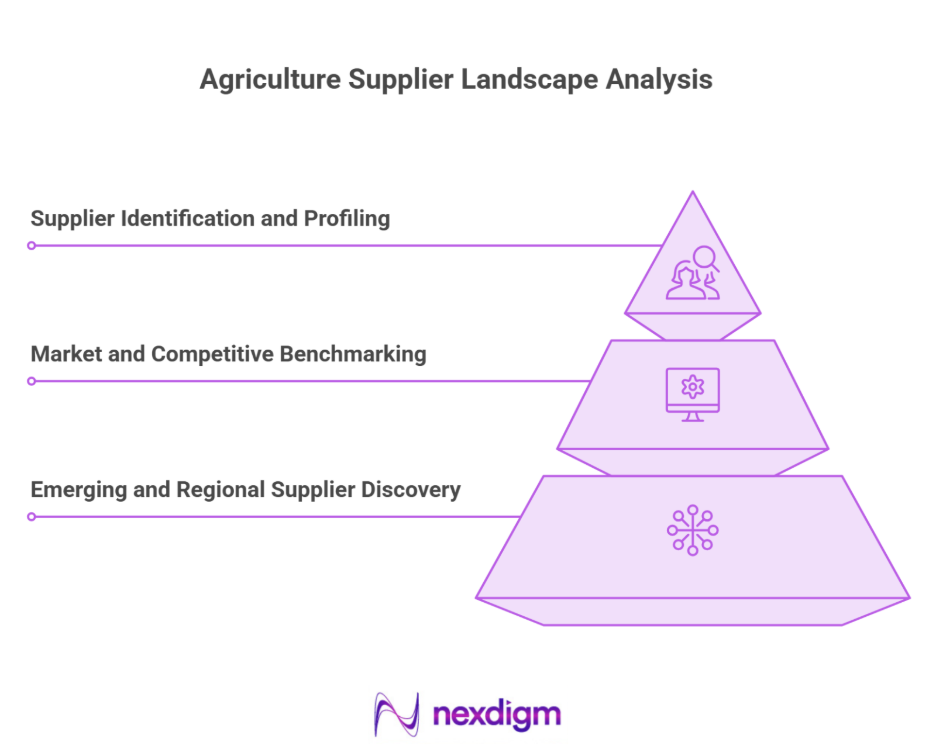
- Supplier Identification and Profiling: Identify manufacturers, distributors, and specialized providers across seeds, fertilizers, crop protection, and farm equipment, with profiles covering portfolios and geographic presence.
- Market and Competitive Benchmarking: Compare supplier capabilities, product positioning, distribution networks, innovation focus, and commercial approaches to understand competitive strengths and market differentiation.
- Emerging and Regional Supplier Discovery: Examine regional manufacturers, niche providers, and developing market participants to identify alternative sourcing options and potential partnership opportunities.
A structured understanding of supplier markets enables agribusinesses to identify relevant providers, compare competitive strengths, and make better-informed sourcing and partnership decisions.
A Glimpse into Nexdigm’s Agriculture Supplier Landscape Analysis
Our agriculture supplier landscape analysis provides a research-led view of manufacturers, distributors, and specialized providers across key agricultural input categories. Our experts examine supplier portfolios, market presence, competitive positioning, and regional capabilities to identify relevant market participants. This intelligence helps agribusinesses assess sourcing alternatives, shortlist potential partners, and align supplier decisions with evolving procurement requirements.
Business Impact Created by Nexdigm’s Agriculture Supplier Landscape Analysis
Our supplier intelligence helps agribusinesses translate market research into practical business decisions. By identifying competitive suppliers, evaluating regional alternatives, and highlighting gaps in supplier capabilities, our analysis can support:
- Improved Procurement Decisions: Compare supplier offerings and commercial positioning to identify sourcing options aligned with cost, quality, and availability requirements.
- Greater Supply Chain Resilience: Identify alternative providers and regional sourcing opportunities to reduce dependence on concentrated supplier networks.
- Stronger Partnership Opportunities: Discover specialized manufacturers and emerging suppliers that may support portfolio expansion, market access, and long-term procurement objectives.
- Better Market Entry Planning: Understand supplier presence, competitive intensity, and distribution networks to assess opportunities for entering new agricultural input markets.
These insights enable agribusinesses to make more informed supplier choices and strengthen their sourcing strategies.
Nexdigm’s Case
An agribusiness sought to diversify its supplier base across seeds, fertilizers, and crop protection products. Nexdigm assessed 22 suppliers based on product portfolios, geographic reach, manufacturing capabilities, and commercial positioning. The analysis found that 30% had limited regional distribution and 25% offered narrow product portfolios. Based on these findings, the company identified alternative providers and shortlisted suppliers for further evaluation.
To take the next step, simply visit our Request a Consultation page and share your requirements with us.
Harsh Mittal
+91-8422857704