

Agricultural supply chains rarely lose value at one dramatic point. The leakage accumulates through repeated handling, intermediary margins, loading charges, quality deterioration, delayed payments, and inefficient movement between collection and processing. By the time produce reaches the final buyer, the original farm-gate economics can look very different.
India’s agricultural supply chain therefore presents a question of network design as much as market access. The opportunity lies in identifying which physical and commercial handoffs are necessary, which can be redesigned, and where direct aggregation can improve both procurement economics and farmer realisation.
The Journey from Farm to Buyer Is Longer Than It Looks
A typical agricultural commodity can move through a village trader, APMC mandi, wholesaler, secondary trader, and finally a processor or retailer. Each transfer can introduce another cost.
Village-level aggregation can add a 2% to 3.5% margin, while mandi commissions and statutory market fees can range from 1.5% to 4.5%, depending on the state. Manual loading, weighing, and unbagging can add ₹15 to ₹30 per 50-kg bag. A secondary wholesaler can add another 4% to 7%.
The physical movement creates another layer of leakage. Grains and oilseeds can experience 4% to 8% physical or quality degradation across transport and storage, while perishables can face 15% to 25% volume and commercial degradation under poorly conditioned transit.
The supply chain is therefore not simply moving a product. It is repeatedly transferring ownership, handling responsibility, quality risk, and financing costs.
The Biggest Gap Is Between the Farmer and the First Reliable Buyer
Direct procurement is often presented as a way to eliminate intermediaries. The more useful question is whether it can replace the functions those intermediaries currently provide.
Farmers frequently accept a discount of 3% to 6% on spot sales when immediate cash is more valuable than waiting for a better price. Institutional procurement can offer better economics but may involve settlement periods of 7 to 14 days.
That creates a practical barrier to direct sourcing. A procurement model that improves the processor’s landed cost, but delays farmer payment may struggle to scale.
Farmer Producer Organizations can help resolve part of this problem. Aggregating 500 to 1,500 smallholders under a single legal entity can create truckload-scale supply and reduce the number of individual transactions required by institutional buyers.
Where Digital Collection Can Remove Friction
The strongest opportunities are not necessarily large logistics assets. They can be relatively small interventions positioned at the right nodes.
- Farm-gate collection centres can consolidate volumes before they enter traditional mandi networks.
- Digital quality assessment can establish moisture and grade at the point of collection, reducing disputes over weight and quality.
- FPO aggregation can convert fragmented farmer output into commercially meaningful lots.
- Faster settlement systems can reduce the financial incentive for farmers to sell immediately to informal traders.
- Route consolidation can reduce empty movement and unnecessary intermediate handling.
The commercial value comes from combining these interventions rather than treating each as a standalone technology investment.
The Real Opportunity Is to Redesign the Flow
A structured agriculture supply chain market assessment can identify where cost and time accumulate between farm and final buyer. Nexdigm can map handling nodes, intermediary margins, quality losses, payment cycles, transport routes, storage requirements, and procurement volumes to identify the points where redesign can create measurable value.
For processors, this can support direct sourcing strategies. For logistics operators, it can identify collection-hub opportunities. For retailers, it can reveal where quality and fulfilment risks originate upstream.
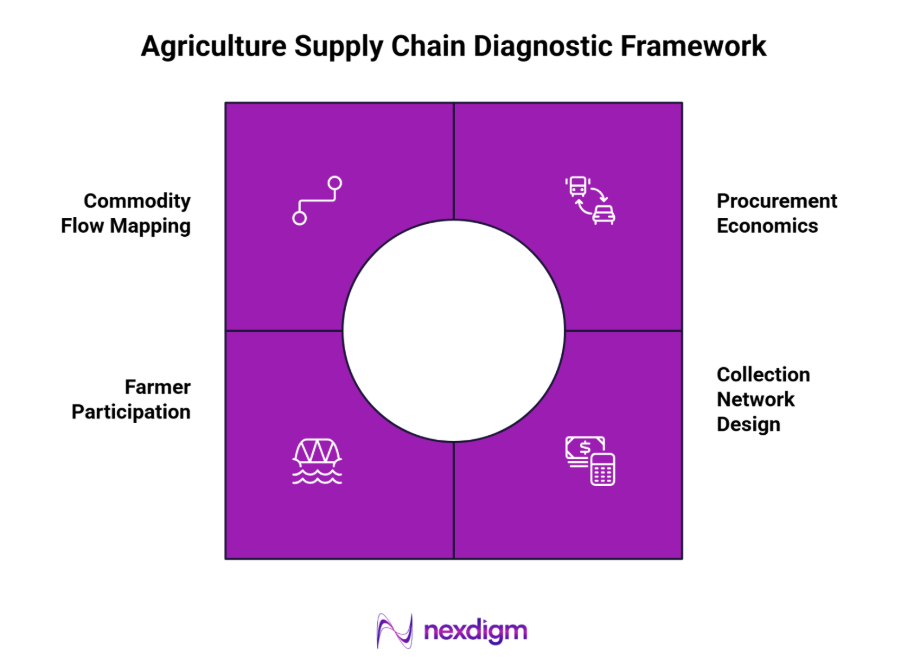
Nexdigm’s Supply Chain Diagnostic Framework
- Commodity Flow Mapping Track ownership transfers, handling points, waiting periods, and costs to locate friction.
- Procurement Economics Compare farm‑gate prices with margins, mandi charges, storage, freight, and landed cost to test if direct procurement is truly economical.
- Farmer Participation Assess payment timing, quality disputes, aggregation density, FPO capability, and trader relationships to gauge farmer incentives.
- Collection Network Design Model hubs, catchment areas, throughput, quality assays, transport routes, staffing, capital needs, and digital settlements for scalable operations.
The result is a supply-chain redesign tied directly to procurement savings, farmer participation, and service reliability.
Nexdigm Case Study: Building a Direct Procurement Network
A direct-from-FPO procurement intervention covering pulses and oilseeds eliminated two intermediate mandi handoffs and compressed total transit time by 48 hours. The redesigned network delivered a reported 9% to 14% reduction in landed procurement costs for the processing partner while improving farmer price realisation by 4% to 6%.
The case demonstrates that supply-chain efficiency does not necessarily require removing every intermediary. The commercial opportunity is to redesign the flow so that essential aggregation and financing functions remain while unnecessary handling, delays, and duplicated margins are reduced.
To take the next step, simply visit our Request a Consultation page and share your requirements with us.
Harsh Mittal
+91-8422857704