
Agricultural supply chains are exposed to risks that rarely remain confined to one part of the network. A poor harvest can reduce raw material availability, increase commodity prices and disrupt processing schedules. A shortage of fertilizer or crop protection inputs can affect production before the crop even reaches the market. Transport delays, inadequate storage and supplier failures can then magnify the original disruption.
For agribusinesses, food processors, input manufacturers and commodity buyers, risk management requires more than maintaining a list of approved suppliers. Organisations need to understand where critical dependencies exist, how disruptions travel through the supply chain and which failures could have the greatest commercial consequences.
Agricultural Supply Chains Face Multiple Sources of Disruption
Weather remains one of the most significant risks. Drought, excessive rainfall, flooding, heat stress and irregular monsoons can affect crop yields, harvesting schedules and the quality of agricultural raw materials. These events may also disrupt transport infrastructure and reduce access to production areas.
Market risks create a different kind of pressure. Commodity price fluctuations, export restrictions, import delays, currency movements and changes in government policy can affect the availability and cost of critical inputs. For businesses sourcing internationally, geopolitical developments and shipping disruptions can introduce additional uncertainty.
Operational risks are equally important. These include inadequate warehousing, cold-chain failures, poor inventory visibility, equipment breakdowns, labour shortages and weak coordination between supply chain partners.
Losses Accumulate at Multiple Stages
Supply chain risk is not limited to the movement of goods between suppliers and buyers. Agricultural produce can deteriorate during harvesting, collection, grading, drying, packaging, transportation, storage and wholesale distribution.
A government-reported post-harvest study estimated losses of 6.02–15.05% for fruits and 4.87–11.61% for vegetables. Cereals recorded estimated losses of 3.89–5.92%, while oilseed losses ranged from 2.87% to 7.51%. The study covered 54 commodities across 15 agro-climatic zones and 292 districts.
These figures demonstrate why supply chain risk cannot be assessed only through supplier delivery performance. Infrastructure and handling weaknesses can create substantial losses even when the original supplier fulfils the order.
Supplier Concentration Creates Hidden Vulnerabilities
A business may appear to have multiple suppliers while depending on the same upstream manufacturer, import origin, transport corridor or raw material source. If those suppliers share a common dependency, the organisation’s actual diversification may be much weaker than its vendor list suggests.
The risk is particularly significant for specialised inputs. A critical pesticide technical ingredient, seed variety, fertilizer raw material or machinery component may have limited qualified alternatives. Replacing the supplier may require regulatory checks, product trials, technical approval or changes to production processes.
Such dependencies should be identified before a disruption occurs. Otherwise, the buyer may discover that an apparently replaceable supplier is essential to maintaining operations.
Regional and Seasonal Risks Are Often Underestimated
Agricultural sourcing is closely linked to local production calendars. A disruption in one crop-producing region can affect several buyers simultaneously, particularly when the region supplies a large share of a particular commodity.
Seasonal concentration also affects transportation and storage. Peak harvest periods can increase demand for trucks, warehouses, labour and processing facilities. Buyers without advance capacity arrangements may face higher logistics costs or delays in moving produce.
The same issue applies to agricultural input distribution. A supplier may have adequate annual capacity but lack the inventory or distribution reach needed during a short demand window.
How Businesses Can Identify and Prioritise Supply Chain Risks
A detailed agriculture supply chain risk analysis should map the movement of products from source markets through suppliers, intermediaries, infrastructure providers and end users. It should identify critical nodes, shared dependencies, geographic concentration and operational constraints.
Risk assessment should consider both likelihood and business impact. A frequently occurring delay may have limited consequences if alternative routes exist. A rare disruption affecting a sole-source input could stop production entirely. Procurement and operations teams should therefore evaluate the time required to identify, qualify and activate an alternative supplier.
Nexdigm supports organisations through supply chain research, supplier intelligence, risk mapping and market analysis. Its work can help businesses identify vulnerable sourcing locations, assess supplier dependencies, evaluate alternative markets and prioritise mitigation investments.
Agriculture Supply Chain Risk Analysis Framework
A practical risk assessment should include seven connected stages:
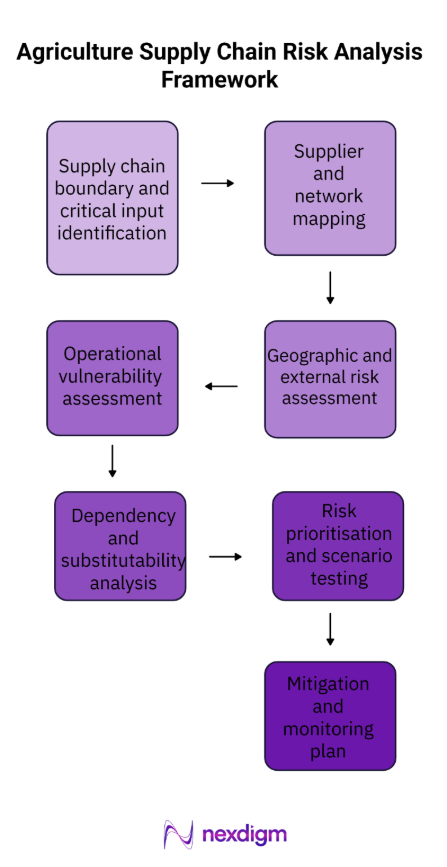
- Supply chain boundary and critical input identification: Define the products, services, facilities and geographies under review. Identify inputs whose shortage could interrupt production, delay deliveries, affect product quality or create regulatory exposure.
- Supplier and network mapping: Map direct suppliers, upstream manufacturers, raw material origins, distributors, transporters, warehouses and other critical partners. Record ownership, operating locations, capacity and important commercial relationships.
- Geographic and external risk assessment: Evaluate exposure to weather events, water stress, regional production concentration, geopolitical developments, trade restrictions, currency movements and changes in regulation. Assess whether several suppliers share the same external risk.
- Operational vulnerability assessment: Examine capacity constraints, inventory practices, lead times, transport routes, storage conditions, technology systems, quality controls and business continuity arrangements. Identify points where delays or failures can affect multiple stages.
- Dependency and substitutability analysis: Determine whether alternative suppliers, materials, routes or facilities are available. Assess qualification requirements, switching costs, replacement lead times and the time an organisation can continue operating with existing inventory.
- Risk prioritisation and scenario testing: Rank risks according to probability, financial and operational impact, duration and recovery difficulty. Test scenarios such as a regional crop failure, import interruption, warehouse outage, supplier shutdown or transport corridor disruption.
- Mitigation and monitoring plan: Define secondary sourcing options, inventory buffers, contract protections, alternative logistics arrangements and escalation procedures. Assign owners, review indicators and trigger points for action.
Nexdigm’s Case Study: Identifying Agricultural Supply Chain Vulnerabilities
Nexdigm assessed 41 supply chain participants across 6 agricultural input and commodity networks, mapping upstream dependencies, logistics constraints and regional concentration. The study prioritised 10 high-exposure risks and identified 7 mitigation opportunities for further evaluation.
To take the next step, simply visit our Request a Consultation page and share your requirements with us.
Harsh Mittal
+91-8422857704