

Agricultural input markets are expanding and evolving, making supplier performance an important consideration for agribusinesses. The global agriculture and agritech industry was estimated at approximately US$630.11 billion in 2025, with fertilizers and agricultural machinery accounting for major market segments.
The Food and Agriculture Organization (FAO) reported that global agricultural use of inorganic fertilizers reached 197 million tonnes of nutrients in 2024. Additionally, the global agricultural equipment market is estimated at US$183.9 billion for 2026. These developments highlight the scale and diversity of agricultural supply markets.
Through agriculture vendor benchmarking research, organizations can compare supplier capabilities, identify performance gaps, and evaluate sourcing options against operational and commercial priorities.
Why Supplier Benchmarking Matters in Agricultural Markets
Agribusinesses depend on suppliers for consistent product quality, competitive pricing, timely delivery, and technical support. However, differences in manufacturing capacity, distribution reach, product innovation, and service capabilities can influence supplier performance. Benchmarking provides a structured way to compare these factors, understand competitive positioning, and identify areas where existing sourcing arrangements may require improvement.
What Should Agribusinesses Compare When Benchmarking Suppliers?
An effective benchmarking exercise should examine more than quoted prices. Three dimensions help establish a meaningful comparison:
- Product and Technical Performance: Compare product specifications, quality standards, certifications, innovation capabilities, and suitability for different crops and operating conditions.
- Commercial and Operational Competitiveness: Assess pricing structures, payment terms, production capacity, delivery timelines, distribution coverage, and responsiveness to changing procurement requirements.
- Service and Supply Reliability: Evaluate technical assistance, after-sales support, order fulfilment, complaint resolution, and consistency across sourcing locations and seasonal demand cycles.
Together, these dimensions help organizations distinguish competitive suppliers from those with performance limitations.
How Nexdigm Identifies Supplier Performance Gaps
Nexdigm’s experts can help agribusinesses establish relevant supplier benchmarks across seeds, fertilizers, crop protection products, and farm equipment. Our agriculture vendor benchmarking research examines supplier portfolios, commercial positioning, geographic presence, operational capabilities, and service models. By comparing these factors across selected market participants, we help organizations identify capability differences, competitive strengths, and areas requiring further supplier evaluation.
Areas Nexdigm’s Benchmarking Covers for Comparing Suppliers
Our benchmarking approach examines supplier performance across multiple dimensions to help agribusinesses understand competitive positioning and identify suitable sourcing options. Key areas include:
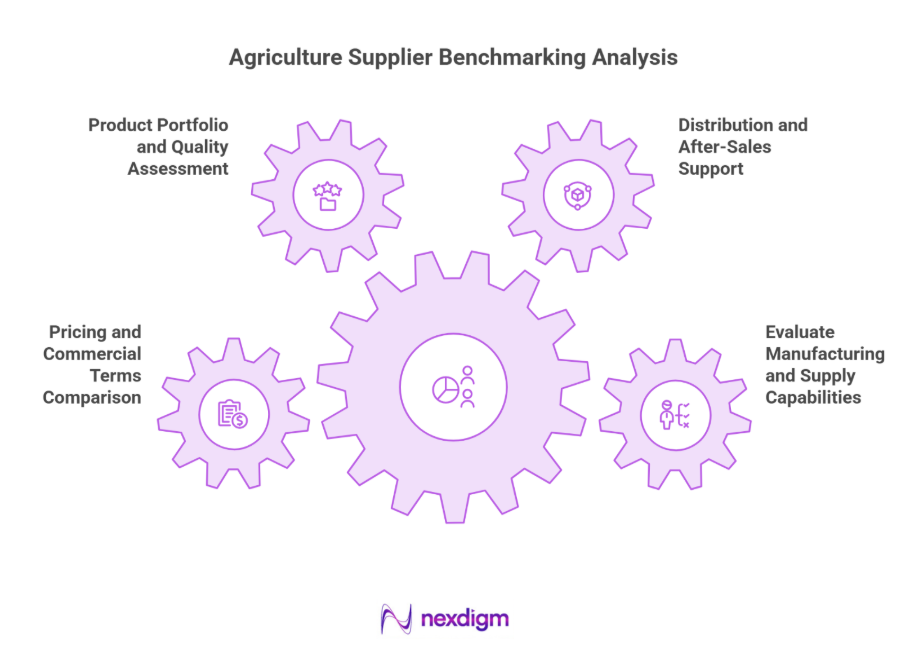
- Product Portfolio and Quality: Assess product range, specifications, certifications, consistency, and suitability across seeds, fertilizers, crop protection, and farm equipment.
- Pricing and Commercial Terms: Compare pricing structures, discounts, payment conditions, contract flexibility, and overall commercial competitiveness across suppliers.
- Manufacturing and Supply Capabilities: Evaluate production capacity, sourcing networks, inventory availability, and ability to meet seasonal demand.
- Distribution and After-Sales Support: Examine geographic reach, delivery networks, technical assistance, maintenance services, and responsiveness to customer requirements.
This multidimensional assessment helps organizations identify supplier strengths, recognize performance gaps, and make more informed procurement choices.
Nexdigm’s Vendor Benchmarking Offering Competitive Advantage
The insights generated through benchmarking help agribusinesses understand where suppliers outperform or fall short of market expectations. Nexdigm can help translate these findings into supplier scorecards, comparative assessments, and prioritized shortlists. This enables procurement teams to focus on competitive providers, address sourcing gaps, and strengthen supplier selection strategies.
Nexdigm’s Case
An agribusiness aimed to strengthen its supplier selection process across seeds, fertilizers, and crop protection products. Nexdigm evaluated 24 suppliers across pricing competitiveness, product quality, delivery reliability, and technical support. The assessment revealed that 29% had less competitive pricing structures, while 21% demonstrated inconsistent delivery capabilities. Based on the findings, 8 suppliers were shortlisted for detailed commercial and operational evaluation.
To take the next step, simply visit our Request a Consultation page and share your requirements with us.
Harsh Mittal
+91-8422857704