

Agrifood expansion is becoming less about finding markets with agricultural output and more about finding markets where the entire commercial chain works. India produced a record 357.73 million tonnes of foodgrains in 2024–25, while horticulture production reached 362.08 million tonnes. Agricultural exports also reached US$52.55 billion in FY2025–26, up from US$51.12 billion in FY2024–25.
These figures establish a large and increasingly diversified agricultural economy. They do not, however, indicate where an agrifood company should invest next.
A state with high crop production may have fragmented sourcing, inadequate processing infrastructure or expensive routes to market. Another region with lower production may offer better access to processors, organised buyers and export infrastructure. Expansion decisions therefore require a market view that connects demand with the conditions required to serve it.
Production Volume Does Not Equal Market Attractiveness
India’s agricultural production is concentrated differently across crops and regions. In 2024–25, rice production reached 150.18 million tonnes, wheat 117.94 million tonnes, pulses 25.68 million tonnes and millets and coarse cereals 18.59 million tonnes.
For an agrifood company, however, production volume is only the starting point. A processor looking for a dependable raw-material base needs to understand production concentration, seasonal availability and the ease of aggregating supply. A consumer-food company may place greater weight on proximity to consumption centres. An exporter may prioritise regions with established processing and logistics networks.
This makes the addressable market different from the total agricultural market.
Sourcing Can Determine Whether Expansion Scales
India’s farm structure adds another layer to the decision. The average operational holding was 1.08 hectares in the 2015–16 Agriculture Census, highlighting the fragmented nature of agricultural production.
For companies dependent on agricultural inputs, this can affect procurement costs and operating models. Direct sourcing may require extensive farmer networks, while aggregators, farmer-producer organisations and other intermediaries can change the economics of market access.
The assessment therefore needs to establish not only how much of a crop is produced, but how accessible that production is to a new entrant.
Processing Creates a Second Layer of Opportunity
The value of agricultural output can change substantially once processing, grading, storage and packaging are introduced. India’s processed food exports accounted for 20.4% of agricultural exports in FY2024–25, up from 13.7% in FY2014–15.
That shift creates opportunities for companies entering markets where primary production can support higher-value processing. But processing infrastructure is not evenly distributed. Existing mills, cold-storage facilities, warehouses and specialised processors can materially reduce the investment required to establish operations.
The question is therefore whether a region offers enough infrastructure to support the intended business model, or whether the entrant would have to build the ecosystem itself.
Distribution Can Change the Expansion Equation
Agricultural products ultimately have to reach processors, retailers, institutional buyers or export markets. Transport distance, storage availability, cold-chain infrastructure and access to major consumption centres can therefore influence the economics of expansion.
Irrigation also matters because it affects production reliability. India’s irrigation coverage increased from 49.3% of gross cropped area in FY2015–16 to 55% in FY2020–21.
A market with strong demand and production may still require significant investment to build the infrastructure needed to serve it, while an established ecosystem can make a smaller market commercially accessible.
For companies evaluating agrifood industry market entry strategy services, this kind of assessment can bring demand, sourcing, infrastructure and route-to-market conditions into a single view, helping distinguish broad market potential from opportunities that are more practical to pursue.
Nexdigm’s Agrifood Market Expansion Framework
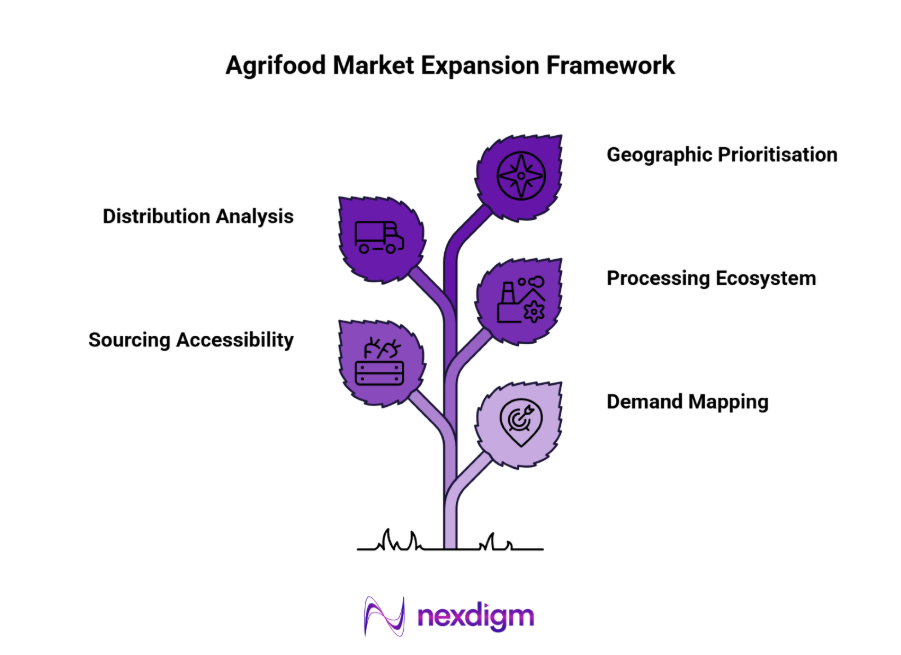
- Addressable Demand Mapping
Assess market size by product, customer segment and geography, then identify the portion that a new entrant can realistically target. This prevents national consumption figures from being mistaken for immediately accessible demand. - Sourcing Accessibility Assessment
Evaluate production concentration, farm structure, seasonality, aggregation networks and procurement channels. The objective is to establish whether sufficient raw material can be secured at commercially viable costs. - Processing Ecosystem Mapping
Identify existing processors, storage facilities, cold chains and value-addition capabilities. This helps determine whether the expansion should leverage existing infrastructure or require new investment. - Distribution and Route-to-Market Analysis
Assess logistics networks, proximity to buyers, distribution channels and export connectivity. Delivered economics should be considered alongside production economics. - Geographic Prioritisation
Combine demand, sourcing, processing, logistics and competitive conditions to rank potential expansion markets according to the company’s specific commercial requirements.
Nexdigm’s Case Study: From National Market to Priority States
An agrifood company screened six Indian states using demand, sourcing, processing and logistics indicators. The assessment narrowed the expansion pipeline to two priority states, where estimated procurement and distribution costs were approximately 18% lower than in the company’s initial target markets.
The objective of an expansion assessment is not simply to identify where agricultural activity is highest. It is to establish where demand, supply and infrastructure combine to create a workable commercial model.
Nexdigm can support agrifood companies with market sizing, geographic prioritisation, sourcing analysis, competitive assessment and market-entry feasibility to help inform expansion decisions.
To take the next step, simply visit our Request a Consultation page and share your requirements with us.
Harsh Mittal
+91-8422857704