

India’s agrochemical industry is expanding its manufacturing and international trade footprint, making procurement competitiveness increasingly important. According to the Department of Chemicals and Petrochemicals, India produced 287,000 tonnes of technical-grade pesticides in FY2024–25, against an installed capacity of 438,000 tonnes. Exports reached approximately 591,000 tonnes during the same period, compared with imports of 76,000 tonnes.
These developments highlight the importance of competitive sourcing, efficient supplier relationships, and cost visibility. Businesses must evaluate raw material prices, manufacturing capabilities, product quality, regulatory compliance, and delivery performance. Agrochemical procurement category benchmarking helps organizations compare suppliers, identify cost inefficiencies, and understand performance gaps across procurement categories.
Why Agrochemical Procurement Costs Require Category-level Assessment
Agrochemical procurement involves diverse inputs, including technical-grade active ingredients, intermediates, solvents, additives, and packaging materials. Supplier costs vary according to sourcing origins, production processes, order volumes, quality specifications, and regulatory requirements. Comparing these categories independently helps businesses identify price differences, understand cost drivers, and evaluate whether supplier performance justifies procurement expenditure across different product requirements.
What Influences Agrochemical Supplier Competitiveness
Supplier competitiveness depends on input sourcing economics, manufacturing efficiency, product quality, regulatory compliance, and delivery reliability. Differences in production capacity, import dependence, batch consistency, documentation, and inventory flexibility can influence overall supplier value. Businesses must evaluate these factors collectively to distinguish commercially attractive vendors from those capable of meeting long-term procurement, quality, and operational requirements.
Nexdigm’s Category-level View for Agrochemical Procurement Benchmarking
Our experts offer chemical industry knowledge, procurement intelligence, and supplier research to help businesses identify differences across agrochemical procurement categories. Our agrochemical procurement category benchmarking brings three areas together:
- Input Cost Intelligence: Examine active ingredient prices, intermediate sourcing, import exposure, and supplier quotations to identify category-specific cost variations and potential negotiation opportunities.
- Supplier Capability Mapping: Identify manufacturers, importers, distributors, and specialized chemical suppliers while assessing their production infrastructure, product portfolios, and market presence.
- Commercial and Operational Comparison: Review order conditions, production flexibility, quality systems, delivery arrangements, and regulatory documentation to understand differences in supplier suitability.
This category-led view helps businesses identify where procurement costs and supplier capabilities differ across their sourcing landscape.
How Experts of Nexdigm Identify Hidden Procurement Inefficiencies
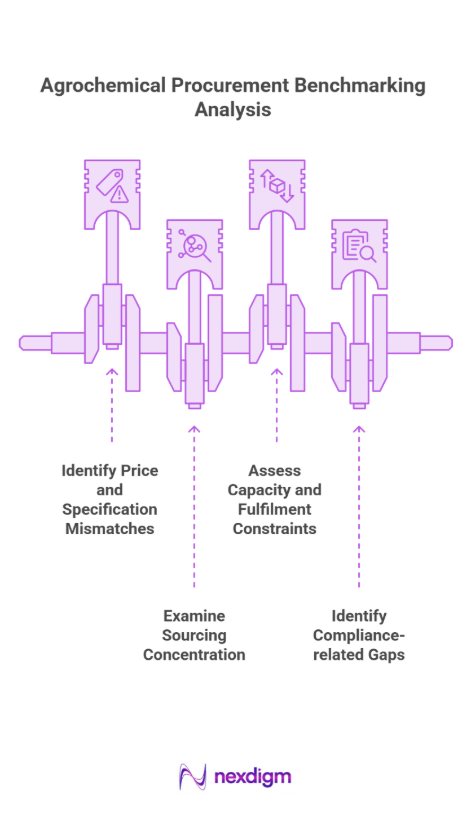
Beyond comparing supplier quotations, our experts examine the underlying factors that can influence procurement expenditure and vendor performance. Our experts help organizations investigate:
- Price and Specification Mismatches: Identify instances where differences in product specifications, quality parameters, or commercial conditions may explain variations in supplier quotations.
- Sourcing Concentration: Examine dependence on particular manufacturers, imported inputs, or geographic sourcing markets to identify opportunities for supplier diversification.
- Capacity and Fulfilment Constraints: Assess production availability, order flexibility, inventory arrangements, and delivery timelines to identify potential procurement bottlenecks.
- Compliance-related Gaps: Review supplier documentation, quality certifications, and regulatory credentials to identify areas requiring additional verification before procurement decisions.
These findings help businesses distinguish avoidable procurement inefficiencies from cost differences arising from genuine product or operational requirements.
Benefits of Nexdigm’s Agrochemical Procurement Benchmarking Research
Our benchmarking strategy helps businesses translate supplier intelligence into practical procurement benefits through the following areas:
- Greater Cost Visibility: Identify pricing differences across active ingredients, intermediates, and formulation inputs to understand cost variations and potential savings opportunities.
- Stronger Supplier Selection: Compare manufacturers on production capabilities, quality standards, regulatory credentials, and delivery reliability to prioritize suitable procurement partners.
- Improved Sourcing Flexibility: Identify alternative suppliers, regional manufacturers, and sourcing markets to reduce dependence on limited vendors.
These benefits help organizations strengthen procurement planning, improve supplier evaluation, and align sourcing decisions with commercial and operational priorities.
Nexdigm’s Case
An agrochemical formulation company engaged Nexdigm to assess supplier competitiveness across selected procurement categories in India. The research evaluated 35 suppliers covering technical-grade ingredients, intermediates, and formulation inputs. The assessment found that 27% of suppliers had significant price variations for comparable inputs, while 24% showed gaps in regulatory documentation. Additionally, 20% had limited flexibility in fulfilling changing order volumes. Based on the findings, the company shortlisted 10 suppliers for further commercial and technical evaluation.
To take the next step, simply visit our Request a Consultation page and share your requirements with us.
Harsh Mittal
+91-8422857704