

The agrochemical market is made up of manufacturers, formulation companies, importers, distributors and specialist product developers. Some suppliers focus on active ingredient production, while others concentrate on formulation, branding or distribution. Their competitive positions also vary by product category, crop segment and geographic market.
For agribusinesses, distributors and companies assessing sourcing or partnership opportunities, understanding this supplier structure is essential. Agrochemical vendor landscape analysis provides a way to identify relevant market participants, compare their capabilities and understand how competition differs across crop protection categories.
A Supplier Landscape with Multiple Layers
Agrochemical suppliers do not all compete in the same part of the value chain. Their business models and capabilities can be grouped into several broad categories.
- Technical-grade manufacturers produce active ingredients used in crop protection formulations. Their competitiveness may depend on manufacturing capacity, process technology, raw material sourcing, regulatory compliance and cost efficiency.
- Formulation manufacturers convert active ingredients into products suitable for approved agricultural applications. Their capabilities may include formulation development, quality control, packaging and product registration.
- Branded agrochemical companies compete through product portfolios, research capabilities, market positioning, farmer engagement and distribution relationships. Some maintain integrated manufacturing and formulation operations, while others rely on third-party production.
- Importers and distributors connect domestic demand with local and international suppliers. Their value depends on sourcing relationships, regulatory documentation, inventory management, regional reach and commercial execution.
- Biological and speciality crop protection providers focus on products such as biopesticides, microbial solutions, botanical formulations and other specialised approaches. Their competitive position may depend on product validation, regulatory pathways and farmer adoption.
These supplier categories often overlap. A company may manufacture selected active ingredients, outsource other formulations and distribute products from additional partners. A landscape assessment should capture these relationships rather than classify every company using only its primary business description.
Competition Differs Across Product Categories
The competitive landscape becomes more useful when examined by product type.
- Insecticides: Suppliers compete through active ingredient portfolios, formulation options, target pest coverage, approved crop applications and distribution availability.
- Fungicides: Product positioning may depend on disease coverage, formulation quality, application suitability and the availability of alternatives for different crops.
- Herbicides: Competition is influenced by crop systems, weed-control requirements, approved uses and application conditions.
- Seed treatment products: Suppliers may differentiate through formulation technology, crop coverage, compatibility and technical support.
- Biological crop protection: Providers compete through product development, scientific validation, regulatory compliance and market education.
The relevant market leaders may differ across each segment. A company with strong capabilities in herbicides may have a comparatively limited presence in biological crop protection. Similarly, a supplier with extensive technical manufacturing capabilities may rely on other companies for farmer-facing distribution.
How to Conduct agrochemical vendor landscape analysis Across Markets
A comprehensive landscape study should begin by defining the relevant product categories and geographic scope. The objective is to identify suppliers that are commercially relevant to the buyer rather than compile an undifferentiated list of every registered company.
Supplier profiles should capture ownership, manufacturing locations, technical and formulation capabilities, product registrations, distribution relationships and market presence. Where possible, the research should distinguish between products manufactured directly by a company and those sourced through third-party arrangements.
India’s crop protection market operates under a regulatory framework administered through the Central Insecticides Board and Registration Committee. Government reporting in December 2025 identified 368 registered technical products and 1,139 registered formulations. This provides an indication of the breadth of the regulated market, although registration counts alone do not establish commercial leadership or actual market share.
Market mapping should also examine the role of domestic manufacturers and international suppliers. Import dependence, raw material availability, manufacturing concentration and regulatory changes can influence the competitiveness of individual companies.
What Determines a Supplier’s Market Position?
Market leadership should not be inferred from company size or the number of products listed in a catalogue. A meaningful assessment considers several dimensions together.
- Portfolio depth: Does the supplier offer a relevant range of active ingredients, formulations and crop applications?
- Manufacturing capability: Does it operate production and formulation facilities, or depend on external manufacturers and sourcing partners?
- Regulatory standing: Are products registered for the relevant uses, and can the company maintain the required compliance documentation?
- Distribution reach: Does the supplier have access to regional distributors, dealers and agricultural markets?
- Research and innovation: Does the company invest in formulation development, biological solutions, product improvement and technical support?
- Commercial strength: Are its prices, supply arrangements, dealer relationships and customer service competitive?
These indicators should be assessed within each product category. A supplier may be a strong candidate for a particular sourcing requirement without being a market leader across the entire agrochemical sector.
Why Supplier Mapping Matters for Procurement and Market Entry
For procurement teams, supplier landscape research can reveal alternative sourcing options, manufacturing dependencies and potential concentration risks. It can also help identify suppliers with complementary product portfolios or stronger regional distribution.
For companies considering market entry or expansion, the research offers a different perspective. It can highlight established competitors, emerging specialists, manufacturing clusters, distribution partnerships and product categories with limited supplier coverage.
The findings can support decisions around supplier qualification, strategic partnerships, acquisition screening and commercial expansion. They also help organisations distinguish between suppliers with broad market visibility and those with capabilities that directly match their intended business requirements.
How Nexdigm Supports Agrochemical Market Research
Nexdigm supports organisations through market intelligence, competitive landscape research, supplier benchmarking and commercial analysis. Its research can help clients identify agrochemical manufacturers and distributors, assess product category capabilities, compare regional market presence and understand the competitive dynamics shaping crop protection supply chains.
Agrochemical Supplier Landscape Assessment
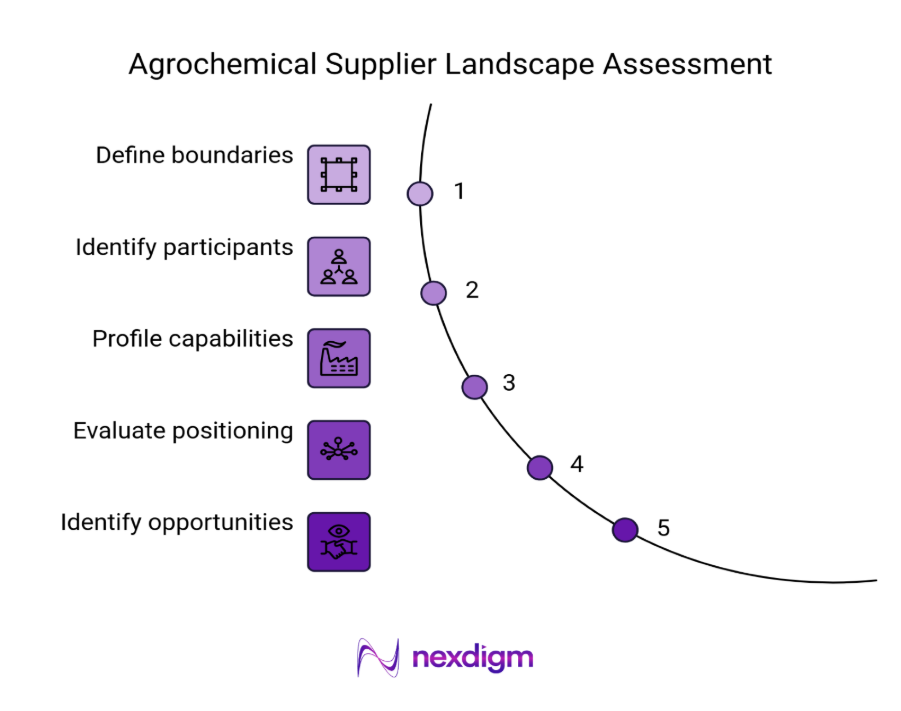
- Define market boundaries: Establish the product categories, crop segments and geographic markets under review.
- Identify market participants: Map manufacturers, formulation companies, importers, distributors and specialist providers.
- Profile supplier capabilities: Assess product portfolios, manufacturing infrastructure, regulatory standing and research activities.
- Evaluate competitive positioning: Compare regional reach, channel relationships, product specialisation and commercial presence.
- Identify strategic opportunities: Highlight sourcing alternatives, supplier gaps, partnership prospects and potential market-entry opportunities.
Nexdigm’s Case Study: Mapping Agrochemical Suppliers
Nexdigm profiled 20 agrochemical suppliers across six crop protection categories, mapped manufacturing and distribution presence in 9 markets and assessed 34 competitive indicators. The research identified five suppliers for further strategic evaluation.
To take the next step, simply visit our Request a Consultation page and share your requirements with us.
Harsh Mittal
+91-8422857704