

A logistics company can have dozens of possible AI applications and still have very few that justify investment.
Demand forecasting, route optimisation, warehouse automation, fleet maintenance and disruption prediction all generate plausible use cases. Their commercial value, however, depends on the quality of available data, the frequency of the decision, the cost of getting that decision wrong and whether the organisation can act on the model’s output.
That is changing the way the logistics AI opportunity should be assessed. The relevant question is no longer how many use cases exist. It is where AI can improve a decision enough to produce measurable economic value.
Forecasting Has a Large Data Advantage
Forecasting is one of the more natural starting points because logistics businesses already accumulate large volumes of historical information.
Order patterns, seasonality, inventory movements, lead times and customer behaviour can be used to identify demand signals that are difficult to process manually. Better forecasts can then influence replenishment, inventory positioning and transport requirements.
The opportunity becomes stronger when forecasts are connected to decisions. A more accurate prediction that does not change purchasing, inventory or capacity planning has limited economic value.
Routing Turns AI Into a Real-Time Decision Tool
A route planned at 8 a.m. may already be suboptimal by noon. Traffic, weather, delivery priorities, vehicle availability and changing customer requirements can alter the economics of a route during the day.
AI and machine-learning systems can process these variables continuously rather than relying entirely on fixed routing rules.
The commercial opportunity is particularly relevant where fleets operate at high frequency or where failed deliveries, empty kilometres, overtime and fuel consumption create significant leakage. Nexdigm identifies route enhancement and fleet management among the practical applications of AI in transportation and logistics.
Warehouse AI Depends on What the Warehouse Already Knows
Warehouse automation is often discussed as a robotics problem. The larger opportunity can begin earlier, with the decisions that determine where inventory sits, how orders are sequenced and how labour is allocated.
AI can support slotting, demand-based inventory positioning, picking optimisation and capacity planning. But these applications require reliable operational data and sufficiently standardised processes.
A warehouse with inconsistent inventory records may gain little from an advanced optimisation model. One with accurate transaction data, predictable workflows and high throughput has a much clearer path to measurable returns.
Fleet Management Offers Several Separate Value Pools
Consider a fleet with 500 vehicles. AI could be applied to route planning, load allocation, driver behaviour, maintenance prediction, fuel consumption or estimated arrival times.
Predictive maintenance addresses downtime. Route optimisation affects kilometres and delivery time. Load optimisation affects vehicle utilisation.
ETA prediction affects customer service and downstream planning.
Treating them as one “AI opportunity” hides the economics. Each use case needs its own baseline, data requirement and return calculation.
The Data Often Determines the Opportunity
The most sophisticated algorithm cannot compensate for missing or unreliable operational data. This is one reason AI adoption in supply chains remains uneven.
A 2025 survey found that 47% of operations and supply-chain leaders cited integration complexity and 44% cited data issues as reasons technology investments had not fully delivered expected results.
The assessment therefore needs to happen before the technology decision. Can shipment events be captured consistently? Are historical demand records usable? Can vehicle and route data be accessed at the required frequency? Can the AI output be connected to the system where the operational decision is made?
Those questions can eliminate some use cases and strengthen others.
Where the Logistics AI Market Opportunity Actually Sits
The most attractive opportunities tend to combine four conditions: a high-frequency decision, substantial financial leakage, usable data and an operating team capable of acting on the output.
Nexdigm’s AI in logistics market opportunity analysis can assess these conditions across routing, demand forecasting, warehouse operations and fleet management. The objective is to distinguish attractive AI opportunities from applications that may be technically possible but commercially premature.
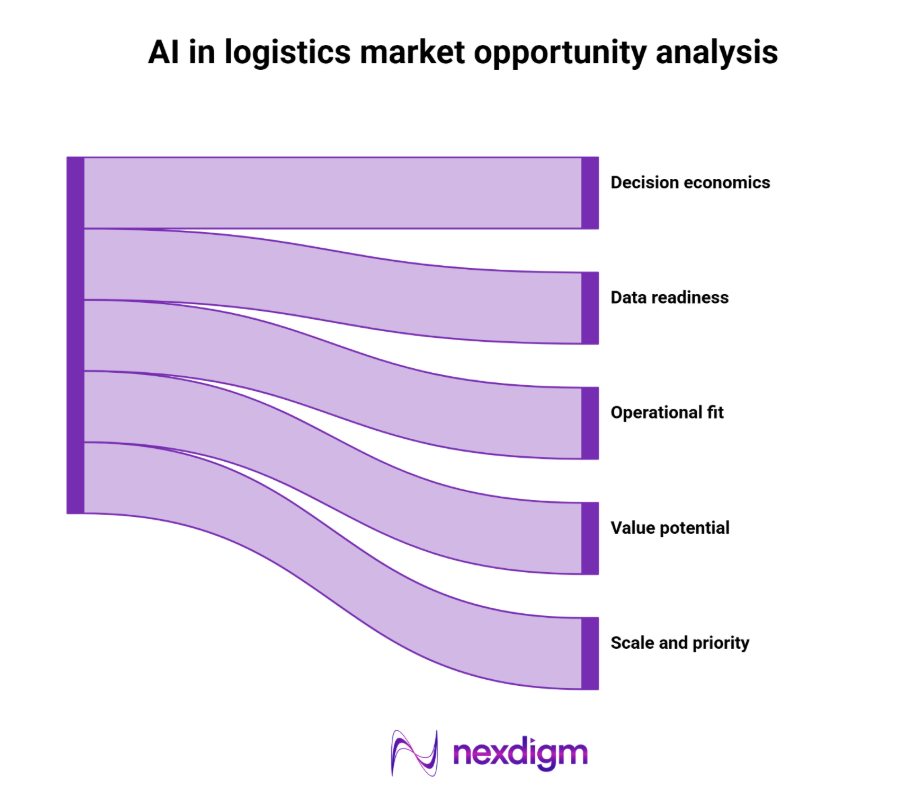
How Nexdigm Screens AI Opportunities in Logistics
Nexdigm can evaluate potential use cases through five decision areas:
- Decision economics: Quantify the cost of the current decision, including fuel, labour, inventory, service failures and downtime.
- Data readiness: Assess availability, quality, granularity and integration of the data required to support the use case.
- Operational fit: Determine where AI output would enter the existing planning or execution workflow.
- Value potential: Estimate achievable savings, productivity improvement, service gains or capacity release.
- Scale and priority: Rank opportunities by ROI, implementation complexity, scalability and time to value.
This gives logistics leaders a basis for deciding which AI applications to pilot, which require foundational investment and which should be deferred.
A Fleet Benchmark Can Reveal the First AI Opportunity
Nexdigm’s work with a regional freight operator combined vehicle-utilisation benchmarking, competitive intelligence and route optimisation. Fleet utilisation increased from 65% to 88% within nine months, while transportation costs fell 19%, unplanned maintenance declined 24%, and on-time delivery improved 17%. The case illustrates how operational data and analytics can identify value pools before broader technology investment is made.
To take the next step, simply visit our Request a Consultation page and share your requirements with us.
Harsh Mittal
+91-8422857704