

AI has moved from experimentation toward enterprise deployment, but the transition is far from uniform. Global direct and indirect AI spending is forecast to reach $2.7 trillion in 2026, representing 49.5% annual growth. Yet only 34% of enterprises are scaling AI initiatives into production, while just 6% report fully AI-ready data architecture.
For an AI company entering a new market, this creates an unusual commercial environment. Demand is growing quickly, but customer readiness varies considerably. A solution can have a strong technical proposition and still encounter limited adoption because customers lack usable data, governance structures, infrastructure or an economic case for deployment.
The AI Market Is Splitting Between Interest and Readiness
Enterprise AI adoption is increasingly moving into production, but the underlying data environment remains a constraint. The report finds that 47% of enterprises describe their data as partially prepared and another 36% as mostly prepared, while only 6% consider it fully ready.
India shows a similar transition. Around 30% of businesses are operating AI in production, while 7% are running agentic workflows.
For an AI provider, the implication is straightforward. The addressable market should not be defined only by organisations expressing interest in AI. It should account for data maturity, infrastructure, governance, budget availability and the ability to integrate the solution into existing workflows.
Use Cases Need to Be Chosen for Economics, Not Novelty
The strongest enterprise AI opportunities are increasingly concentrated in repetitive, structured workflows where the value of automation can be measured.
The report identifies customer support, software development, finance and accounting, cybersecurity incident triage and supply-chain compliance as areas where AI agents can address labour intensity, response times, error rates and compliance requirements.
This makes use-case prioritisation a central part of market entry. A technically impressive application may have limited commercial potential if the underlying workflow is infrequent or inexpensive. A less spectacular application can become more attractive when it addresses a large transaction volume, expensive labour requirement or significant compliance exposure.
Pricing Must Account for the Cost of Intelligence
AI also changes software economics. Every inference introduces underlying compute and token costs, meaning that a high-usage customer can be substantially more expensive to serve than a low-usage customer.
The report identifies a shift away from pure subscription models toward combinations of platform fees, consumption credits and outcome-linked charges.
Infrastructure adds another consideration. AI-optimised IaaS spending is projected to reach $42 billion in 2026, growing 96% year over year.
An AI provider entering a market therefore needs to understand not only what customers will pay, but also what it will cost to serve them.
AI Market Entry Framework
An AI market entry strategy consulting framework needs to connect the AI use case with the customer’s readiness and the vendor’s commercial model.
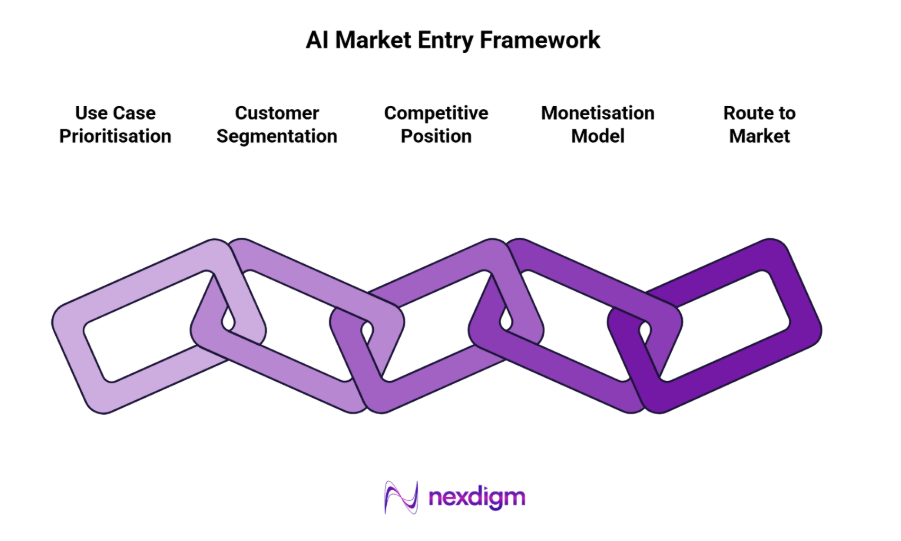
- Prioritise use cases by economic value.
Assess workflow frequency, labour costs, transaction volumes, error exposure and potential savings. The strongest use cases should have measurable economics rather than relying on general productivity claims. - Segment customers by AI readiness.
Evaluate data architecture, integration capacity, governance, cybersecurity and internal expertise. This separates customers that can deploy immediately from those requiring extensive preparation. - Define the competitive position.
Compare specialist AI vendors with incumbent enterprise software, internal development and general-purpose model providers. A differentiated proposition needs to survive comparison with the customer’s actual alternatives. - Design the monetisation model.
Test subscriptions, usage-based pricing, credits and outcome-linked fees against customer value and vendor infrastructure costs. The pricing structure needs to remain viable as usage scales. - Build the route to market around enterprise buying behaviour.
Enterprise technology transactions can involve an average of 22 stakeholders, while 54% of technology buyers complete transactions through digital self-service channels or cloud marketplaces without an initial sales-representative interaction.
That makes cloud marketplaces, technology partnerships and implementation ecosystems important components of an AI market-entry plan rather than secondary distribution options.
Nexdigm Case: Building an AI Market Entry Roadmap
An AI software provider evaluated 5 use cases across 4 markets, combining 2,100 enterprise interviews with 36 competitor assessments. Nexdigm identified 3 priority opportunities, narrowed the initial market focus by 40%, and established a target pricing range of 800–1,200 per month.
Nexdigm’s AI market entry strategy consulting helps businesses evaluate use cases, customer readiness, competition, pricing, partnerships, infrastructure and routes to market.
To take the next step, simply visit our Request a Consultation page and share your requirements with us.
Harsh Mittal
+91-8422857704