

Enterprise AI procurement is moving beyond experimentation. Organisations are evaluating platforms that can support customer service, document processing, predictive analytics, software development, knowledge management and business process automation. The challenge is that the AI market includes infrastructure providers, foundation model developers, cloud platforms, data and analytics vendors, automation specialists and enterprise application providers. Their products may overlap, but they solve different problems.
A business selecting an AI platform must therefore consider more than model capability. Data access, integration, security, governance, deployment flexibility and consumption costs all influence whether a solution can move from a pilot into production.
A structured AI platform vendor analysis helps enterprises compare suppliers according to their intended use cases and assess the technical and commercial implications of adopting different AI technologies.
Enterprise AI Adoption Is Moving Beyond Early Experiments
Eurostat reported that 19.95% of EU enterprises used AI technologies in 2025, up from 13.48% in 2024. Adoption was notably higher among large enterprises, reaching 55.03%, compared with 17% among small enterprises.
The figures reflect a widening gap between organisations experimenting with AI and those investing in broader implementation. They also show why supplier evaluation needs to account for enterprise readiness. A platform suitable for a small proof of concept may not provide the governance, integration or operational controls required for organisation-wide deployment.
AI procurement is no longer just a question of which model produces the strongest output. It is a question of which platform can support a defined business outcome within acceptable risk and cost parameters.
Different AI Use Cases Require Different Platform Capabilities
The first step in supplier evaluation is to distinguish between the applications the organisation intends to support.
- Generative AI and enterprise knowledge applications can assist with document summarisation, information retrieval, content generation, coding and employee support. Buyers should assess model quality, context handling, retrieval capabilities, data controls and the ability to ground responses in approved enterprise information.
- Predictive analytics and machine learning support forecasting, classification, anomaly detection, customer segmentation and operational optimisation. These applications require access to reliable data, model development tools, deployment infrastructure and ongoing performance monitoring.
- AI-enabled automation can support document extraction, request classification, workflow routing and decision assistance. Procurement teams should assess accuracy, exception handling, integration and the extent of human review required.
- Computer vision and speech technologies may be relevant to quality inspection, document processing, voice-based customer support and operational monitoring. Their suitability depends on the data available, deployment environment and performance requirements.
A supplier that performs well in generative AI may not necessarily be the strongest option for predictive modelling or industrial computer vision.
What Makes an AI Platform Enterprise-Ready?
Technical capability is only one part of the assessment. Enterprise buyers need to understand how a platform handles data, manages access and supports the full lifecycle of AI applications.
Important evaluation areas include:
- Model capabilities: Accuracy, reasoning performance, supported tasks, language coverage and customisation options.
- Data integration: Connectivity with enterprise databases, document repositories, APIs and existing applications.
- Security and governance: Access controls, encryption, data handling, auditability and model usage policies.
- Deployment flexibility: Cloud, private cloud, hybrid and other supported deployment arrangements.
- Operational management: Monitoring, version control, evaluation, incident handling and model updates.
The National Institute of Standards and Technology’s AI Risk Management Framework provides a useful reference for organisations establishing governance and risk controls. Its Generative AI Profile further addresses risks associated with generative AI systems. Procurement teams can use these principles to structure supplier questions around transparency, evaluation, accountability and ongoing monitoring.
Integration and Data Readiness Can Determine the Outcome
AI platforms depend on the quality and accessibility of enterprise data. A supplier may offer advanced models, but implementation can become difficult when information is fragmented across applications, stored in inconsistent formats or subject to restrictive access permissions.
Businesses should examine data ingestion, transformation, retrieval, permissions and connectivity. For generative AI, retrieval-augmented generation and enterprise search capabilities may be important where outputs need to reference internal documents and approved information.
Integration with existing workflow, analytics and security systems should also be tested. A platform that requires extensive custom development may increase implementation costs and delay deployment.
Understanding AI Platform Economics
AI pricing can be more difficult to forecast than traditional software subscriptions. Costs may depend on model usage, input and output tokens, API calls, processing time, compute capacity, storage, training and specialised services.
The commercial assessment should compare costs under realistic usage scenarios rather than relying on introductory pricing or small-scale pilot consumption.
Procurement teams should also account for model evaluation, data preparation, integration, security controls, ongoing monitoring and specialist skills. Where multiple models or providers are used, the cost of routing requests and managing separate environments should be included.
Vendor contracts should clarify data usage, retention, model training permissions, service availability, intellectual property and exit arrangements. These terms can be as important as the headline price.
AI Platform Vendor Evaluation Framework
A robust assessment should connect each platform to a specific business application and a measurable operational requirement:
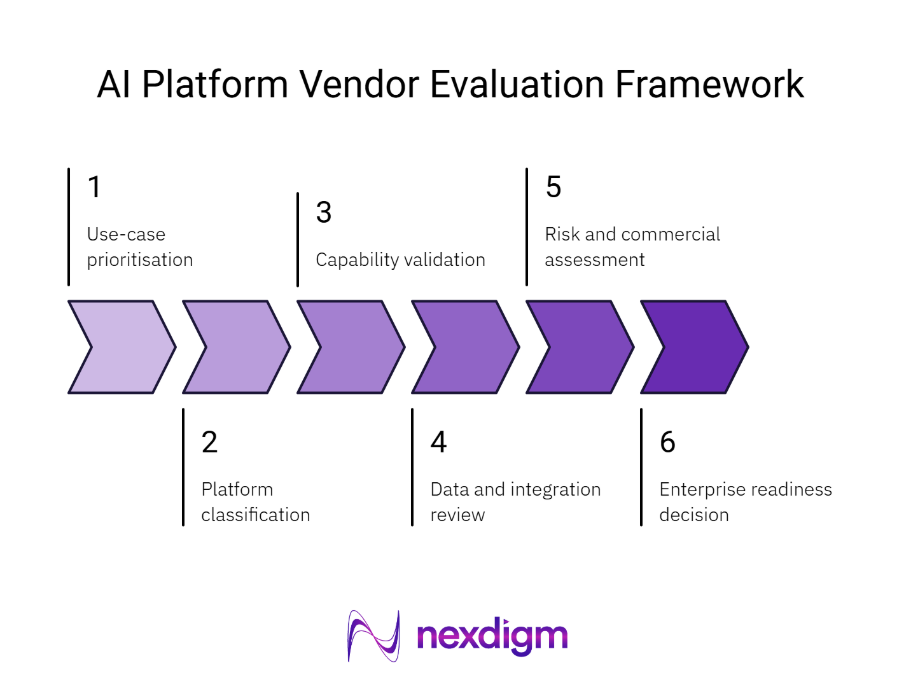
- Use-case prioritisation: Identify automation, analytics and generative AI applications according to business impact and feasibility.
- Platform classification: Separate model providers, AI development environments, cloud AI services, data platforms and application-level solutions.
- Capability validation: Compare model performance, supported workloads, customisation and deployment options using representative tests.
- Data and integration review: Assess data readiness, application connectivity, access permissions and enterprise knowledge integration.
- Risk and commercial assessment: Examine governance, security, usage pricing, implementation costs and contractual data protections.
- Enterprise readiness decision: Evaluate shortlisted providers against scalability, monitoring, operational support and measurable business outcomes.
Nexdigm can support organisations through AI market research, vendor landscape analysis, platform benchmarking and commercial intelligence. This helps technology buyers understand supplier capabilities, compare emerging solutions and identify platforms aligned with enterprise automation, analytics and generative AI priorities.
Nexdigm’s Case Study: Mapping Enterprise AI Platform Capabilities
Nexdigm assessed 14 AI platform providers across 5 enterprise use-case categories, comparing automation, analytics, generative AI, governance and pricing. The research identified 6 capability gaps, shortlisted 4 providers and established 9 technical and commercial evaluation benchmarks.
To take the next step, simply visit our Request a Consultation page and share your requirements with us.
Harsh Mittal
+91-8422857704