

AI product commercialization strategies accelerate enterprise adoption and revenue growth by translating advanced AI capabilities into clear, market-ready solutions. As enterprises seek practical tools for automation, analytics, customer engagement, and decision support, providers must align product features with measurable business outcomes.
A strong market entry strategy helps define target customers, pricing models, distribution channels, adoption support, and competitive positioning. An effective AI product commercialization strategy enables providers to reduce buyer uncertainty, demonstrate return on investment, improve sales conversion, and build scalable revenue streams across enterprise segments where AI adoption is becoming a core business priority.
AI commercialization is gaining momentum as 88% of organizations reported regular AI use in at least one business function in 2025, up from 78% a year earlier. The global AI market was valued at approximately USD 390.9 billion in 2025 and is projected to reach USD 3,497.3 billion by 2033, growing at a 30.6% CAGR. These figures show strong demand for structured commercialization strategies that drive adoption and revenue growth.
Using AI Product Commercialization as a Driver of Enterprise Adoption
Using AI product commercialization as a driver of enterprise adoption involves aligning product capabilities with business needs, demonstrating measurable value, reducing buyer uncertainty, and enabling scalable implementation.
- Business Need Alignment: Connect AI product features with enterprise priorities, operational challenges, workflow gaps, and measurable business improvement opportunities.
- Value Demonstration: Show how the product improves productivity, accuracy, decision speed, cost efficiency, and customer outcomes through practical use cases.
- Buyer Confidence Building: Reduce adoption hesitation by providing clear ROI evidence, implementation clarity, security assurance, and credible success indicators.
- Commercial Readiness Assessment: Evaluate pricing, packaging, deployment support, sales materials, onboarding processes, and customer success capabilities before market launch.
Nexdigm’s Customer Segment Prioritization for AI Product Adoption
Nexdigm’s Customer Segment Prioritization for AI Product Adoption helps identify enterprise groups with the strongest adoption potential, budget readiness, use case relevance, and decision-making influence. This support enables AI product providers to focus resources on high-value segments, improve targeting efficiency, and accelerate commercial traction across priority markets.
Nexdigm’s Commercialization Roadmap Support for Scalable AI Product Growth
Nexdigm’s Commercial Roadmap Support for Scalable AI Product Growth helps define phased market entry actions, revenue milestones, adoption priorities, sales enablement needs, and expansion pathways:
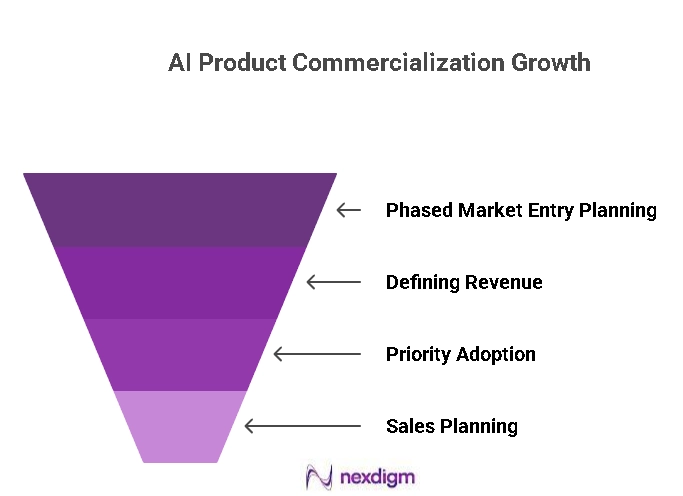
- Phased Market Entry Planning: Define launch stages, priority markets, customer groups, and execution timelines for structured AI product growth.
- Revenue Milestone Definition: Set measurable revenue targets, conversion goals, renewal expectations, and expansion benchmarks to track commercial performance.
- Adoption Priority Mapping: Identify enterprise functions, buyer needs, and use cases most likely to support early product adoption.
- Sales Enablement Planning: Develop sales narratives, value calculators, demo materials, objection responses, and proof points to improve buyer conversion.
To take the next step, simply visit our Request a Consultation page and share your requirements with us.
Harsh Mittal
+91-8422857704