

AI software is moving from experimentation toward broader enterprise deployment, changing how organizations automate processes, analyze information, support employees, serve customers, and make decisions. The opportunity is expanding beyond general-purpose tools into specialized applications designed around specific business functions and industry workflows.
The commercial opportunity is already substantial. Gartner forecasts $453.2 billion in worldwide AI software spending in 2026, up from $282.9 billion in 2025. Overall AI spending is expected to reach $2.59 trillion, a 47% year-on-year increase.
These numbers indicate strong investment, but spending alone does not reveal where sustainable commercial value is being created. For software companies, technology providers, investors, enterprises, private-equity firms, cloud providers, and digital businesses, an AI software market potential study helps evaluate use cases, enterprise adoption, customer demand, technology readiness, and scalability.
Why AI Software Matters
AI software is transforming how organizations improve productivity, generate revenue, enhance customer experiences, strengthen decision-making, manage risk, and optimize operating costs.
Its commercial impact is determined not by the technology itself, but by its ability to solve high-value business challenges and deliver measurable outcomes at scale.
From Technology to Value
As AI adoption matures, organizations are increasingly focused on translating technological capabilities into tangible business results.
Successful deployments are evaluated through metrics such as productivity improvement, revenue growth, cost reduction, risk mitigation, and customer satisfaction, creating a clearer link between AI investment and enterprise value.
Where Spending Is Moving
AI investment is expanding across applications, platforms, foundation models, services, cybersecurity, infrastructure, and data management solutions.
Understanding how spending is distributed across these categories provides insight into emerging demand patterns, technology priorities, and the areas where scalable software opportunities are gaining traction.
Role of Nexdigm in Assessing AI Software Market Potential
As AI software markets become increasingly crowded, businesses need a structured approach to identify where demand, adoption, and commercial value are most likely to scale. Nexdigm evaluates opportunities across multiple dimensions to help clients prioritize high-potential AI segments and investment areas.
- Market Sizing & Growth Assessment: Evaluates current market size, growth forecasts, and investment trends to identify AI software segments with the strongest expansion potential and long-term attractiveness.
- Enterprise Adoption Analysis: Assesses adoption levels across industries, business functions, and enterprise sizes to understand demand maturity, deployment patterns, and market readiness.
- Use Case Prioritization: Identifies AI applications delivering measurable productivity, revenue, operational, or customer-experience benefits, helping focus on commercially viable solutions.
- Competitive Landscape Evaluation: Analyzes vendors, product offerings, market positioning, and differentiation to understand competitive intensity and whitespace opportunities within the ecosystem.
AI software is evolving from a technology-led opportunity to a value-driven market. Organizations that align AI investments with high-impact use cases, enterprise demand, and scalable business outcomes will be best positioned to capture long-term growth.
Nexdigm’s Framework for AI Opportunity Evaluation
An AI software market potential study helps organizations identify where demand, adoption, and commercial value are aligning. Nexdigm’s framework provides a structured approach to evaluate opportunities and prioritize high-growth AI software segments.
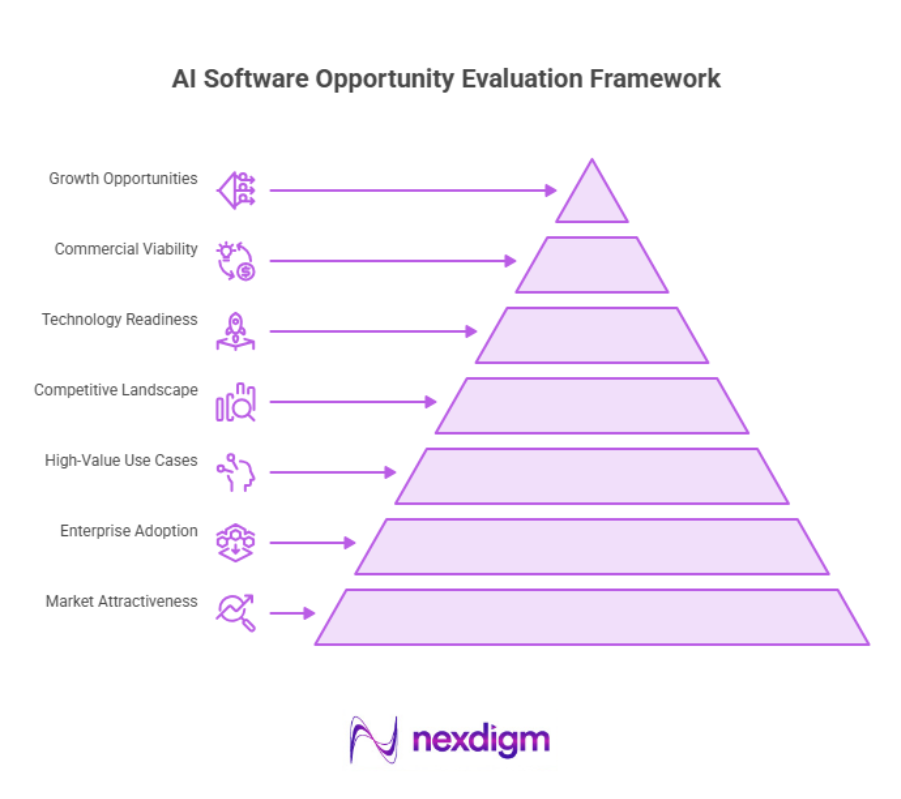
- Step 1: Assess Market Attractiveness
Evaluate market size, growth rates, investment activity, and competitive intensity to identify the most promising AI software segments. - Step 2: Analyze Enterprise Adoption & Demand
Assess adoption trends across industries, functions, and customer segments to understand market readiness and demand drivers. - Step 3: Prioritize High-Value Use Cases
Identify AI applications delivering measurable business outcomes, including productivity improvements, revenue growth, cost savings, and risk reduction. - Step 4: Evaluate the Competitive Landscape
Analyze key vendors, product capabilities, market positioning, and differentiation to uncover competitive advantages and whitespace opportunities. - Step 5: Assess Technology Readiness & Scalability
Review technology maturity, implementation requirements, data dependencies, and scalability to determine long-term viability. - Step 6: Validate Commercial Viability
Examine pricing models, monetization potential, customer willingness to pay, and value realization to assess market attractiveness. - Step 7: Prioritize Growth Opportunities
Combine market, customer, competitive, and technology insights to identify the most attractive areas for investment, expansion, and innovation.
As enterprise adoption scales, understanding where customer demand, use case viability, competitive intensity, and commercial potential intersect is essential for identifying sustainable growth opportunities and maximizing return on AI investments.
Driving Informed Decisions in the AI Software Market
As organizations navigate a rapidly evolving AI landscape, Nexdigm helps translate market complexity into actionable growth opportunities. Through AI software market potential studies, competitive intelligence, customer demand assessment, and strategic growth analysis, Nexdigm enables businesses, investors, and technology providers to evaluate opportunities, prioritize investments, and make informed decisions in high-growth AI software markets.
Nexdigm’s Case Study
A technology provider engaged with Nexdigm to assess AI software opportunities across enterprise use cases, adoption, and spending. The analysis identified priority segments with 19% higher projected demand, 15% stronger adoption potential, and 12% greater revenue opportunity, helping refine product priorities and focus commercial investment on higher-value AI applications.
To take the next step, simply visit our Request a Consultation page and share your requirements with us.
Harsh Mittal
+91-8422857704