

AI go-to-market strategies help convert innovation into commercial success by aligning advanced AI capabilities with clear customer needs, measurable business outcomes, and scalable sales models. As AI solutions move from experimentation to enterprise adoption, providers must define target segments, pricing structures, deployment models, partnerships, and adoption support. A strong market entry strategy ensures that AI offerings are positioned around practical value rather than technical novelty.
An effective AI solution go to market strategy enables providers to communicate differentiation, reduce buyer uncertainty, accelerate customer acquisition, and build sustainable revenue growth in increasingly competitive AI markets.
AI commercialization is accelerating as 88% of organizations reported regular AI use in at least one business function in 2025, up from 78% a year earlier. The global AI market was valued at approximately USD 390.9 billion in 2025 and is projected to reach USD 3,497.3 billion by 2033, growing at a 30.6% CAGR. These figures highlight the need for focused go-to-market strategies that convert adoption into revenue.
Assessing Market Demand for AI Solutions Across Enterprise Segments
Assessing market demand for AI solutions across enterprise segments involves evaluating customer needs, adoption readiness, budget availability, use case relevance, competitive gaps, and expected business outcomes.
- Customer Need Assessment: Evaluate enterprise pain points, operational challenges, automation gaps, and decision-making needs that AI solutions can address.
- Adoption Readiness Evaluation: Assess digital maturity, data availability, leadership support, workforce capability, and willingness to adopt AI-enabled solutions.
- Budget Availability Review: Analyze technology spending capacity, procurement priorities, investment timelines, and willingness to fund AI implementation.
- Use Case Relevance Mapping: Identify AI use cases aligned with enterprise functions, measurable outcomes, efficiency gains, and strategic business priorities.
Nexdigm’s Pricing and Monetization Strategy for AI Solution Market Entry
Nexdigm’s Pricing and Monetization Strategy for AI Solution Market Entry helps providers design scalable pricing models, assess customer willingness to pay, and define revenue streams. This support enables effective commercialization, stronger positioning, sustainable margins, and improved adoption across enterprise segments seeking measurable AI-driven business value.
Nexdigm’s Market Entry Strategy Support for AI Solution Commercialization
Nexdigm’s Market Entry Strategy Support for AI Solution Commercialization helps identify target segments, assess demand, define positioning, evaluate competition, and build go-to-market plans for scalable adoption:
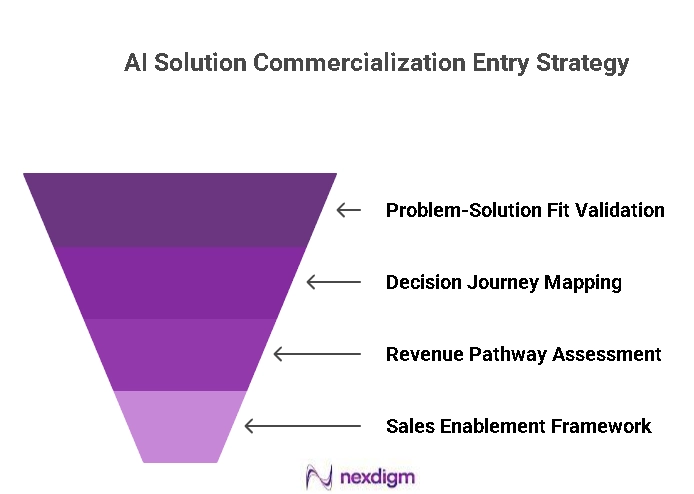
- Problem-Solution Fit Validation: Test whether the AI solution addresses urgent enterprise problems, not just broad digital transformation needs.
- Buyer Persona and Decision Journey Mapping: Identify economic buyers, technical evaluators, influencers, procurement stakeholders, and approval steps shaping AI purchase decisions.
- Revenue Pathway Assessment: Evaluate subscription, usage-based, outcome-linked, licensing, and service-led monetization routes for sustainable market entry.
- Sales Enablement Framework: Develop messaging, pitch materials, objection handling, demo narratives, and value calculators to support conversion.
Nexdigm’s case:
Nexdigm supported an AI solution provider convert innovation into commercial success through a structured market entry strategy. The engagement validated 9 enterprise buyer personas, assessed 14 priority use cases, and defined 5 proof-of-value metrics. Nexdigm’s support helped the company improve lead qualification accuracy by 26%, reduce go-to-market planning time by 30%, and build a scalable roadmap for revenue growth.
To take the next step, simply visit our Request a Consultation page and share your requirements with us.
Harsh Mittal
+91-8422857704