

AI platforms compete on model accuracy, processing scale, latency, infrastructure efficiency, deployment flexibility, and rapidly evolving commercial structures. An AI technology price competitiveness study helps businesses compare provider pricing and cost-to-capability differences across competing platforms.
Businesses can benchmark AI solutions, evaluate performance premiums, identify pricing gaps, and assess scalability economics using pricing analysis services. This can help them with competitive pricing benchmarking, AI platform cost comparison, and AI cost optimization to improve platform selection, sourcing decisions, and long-term AI investment value.
Comparative AI pricing scenarios reveal a 15%–35% hike in effective workload costs across platforms when accuracy, inference volumes, model tiers, and performance requirements vary. Pricing Analysis Services help quantify these gaps, optimize provider selection, and strengthen AI cost efficiency.
AI Pricing Analysis for Platform Performance, Scale, and Cost Competitiveness
AI pricing analysis helps enterprises improve sourcing, budget control, model selection, and long-term AI investment value. Its key dimensions provide a structured basis for comparing AI platforms across performance, scale, cost, and commercial efficiency, which involves:
- Model Accuracy and Output Quality: Compares prediction quality, reasoning reliability, response consistency, and task performance to determine whether higher-priced AI platforms deliver proportionate value for enterprise workloads.
- Inference Cost Analysis: Evaluates per-request, token, compute, or processing charges to understand how workload intensity influences effective AI costs across competing platforms and model tiers.
- Scalability Cost Efficiency: Measures how pricing changes as users, transactions, tokens, or workloads expand to identify platforms that support growth without disproportionate cost escalation.
- Infrastructure and Hosting Costs: Evaluates API, cloud, dedicated infrastructure, accelerator, and deployment expenses to understand the broader cost implications of operating AI platforms at scale.
- Context and Token Efficiency: Analyzes context-window requirements, token consumption, caching, and prompt efficiency to identify how usage patterns influence total AI expenditure across competing platforms.
Nexdigm’s Pricing Analysis Support for AI Platform Value and Scalability
Nexdigm supports enterprises in evaluating AI platforms through structured pricing analysis services, performance benchmarking, workload economics, and scalability assessment. Supported with AI pricing analysis, competitive pricing benchmarking, price-to-performance analysis, AI cost optimization and provider pricing comparison, Nexdigm helps organizations assess platform value, optimize model selection, strengthen sourcing decisions, control expenditure, and improve scalable AI investment outcomes.
Nexdigm’s AI Platform Pricing Roadmap for Performance and Cost Efficiency
Nexdigm’s AI platform pricing roadmap combines performance intelligence and scalability insights to help businesses optimize AI pricing decisions, cost efficiency, and long-term platform value. Its structured steps guide organizations from workload assessment through provider comparison and cost optimization. These steps are:
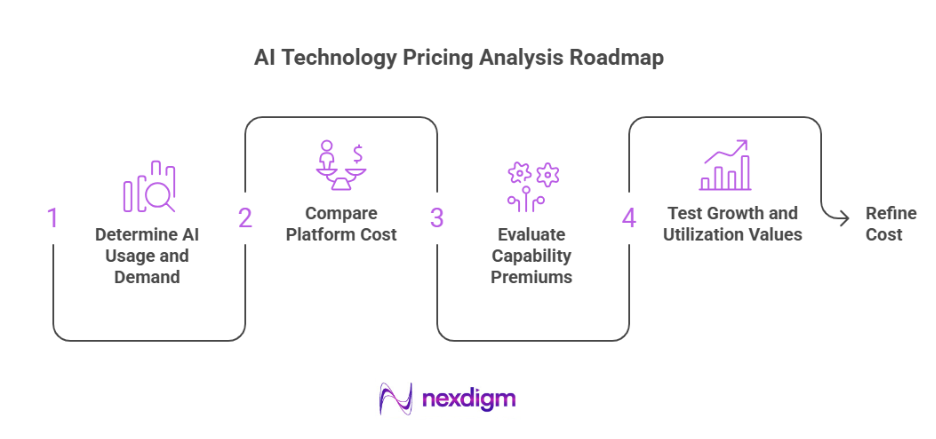
- Determine AI Usage and Demand: Map application volumes, token requirements, concurrency, latency expectations, and business criticality to establish realistic workload patterns for platform pricing evaluation.
- Compare Platform Cost Structures: Assess token rates, API charges, hosting fees, infrastructure requirements, discounts, and enterprise commitments to understand effective costs across competing AI providers.
- Evaluate Capability Premiums: Determine whether higher-priced platforms deliver sufficient gains in accuracy, reasoning, multimodal functionality, reliability, or throughput to justify incremental expenditure.
- Test Growth and Utilization Values: Model workload expansion, user adoption, processing intensity, and model-tier changes to understand how platform costs may evolve as enterprise AI usage scales.
- Prioritize Cost-Effective Platform Mix: Select and combine AI platforms according to workload complexity, performance requirements, commercial terms, and cost efficiency to optimize overall enterprise AI economics.
Nexdigm’s Case
Nexdigm supported AI platform optimization across model tiers and workloads. The engagement contributed to 21% lower premium-model expenditure, 15% improved workload allocation efficiency, and 10% stronger processing economics, enhancing cost control, scalability, and platform value.
To take the next step, simply visit our Request a Consultation page and share your requirements with us.
Harsh Mittal
+91-8422857704