

Air cargo remains critical for time-sensitive, high-value, and internationally traded products. E-commerce, pharmaceuticals, electronics, perishables, automotive components, and premium consumer goods continue creating demand for reliable and fast freight networks.
The market entered 2026 with strong momentum. IATA reported that global air-cargo demand increased 5.6% year-on-year in January 2026, while international demand grew 7.2%. Capacity increased by 3.6% globally, indicating that demand was expanding faster than available capacity.
The momentum continued during the year. However, air-cargo opportunities are not evenly distributed. Commodity characteristics, trade lanes, airport connectivity, aircraft capacity, freight rates, handling infrastructure, and shipper requirements can significantly affect route economics.
For airlines, cargo operators, freight forwarders, airports, logistics providers, manufacturers, e-commerce companies, investors, and infrastructure developers, the key question is if the target air-cargo market is attractive enough to justify entry
An air cargo market feasibility entry consulting approach helps evaluate commodity mix, route demand, airport capacity, pricing, infrastructure, and operating economics to determine where air-cargo entry can create sustainable commercial value.
Understanding the Current Air Cargo Market Dynamics
Air-cargo market attractiveness can change rapidly as demand, capacity, trade flows, and freight rates evolve. Monitoring these market dynamics helps stakeholders identify opportunities, assess risks, and prioritize high-potential entry markets.
- Demand vs. Capacity Trends: Evaluate whether cargo demand is growing faster than available air-freight capacity, creating potential market opportunities.
- Trade Lane Performance: Analyze growth across key cargo corridors to identify routes experiencing increasing shipment volumes and commercial demand.
- Freight Rate Developments: Review pricing trends and yield movements to understand market profitability and revenue potential.
- Airport Throughput Trends: Assess cargo volumes and throughput growth at major airports to identify emerging logistics hubs.
Understanding current market dynamics helps organizations identify favorable entry opportunities and adapt strategies to evolving air-cargo market conditions.
How Nexdigm Analyzes Air Cargo Opportunities
Identifying an attractive air-cargo market requires balancing demand potential, infrastructure readiness, competitive dynamics, and commercial viability. Nexdigm helps stakeholders assess these factors through a structured air cargo market feasibility entry consulting framework, enabling informed market-entry and investment decisions through:
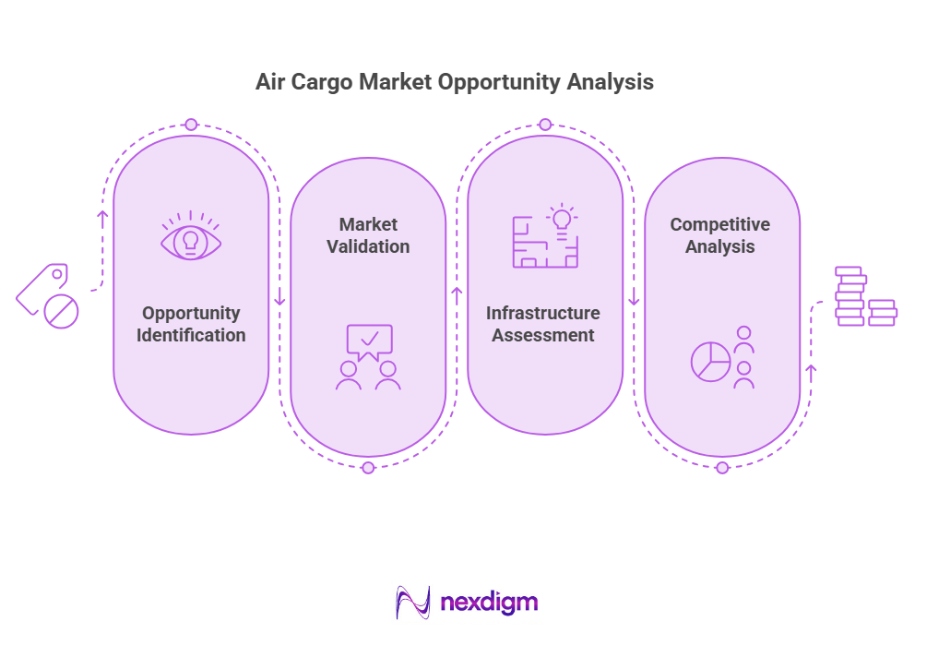
- Opportunity Identification: Identification of attractive air-cargo markets by analyzing cargo demand, trade flows, industry activity, and growth trends to uncover opportunities with strong commercial potential.
- Market Validation: Assessment of demand fundamentals, customer requirements, shipment volumes, and market conditions to determine whether a target market can support sustainable air-cargo operations.
- Infrastructure Assessment: Evaluation of airport capacity, cargo-handling facilities, storage infrastructure, connectivity, and operational capabilities to ensure efficient cargo movement and future scalability.
- Competitive Analysis: Analysis of existing cargo operators, service offerings, market share, pricing dynamics, and competitive gaps to identify differentiation and market-entry opportunities.
Nexdigm helps organizations transform market insights into practical air-cargo entry strategies that support sustainable growth and long-term value creation.
Benefits of Nexdigm’s Air Cargo Opportunity Assessment
Identifying an attractive air-cargo market requires a clear understanding of demand drivers, operational requirements, and commercial viability. Nexdigm’s air cargo market feasibility entry consulting approach helps stakeholders make informed decisions by:
- Improved Market Selection: Helps identify the most attractive markets by evaluating cargo demand, trade activity, competitive intensity, and long-term growth potential.
- Reduced Entry Risk: Provides data-driven insights into market conditions, operational challenges, and commercial uncertainties, enabling businesses to mitigate risks before investment.
- Stronger Investment Decisions: Supports capital allocation by assessing revenue potential, infrastructure requirements, operating costs, and expected returns across target markets.
- Enhanced Competitive Positioning: Identifies market gaps, customer needs, and service differentiation opportunities that can strengthen a company’s market presence.
Nexdigm’s opportunity assessment enables stakeholders to enter air-cargo markets with greater confidence, stronger commercial visibility, and a clearer path to sustainable growth.
Nexdigm in Enabling Confident Air Cargo Market Entry
Air-cargo investments involve significant operational and commercial commitments. Through its air cargo market feasibility entry consulting expertise, Nexdigm helps stakeholders validate opportunities, assess risks, and prioritize markets with the strongest potential for sustainable growth and profitability by providing the following benefits of:
- Data-Backed Decision Making: Replaces assumptions with market-driven insights, helping organizations make informed entry and investment decisions.
- Clear Opportunity Prioritization: Identifies and ranks opportunities based on demand potential, commercial attractiveness, and operational feasibility.
- Strategic Risk Visibility: Highlights potential challenges early, enabling stakeholders to develop effective mitigation strategies before market entry.
Nexdigm helps organizations move forward with greater certainty by transforming market insights into actionable and commercially viable decisions.
Nexdigm’s Case
A logistics provider engaged Nexdigm to evaluate airport capacity, cargo corridors, commodity flows, and shipper requirements before expanding its air-freight network. The analysis identified priority routes and capacity gaps, contributing to 16% higher projected cargo volumes, 13% improved utilization, and 11% lower network operating costs, strengthening expansion economics.
To take the next step, simply visit our Request a Consultation page and share your requirements with us.
Harsh Mittal
+91-8422857704