

Global air freight markets require disciplined pricing decisions across routes, products, capacity levels, and service commitments. Air cargo pricing analysis helps airlines, forwarders, and shippers evaluate demand patterns, load factors, fuel exposure, handling costs, urgency premiums, and competitive rates.
With the help of pricing analysis, businesses can identify underpriced capacity, refine contract and spot quotations, and protect margins. Data-driven insights also support faster responses to seasonal peaks, trade disruptions, and capacity shifts across complex international cargo networks worldwide.
Recent industry modelling shows data-driven air cargo pricing can outperform alternative strategies by over 3% in revenue. IATA reported record 2025 demand, up 3.4% year over year, while April 2026 volumes rose 4.0%, supporting stronger pricing analysis decisions.
Strategic Pricing Analysis for Air Cargo Capacity and Revenue Optimization
Air cargo pricing analysis helps carriers align capacity, demand, route economics, and service urgency to strengthen yields, improve load factors, protect margins, and support responsive revenue decisions across global networks. Key strategic steps of the same are:
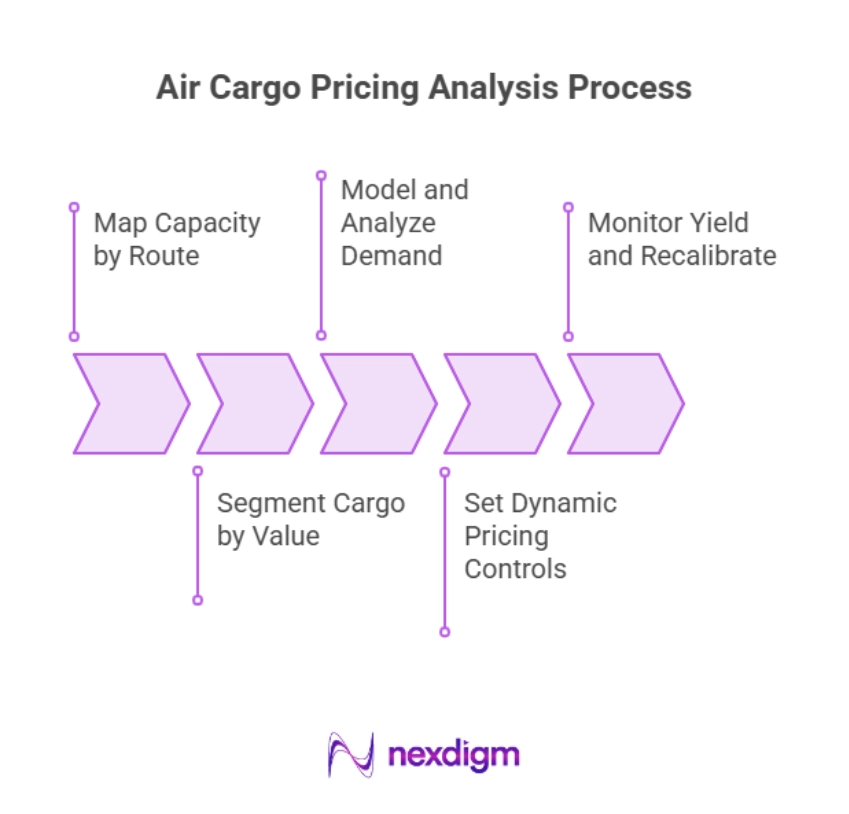
- Map Capacity by Route: Evaluate available belly and freighter space, flight frequency, seasonal constraints, and directional imbalances to identify where scarce capacity requires differentiated pricing and allocation of decisions.
- Segment Cargo by Value: Classify shipments by urgency, density, perishability, handling complexity, and customer sensitivity to create service-based rates that reflect operational requirements and willingness to pay accurately.
- Model and Analyze Demand: Analyze historical bookings, lead times, cancellations, and peak patterns to forecast demand, adjust rate availability, and prevent valuable capacity from being sold too early.
- Set Dynamic Pricing Controls: Establish pricing floors, surcharge rules, booking thresholds, and approval limits that respond to changing demand while preserving margin discipline and commercial consistency across sales channels.
- Monitor Yield and Recalibrate: Track revenue per kilogram, load factor, quote acceptance, route contribution, and unused capacity to refine pricing decisions and improve performance across successive booking cycles continuously.
Nexdigm’s Expertise in Air Cargo Pricing Analysis and Yield Optimization
Nexdigm’s advisory expertise in air cargo pricing and yield optimization combines air cargo pricing analysis, air freight pricing strategies, cargo yield management, and revenue optimization analysis to help businesses improve pricing decisions. By evaluating route profitability, capacity utilization, demand fluctuations, fuel costs, and market benchmarks, Nexdigm enables data-driven pricing strategies that enhance margins, optimize cargo allocation, strengthen revenue management, and improve competitiveness across dynamic global air freight networks.
Nexdigm’s Strategic Planning Model for Dynamic Air Cargo Pricing Analysis
Nexdigm’s structured approach combines dynamic pricing models, demand forecasting, capacity controls, and route-level analytics to help air cargo operators improve yields, responsiveness, and profitable allocation across changing global markets consistently. Some important frameworks and models used for the strategic process are:
- Demand Forecasting Model: Uses booking curves, seasonality, trade flows, and historical volumes to predict lane demand, supporting earlier pricing adjustments and stronger capacity allocation decisions across markets globally.
- Shipment Value Segmentation Model: Groups cargo by urgency, perishability, density, handling requirements, and customer value, supporting differentiated pricing aligned with operational complexity and service expectations across shipment categories.
- Competitive Rate Intelligence Model: Compares route-level quotations, market indices, forwarder rates, and capacity movements to identify pricing gaps and maintain competitive positioning without relying on broad discounting practices.
- Network Contribution Model: Evaluates cargo revenue across origin, destination, connection, and onward-routing combinations to prioritize bookings that deliver stronger total network value rather than isolated route margins.
Nexdigm’s Case
Nexdigm supported an international air cargo operator in redesigning its dynamic pricing strategy across major trade corridors. By applying yield optimization models, demand forecasting, and route-level pricing analytics, the engagement improved cargo yields by 14%, increased load factors by 11% and enhanced revenue visibility by 16% within eight months.
To take the next step, simply visit our Request a Consultation page and share your requirements with us.
Harsh Mittal
+91-8422857704