

Air cargo is often selected when shipment speed, product value or delivery commitments make other transportation modes unsuitable. However, air freight can represent a substantial logistics expense, particularly for businesses shipping high volumes across international markets.
The total cost of air cargo procurement is influenced by more than the quoted freight rate. Fuel surcharges, security charges, terminal handling, screening, documentation and destination fees can significantly affect the final amount paid.
For procurement teams, air cargo procurement cost benchmarking consulting provides a way to compare provider quotations, understand route-level cost differences and evaluate the commercial competitiveness of existing freight arrangements.
Understanding the Components of Air Cargo Costs
Air cargo pricing typically depends on chargeable weight, shipment dimensions, destination, cargo category and available capacity.
Chargeable weight is generally determined by comparing actual gross weight with volumetric weight. This means that lightweight but bulky consignments can attract higher charges than their physical weight might suggest.
The quoted freight rate is only one part of the total procurement cost. Other components may include:
- Freight and fuel charges: Base air freight rates, fuel adjustments and capacity-related pricing.
- Origin charges: Cargo handling, screening, documentation, terminal and security fees.
- Destination charges: Terminal handling, customs-related charges, storage and delivery fees.
Specialised shipments may involve additional expenses for temperature control, dangerous goods handling, high-value cargo security or special equipment.
A meaningful cost assessment must identify which charges are included in the quotation and which are billed separately.
Comparing Freight Rates Across Providers
Air cargo rates can vary considerably between airlines, freight forwarders and integrated logistics providers.
Differences may arise from route availability, flight frequency, aircraft capacity, transit arrangements, carrier relationships and seasonal demand.
Procurement teams should compare providers using standardised shipment profiles. The comparison should specify origin, destination, cargo type, chargeable weight, delivery timeline and required service scope.
Comparing quotations without standardising these details can produce misleading results. One provider may offer a lower rate for airport-to-airport transportation, while another may include additional handling or destination services.
Rate benchmarking should also account for contract conditions, including minimum shipment volumes, rate validity, peak-season adjustments and capacity commitments.
Route Economics and Trade Lane Variations
Route selection has a direct influence on air cargo expenditure.
Direct flights may reduce transit time and handling requirements but can carry higher freight rates. Connecting routes may offer lower quoted prices, although additional transfers can increase handling costs and expose shipments to delays.
Procurement teams should evaluate the economics of each trade lane rather than comparing providers only at an overall network level.
Important considerations include flight frequency, direct connectivity, available capacity, transit time, transshipment points and alternative routing options.
Geographical factors can also influence costs. Airport infrastructure, handling capacity, congestion, local operating charges and customs processes may vary between markets.
Businesses with regular international shipment volumes can use route-level benchmarking to identify where alternative carriers, consolidation arrangements or revised shipping schedules may improve cost efficiency.
Assessing Handling Charges and Additional Cost Exposure
Handling charges can vary according to the airport, cargo category, service provider and shipment requirements.
Origin and destination handling, screening, storage, documentation and customs brokerage should be reviewed separately to establish the complete cost of transportation.
Specialised cargo can introduce additional requirements. Pharmaceutical shipments may require temperature-controlled handling, while dangerous goods can involve specific documentation, acceptance procedures and handling arrangements.
Procurement teams should also examine storage and demurrage-related exposure where shipments are delayed or remain at airport facilities beyond permitted periods.
Invoice-level analysis is useful for identifying differences between contracted rates and actual charges. It can reveal recurring surcharges, inconsistent billing practices and cost components that were not clearly identified during supplier negotiations.
Evaluating Total Air Cargo Procurement Cost
The lowest freight rate does not always represent the lowest total logistics cost.
A provider offering cheaper transportation may use longer connecting routes or provide limited shipment visibility. Additional transit time can increase inventory carrying costs, while unreliable schedules may create production or customer service disruptions.
Businesses should therefore assess freight costs alongside transit performance, handling reliability, shipment damage, claims resolution and capacity availability.
A total cost comparison should incorporate freight, surcharges, origin and destination handling, customs-related expenses, specialised services and any additional costs associated with delays or route changes.
This provides a more accurate basis for supplier selection and commercial negotiation.
Air Cargo Procurement Cost Benchmarking Framework
A structured air cargo procurement cost benchmarking consulting exercise should include:
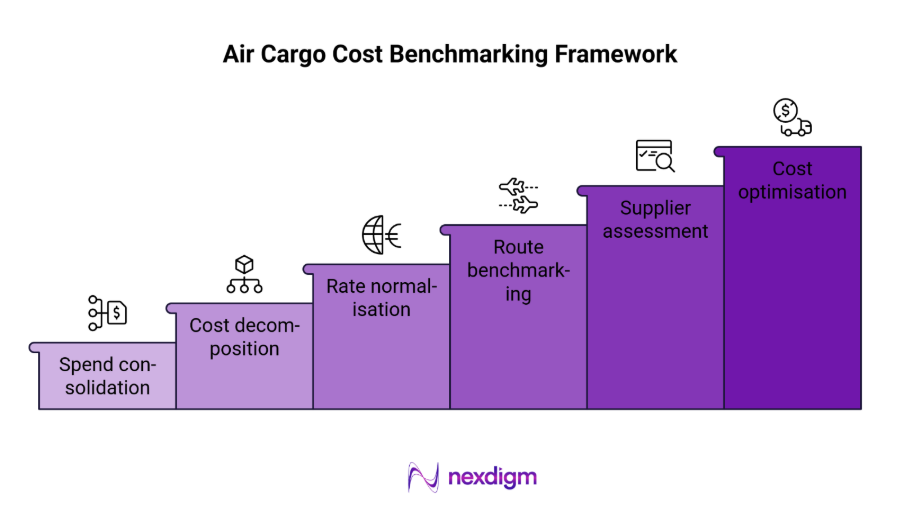
- Spend consolidation: Collect freight invoices, rate cards and shipment data across providers and trade lanes.
- Cost decomposition: Separate base freight, fuel surcharges, handling, screening, documentation and destination charges.
- Rate normalisation: Compare providers using equivalent cargo profiles, chargeable weights and service requirements.
- Route benchmarking: Evaluate direct and connecting routes, transit times, flight frequency and alternative trade lanes.
- Supplier assessment: Review pricing competitiveness, capacity, service reliability and contractual terms.
- Cost optimisation: Identify opportunities through carrier allocation, route changes, shipment consolidation and contract renegotiation.
Nexdigm can support organisations through air cargo market research, freight rate benchmarking, supplier intelligence and route-level procurement analysis. These services help businesses understand air freight cost structures, compare providers and identify opportunities to improve international transportation expenditure.
Nexdigm’s Case Study: Improving Air Freight Cost Visibility
Nexdigm benchmarked 11 air cargo providers across 5 international trade lanes, analysing freight rates, surcharges and handling costs. The assessment identified a 17% variation in comparable shipment costs, shortlisted 4 providers and established 7 route-level procurement benchmarks.
To take the next step, simply visit our Request a Consultation page and share your requirements with us.
Harsh Mittal
+91-8422857704