

Air cargo plays an important role in international trade, particularly for high-value products, time-sensitive shipments, pharmaceuticals, electronics and perishable goods. Businesses rely on airlines, freight forwarders, integrated logistics providers and specialised cargo operators to move shipments across international markets.
However, the air cargo vendor landscape is not defined by a single measure of market leadership. Providers differ in their geographical networks, available capacity, handling infrastructure, service models and expertise across specialised cargo categories.
For procurement teams, identifying the right provider requires an understanding of trade lane capabilities and the operational requirements associated with different shipment types.
Understanding the Air Cargo Vendor Landscape
Air cargo services are delivered through several provider categories, each offering different capabilities.
- Cargo airlines: These operators provide dedicated freighter capacity and scheduled cargo services across domestic and international routes. Their suitability depends on network coverage, available capacity and schedule reliability.
- Passenger airlines with belly cargo capacity: These carriers transport cargo in the lower-deck compartments of passenger aircraft. Their networks can provide access to destinations with frequent passenger services, although cargo capacity may fluctuate with passenger demand and aircraft deployment.
- Freight forwarders: Forwarders coordinate shipments across multiple airlines, manage documentation and arrange customs clearance and other logistics services. They can provide flexibility by sourcing capacity from different carriers.
- Integrated logistics providers: These companies combine air transportation with warehousing, customs brokerage, ground transportation and distribution services.
- Specialised cargo operators: These providers focus on pharmaceuticals, perishables, dangerous goods, live animals and other shipments requiring specialised handling.
Each category should be evaluated according to the shipper’s operational requirements rather than treated as directly interchangeable.
Comparing Major Trade Lanes and Market Capabilities
Air cargo performance varies across international trade lanes. Capacity availability, transit schedules, airport infrastructure, customs procedures and regional demand influence provider suitability.
Important corridors include:
- Asia-Pacific to Europe: Important for electronics, automotive components, industrial products and e-commerce shipments.
- Asia-Pacific to North America: A major corridor for technology products, consumer goods and manufacturing supply chains.
- Europe to North America: Supports pharmaceutical, automotive, industrial and high-value commercial shipments.
- Middle East to Asia: Connects manufacturing centres with international distribution markets through major aviation hubs.
- Intra-Asian routes: Support regional manufacturing networks and cross-border distribution.
According to IATA’s 2025 full-year air cargo data, global cargo demand increased by 3.4% compared with 2024, while available cargo capacity increased by 3.7%. The same data showed varying regional performance, highlighting why procurement decisions should consider individual corridors rather than global averages alone.
Evaluating Air Cargo Vendors Across Service Requirements
The most suitable provider depends on shipment characteristics and service expectations.
Procurement teams should compare the following parameters:
- Network coverage: Examine the number of destinations served, direct flight availability and access to major cargo hubs.
- Capacity availability: Assess aircraft capacity, booking flexibility, frequency and seasonal constraints.
- Transit reliability: Compare scheduled and actual delivery times, delays and shipment handling efficiency.
- Cargo specialisation: Review capabilities for pharmaceuticals, perishables, dangerous goods and high-value products.
- Technology and visibility: Evaluate shipment tracking, electronic documentation and exception notifications.
- Commercial performance: Compare freight rates, fuel surcharges, handling charges, capacity commitments and contractual terms.
Specialised cargo capabilities require particular attention. For pharmaceutical shipments, temperature-controlled infrastructure, trained personnel, documented handling procedures and monitoring systems are important.
IATA’s CEIV Pharma certification provides an industry-recognised assessment framework for pharmaceutical logistics, covering quality management, personnel, infrastructure, documentation, supplier management and transportation processes.
Air Cargo Service Vendor Landscape Framework
An air cargo service vendor landscape assessment should combine market mapping with trade lane benchmarking and service-level evaluation.
A practical framework includes:
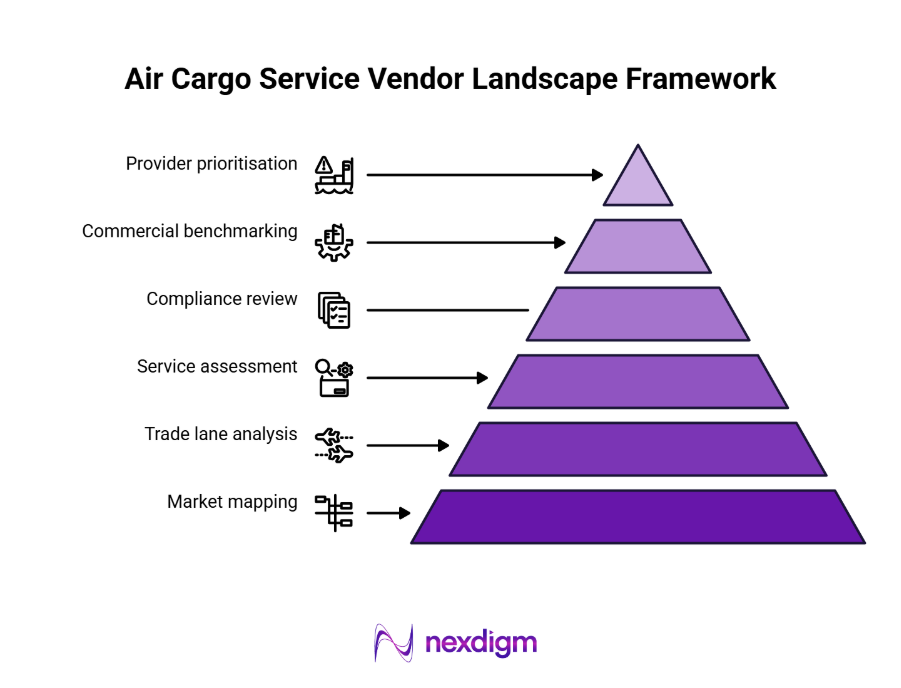
- Market mapping: Identify cargo airlines, passenger carriers, freight forwarders and integrated logistics providers operating across target markets.
- Trade lane analysis: Compare direct connectivity, transit schedules, available capacity and alternative routing options.
- Service assessment: Evaluate shipment handling, cargo specialisation, tracking and delivery reliability.
- Compliance review: Examine aviation security requirements, customs processes, cargo documentation and relevant industry certifications.
- Commercial benchmarking: Compare freight rates, surcharges, capacity commitments and contractual flexibility.
- Provider prioritisation: Rank vendors according to route suitability, service requirements, operational reliability and total transportation cost.
Nexdigm can support organisations through air cargo market research, supplier identification, trade lane benchmarking and comparative vendor assessments. These services help procurement teams understand provider capabilities, identify suitable service models and evaluate commercial and operational considerations across international markets.
Nexdigm’s Case Study
Nexdigm assessed 10 air cargo providers across 3 major international trade corridors, comparing capacity, transit times, route connectivity and pricing. The research identified 4 preferred providers, highlighted 15% cost variations across comparable routes and helped establish a trade lane-based supplier allocation strategy.
To take the next step, simply visit our Request a Consultation page and share your requirements with us.
Harsh Mittal
+91-8422857704