

Air cargo is an important transportation option for businesses handling time-sensitive, high-value and specialised shipments. Electronics, pharmaceuticals, automotive components, perishables and industrial equipment often require faster transportation than conventional ocean or road freight can provide.
However, selecting an air cargo provider involves more than comparing transit times and freight rates. Airline connectivity, cargo capacity, airport handling infrastructure, specialised cargo capabilities and service reliability all influence the suitability of a provider.
For procurement teams, the objective is to identify operators that can meet specific trade lane requirements while maintaining commercially viable and dependable service arrangements.
Understanding the Air Cargo Provider Landscape
Air cargo services are delivered through several provider categories.
- Dedicated cargo airlines operate freighter aircraft and provide scheduled or chartered cargo capacity.
- Passenger airlines offer cargo space in aircraft belly holds, providing access to destinations served by their passenger networks.
Freight forwarders coordinate shipments across multiple airlines and can provide access to different routes, handling facilities and consolidation services. Integrated logistics providers combine air transportation with customs brokerage, warehousing and ground transportation.
These providers are not directly interchangeable. A manufacturer shipping large volumes of industrial components may prioritise dedicated cargo capacity, while a business shipping smaller consignments across several destinations may prefer a freight forwarder with a broad carrier network.
Evaluating Trade Lane Connectivity and Capacity
Trade lane suitability should be assessed at the origin-destination level.
A provider may operate an extensive international network but offer limited direct connectivity between the specific markets required by a business. Connecting routes can increase transit times and expose shipments to additional handling and transfer delays.
Procurement teams should examine flight frequency, direct connections, available capacity, transshipment arrangements and alternative routing options.
Capacity availability also varies according to season, aircraft deployment and competing demand. Businesses should establish whether providers can support regular shipments, peak-period volumes and specialised equipment requirements.
Service Quality, Specialised Handling and Compliance
Transit time alone does not establish air cargo service quality. Shipment acceptance, cargo handling, documentation, customs coordination and final delivery all influence end-to-end performance.
For pharmaceutical shipments, suppliers should demonstrate appropriate temperature-controlled infrastructure and documented handling procedures. Perishable cargo requires suitable storage, monitoring and transfer arrangements.
Specialised cargo certifications and facility assessments can provide additional assurance regarding operational procedures and handling capabilities.
Cargo handling infrastructure should also be assessed. Procurement teams should review equipment availability, handling capacity, security arrangements and the ability to accommodate unusual or high-value shipments.
Other important evaluation considerations include shipment tracking, cargo damage rates, claims handling, documentation accuracy and exception management.
Commercial Comparison and Provider Selection
Air cargo pricing depends on chargeable weight, shipment dimensions, destination, capacity availability, cargo category and delivery requirements.
A meaningful comparison should include base freight, fuel surcharges, security fees, screening, terminal handling, documentation and destination charges.
Procurement teams should also distinguish between airport-to-airport and door-to-door services. A competitive air freight quotation may exclude customs brokerage, local transportation and final delivery.
Contractual evaluation should cover rate validity, minimum volume commitments, capacity allocation, claims provisions and service-level requirements.
Nexdigm’s Air Cargo Supplier Evaluation Framework
A structured air cargo supplier evaluation consulting exercise should include:
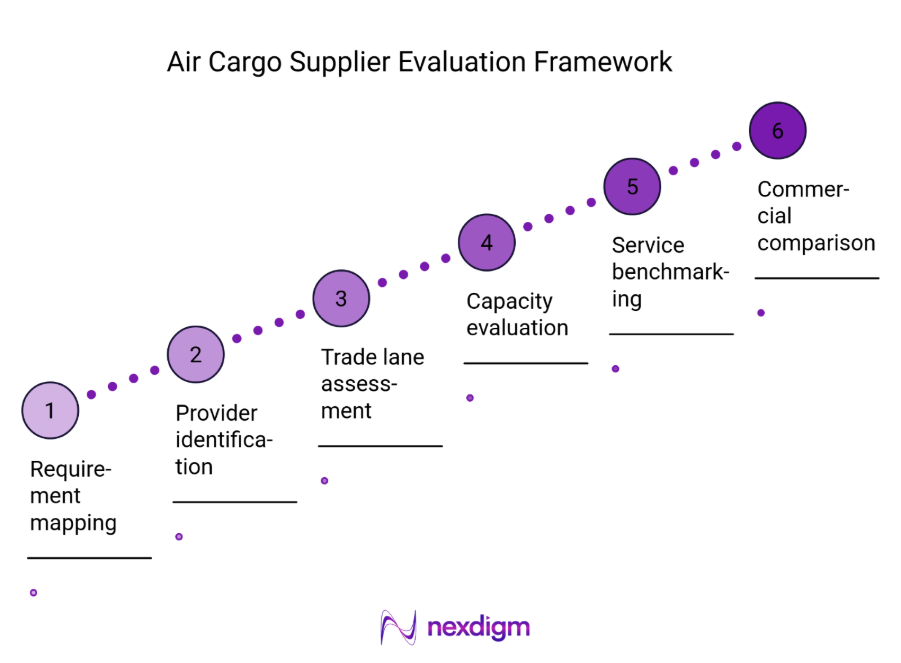
- Requirement mapping: Define cargo categories, shipment volumes, priority markets and delivery timelines.
- Provider identification: Map cargo airlines, passenger carriers, freight forwarders and integrated logistics operators.
- Trade lane assessment: Compare direct connectivity, flight frequency, transit schedules and alternative routes.
- Capacity evaluation: Review booking availability, peak-season flexibility and specialised cargo infrastructure.
- Service benchmarking: Assess handling quality, tracking, documentation, compliance and delivery reliability.
- Commercial comparison: Evaluate freight rates, surcharges, capacity commitments and contractual conditions.
Nexdigm can support organisations through air cargo market research, provider identification, trade lane benchmarking and supplier due diligence. These services help businesses compare cargo providers against specific shipment requirements and identify suitable partners across international markets.
Nexdigm’s Case Study: Matching Air Cargo Providers to Critical Trade Lanes
Nexdigm assessed 12 air cargo providers across 5 international trade lanes, comparing capacity, transit schedules, handling infrastructure and pricing. The research shortlisted 4 providers, identified an 18% variation in comparable freight costs and established 7 trade lane performance benchmarks.
To take the next step, simply visit our Request a Consultation page and share your requirements with us.
Harsh Mittal
+91-8422857704