

Air freight demand is not growing evenly across products or trade lanes. Its strongest opportunities remain concentrated in goods where speed, reliability, product value, or the cost of delay justify a premium over ocean and surface transport.
Global air cargo demand increased 3.4% in 2025, reaching a record level. Asia-Pacific was the strongest regional market, with demand up 8.4%. The shift was also visible across trade lanes: Europe-Asia grew 10.3%, intra-Asia 10.0%, while Asia-North America declined 0.8% for the year.
For airlines, airports, freight forwarders, and logistics providers, the opportunity is therefore to identify which product flows are structurally suited to air and which corridors can support sustained demand.
High-Value Products Continue to Anchor Air Freight
Air freight makes the strongest economic sense when the value or urgency of a shipment outweighs its higher transportation cost.
The dependence on air is particularly striking for certain products. More than 99% of global trade in memory chips and gold is transported by air. Pharmaceuticals also show a high dependence on the mode, with approximately 72% of vaccine trade by value moving by air. For highly time-sensitive perishables such as fresh-cut roses and truffles, the share is around 82%.
These flows create several distinct demand pools:
- Semiconductors and electronics
- Pharmaceuticals and medical products
- High-value industrial components
- Time-sensitive perishables
- Aerospace and automotive components
- Urgent replacement parts
The important variable is not simply industry growth. It is whether the underlying product has enough value density, urgency, or sensitivity to sustain air freight usage.
AI Is Creating a New High-Value Cargo Pool
AI infrastructure has become an important driver of air cargo demand.
In 2025, more than two-thirds of AI-related trade by value was transported by air, while air cargo consignments of AI-related goods increased 20% year on year. AI-related products represented 53.5% of the total value of air-transported trade but only 7% of its volume, demonstrating how strongly value density can influence mode selection.
The implications extend beyond semiconductors. Servers, memory, data-storage equipment, networking components, and other technology hardware can require rapid movement between manufacturing locations and data-centre markets.
This creates demand around production clusters rather than simply around traditional air cargo hubs.
Asia Is Driving the Expansion of Key Cargo Flows
Asia remains central to the air freight opportunity. It accounted for 35.8% of global air cargo traffic in 2025, the largest regional share, while demand from Asia-Pacific carriers increased 8.4%.
The growth is increasingly connected to regional manufacturing and sourcing networks. Intra-Asia demand rose 10.0% in 2025, reflecting the importance of movements between Asian production centres.
Europe-Asia was even stronger. The corridor grew 10.3% in 2025 and represented 21.5% of global international air cargo demand, making it one of the most important growth corridors for manufacturing inputs, high-value goods, and time-sensitive shipments.
This suggests that air freight opportunity is increasingly tied to the reconfiguration of supply chains within and around Asia.
Corridor Growth Can Change Quickly
Trade lanes also need to be assessed dynamically. The Asia-North America corridor accounted for 23.5% of global air cargo demand, but its full-year demand declined 0.8% in 2025 as tariff changes and the removal of the US de minimis exemption affected trade flows.
By June 2026, however, Asia-North America demand had rebounded sharply, growing 14.7% year on year. Europe-Asia increased another 7.1%, while intra-Asia grew 7.2%.
For capacity planners, this volatility matters. A corridor experiencing rapid growth may reflect a structural change in sourcing or a temporary trade response. Distinguishing between the two is essential before adding aircraft capacity, warehouse space, or dedicated services.
The Best Opportunities Combine Product and Corridor Strength
A growing product category does not automatically create an attractive air freight market. The opportunity becomes stronger when product characteristics align with a corridor that has sufficient volume, manufacturing concentration, and limited practical alternatives.
Assessment should therefore examine:
- Product value, weight, and urgency
- Shipment frequency and seasonality
- Manufacturing and consumption clusters
- Existing air cargo capacity and frequencies
- Ocean and surface alternatives
- Forwarder and shipper concentration
- Structural versus temporary demand
- Pricing and yield potential
This helps distinguish a durable cargo opportunity from a short-lived spike caused by tariffs, inventory front-loading, production disruptions, or exceptional events.
How Nexdigm Identifies the Air Freight Opportunities Worth Pursuing
Nexdigm’s air freight market demand assessment connects product-level demand with corridor economics to identify sustainable opportunities.
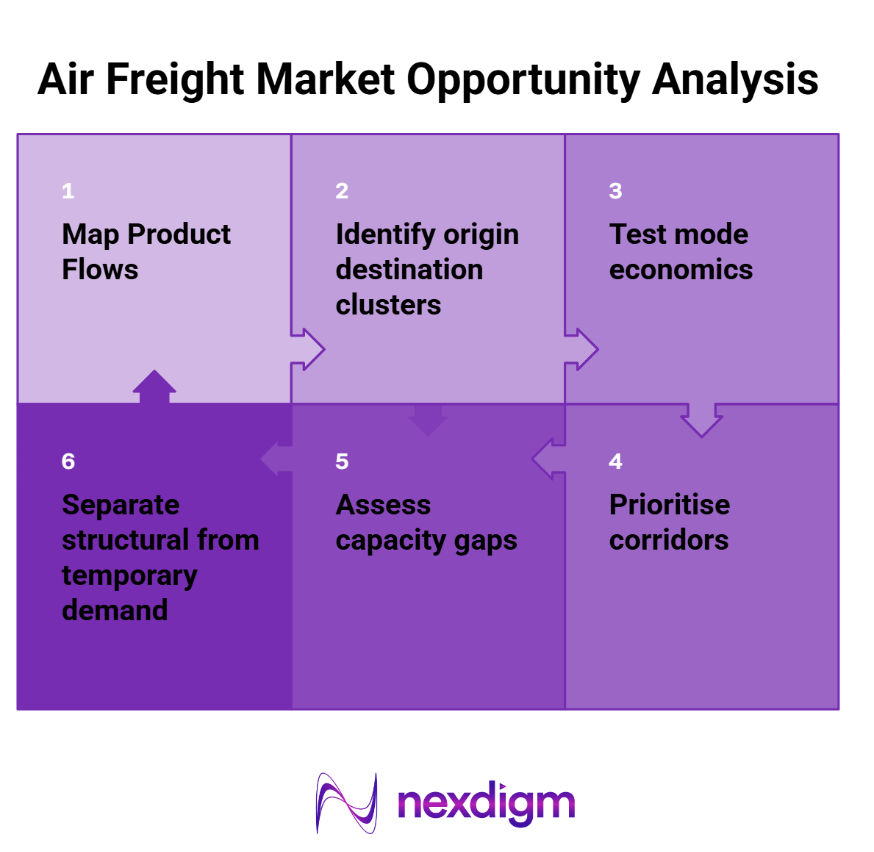
- Map product flows: Analyse commodity volumes, shipment values, frequency, and time sensitivity to identify products with a structural propensity for air freight.
- Identify origin-destination clusters: Map manufacturing centres, consumption markets, airports, and emerging sourcing locations.
- Test mode economics: Compare air with ocean, road, rail, and multimodal alternatives, including inventory costs and the financial impact of delays.
- Separate structural from temporary demand: Analyse historical trends, seasonality, trade-policy changes, disruptions, and front-loading effects.
- s:Assess capacity gap Examine frequencies, cargo capacity, airport infrastructure, forwarder presence, and incumbent service levels.
- Prioritise corridors: Rank product-corridor combinations by addressable volume, growth, value density, capacity constraints, pricing potential, and competitive intensity.
How Nexdigm Prioritised High-Value Air Freight Corridors
A logistics provider handling 2.8 million tonnes annually wanted to expand beyond established routes. Nexdigm assessed 14 product categories across 22 corridors, identifying six high-value electronics, pharmaceutical, and industrial cargo lanes. Prioritising these corridors increased projected cargo volume by 19% and expected yield by 11%.
To take the next step, simply visit our Request a Consultation page and share your requirements with us.
Harsh Mittal
+91-8422857704