

The air freight sector faces significant demand volatility driven by seasonal peaks, fuel price fluctuations, and shifting trade patterns. Air freight market intelligence provides businesses with critical insights into capacity trends, competitor strategies, and regional demand shifts. By leveraging competitive intelligence, companies can optimize routing, manage costs, anticipate market disruptions, and make data-driven decisions, ensuring resilience and efficiency in an increasingly dynamic and competitive global air cargo environment.
Global air freight demand has shown continued resilience with air cargo volumes growing 5.5 % year‑on‑year in late 2025, driven by key trade lanes such as Asia‑Pacific and Europe, while capacity increased 4.7 % over the same period. Some regions like Africa recorded even stronger expansion. Demand growth has moderated from earlier peaks but remains positive, reflecting ongoing trade activity and e‑commerce influences on global air freight markets.
Understanding Air Freight Volatility Through Competitive Intelligence
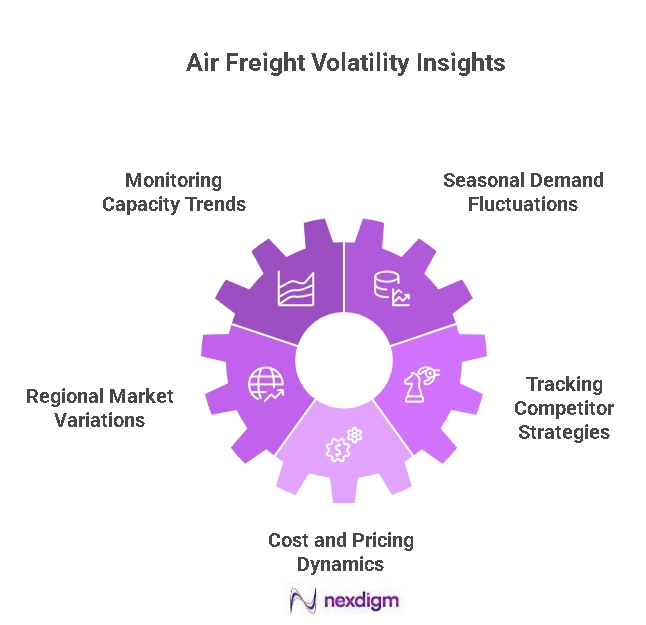
Understanding air freight volatility through competitive intelligence involves analyzing demand fluctuations, capacity constraints, seasonal trends, and competitor strategies, enabling businesses to make informed decisions and optimize logistics in dynamic markets:
-
Monitoring Capacity Trends
Competitive intelligence tracks airline fleet utilization, route capacity, and cargo availability to anticipate supply-demand imbalances in air freight operations.
-
Analyzing Seasonal Demand Fluctuations
Tracking peak seasons, holidays, and industry cycles helps businesses predict cargo volume changes and optimize resource allocation.
-
Assessing Regional Market Variations
Competitive insights highlight differences in demand, capacity, and pricing across regions, guiding strategic routing and operational planning.
-
Tracking Competitor Strategies
Monitoring competitors’ pricing, service levels, and capacity deployment enables proactive adjustments and competitive advantage.
-
Evaluating Cost and Pricing Dynamics
Analyzing fuel costs, tariffs, and market rates allows businesses to optimize pricing strategies and maintain profitability.
Nexdigm Solutions to Optimize Air Freight Operations
Nexdigm solutions optimize air freight operations by combining competitive intelligence, predictive analytics, and data-driven insights. They help businesses forecast demand, manage cost fluctuations, streamline carrier and route selection, and mitigate operational risks. By providing real-time monitoring, regional market insights, and scenario planning tools, Nexdigm enables organizations to improve efficiency, reduce delays, and maintain a strategic advantage in volatile global air freight markets.
Forecasting Air Cargo Demand with Nexdigm’s Predictive Intelligence
Nexdigm’s predictive intelligence forecasts air cargo demand by analyzing historical trends, market dynamics, and competitor data, enabling businesses to optimize capacity, plan routes efficiently, manage costs, and mitigate operational risks.
-
Analyzing Historical Freight Data
Nexdigm evaluates past air cargo volumes, seasonal trends, and trade patterns to inform accurate demand forecasting and planning.
-
Monitoring Market Dynamics
Tracking shifts in global trade, fuel costs, and capacity constraints helps anticipate demand fluctuations and optimize operations.
-
Incorporating Competitive Intelligence
Analyzing competitor pricing, route strategies, and capacity allocation allows businesses to make informed, proactive freight decisions.
-
Predictive Analytics for Demand Planning
AI-driven models forecast future cargo volumes, helping allocate resources, optimize routes, and reduce operational inefficiencies.
-
Regional and Trade-Lane Insights
Understanding demand variations across regions and corridors guides strategic planning for cross-border and domestic air freight operations.
Nexdigm’s case:
Nexdigm assisted a diagnostics manufacturer in optimizing its distribution network, improving demand planning and warehouse utilization. The engagement delivered 16 % cost savings through better freight and inventory strategies, boosted service levels by 7 %, and, with strategic warehouse adjustments, generated an additional 27 % reduction in overall supply chain costs. These improvements enhanced logistics efficiency and operational resilience.
To take the next step, simply visit our Request a Consultation page and share your requirements with us.
Harsh Mittal
+91-8422857704