

Time-sensitive air freight lanes face sharp cost swings driven by fuel prices, capacity shortages, seasonal demand, geopolitical disruptions, and service urgency. Air freight rate benchmarking research enables shippers, forwarders, and carriers to compare lane-level charges, surcharges, transit commitments, and market movements through structured pricing analysis.
By identifying rate outliers and cost-to-serve differences, organizations can strengthen negotiations and select commercially sustainable service options. Reliable benchmarks also support faster repricing, better contract governance, stronger budget control, and margin visibility across high-value international trade corridors during volatile market conditions globally.
Recent industry studies found data-driven air cargo pricing delivered more than 3% higher revenue than alternative strategies. Meanwhile, May 2026 global spot rates reached $3.40 per kilogram, up 41% year over year, demonstrating importance of pricing analysis.
Market-Based Air Freight Pricing Analysis Across Global Lanes
Market-based air freight rate analysis helps organizations benchmark global lanes, compare pricing structures, reduce cost variability, strengthen negotiations, and improve commercial decisions across time-sensitive cargo networks worldwide. Core benefits of air freight pricing analysis are:
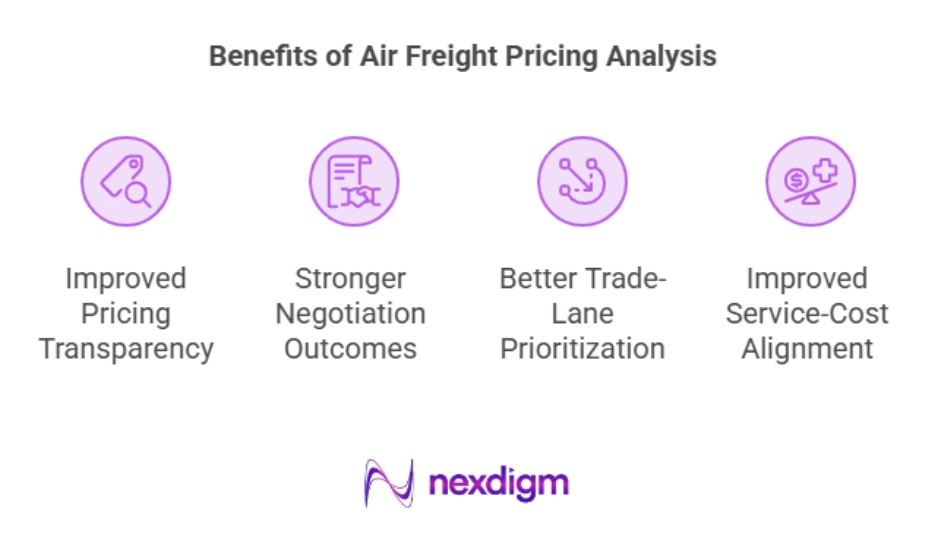
- Improved Pricing Transparency: Pricing analysis exposes differences in freight rates, surcharges, and service premiums across lanes, helping businesses understand market movements and eliminate unsupported pricing inconsistencies effectively.
- Stronger Negotiation Outcomes: Access to market benchmarks equips procurement teams with evidence-based insights, enabling more balanced negotiations and improving leverage with airlines, forwarders, and logistics providers.
- Better Trade-Lane Prioritization: Rate comparisons highlight lanes with excessive cost variability or limited competition, helping teams focus negotiation resources on routes with the greatest savings potential.
- Improved Service-Cost Alignment: Pricing analysis compares premium rates with transit speed, handling quality, and capacity guarantees, ensuring higher charges are supported by measurable service value.
Nexdigm’s Advisory Role in Offering Air Freight Pricing Analysis
Nexdigm’s advisory expertise in global air freight rate benchmarking combines pricing analysis, air freight rate benchmarking research, logistics cost optimization, and freight pricing intelligence to help businesses strengthen procurement and commercial decisions. By evaluating lane economics, market trends, surcharge structures, and capacity dynamics, Nexdigm enables data-driven pricing strategies that improve cost visibility, optimize negotiations, reduce pricing variability, and enhance profitability across global air cargo networks.
Nexdigm’s Trade-Lane Air Freight Pricing and Benchmarking Framework
Nexdigm’s framework combines trade-lane benchmarking, cost intelligence, capacity signals, and pricing governance to help air freight businesses improve rate decisions, control volatility, and strengthen commercial outcomes across global networks consistently. Major strategies used in the framework model are:
- Lane Segmentation Strategy: Classifies corridors by urgency, shipment profile, capacity availability, seasonality, and cost volatility, enabling more relevant benchmarks and differentiated pricing decisions across diverse trade lanes globally.
- Market Index Alignment Strategy: Links internal rates with external market indices, spot movements, and carrier benchmarks, helping organizations detect pricing gaps and respond quickly to changing freight conditions worldwide.
- Time-Sensitivity Pricing Strategy: Aligns rate benchmarks with delivery urgency, cut-off requirements, and recovery options, ensuring premium prices reflect genuine speed and service advantages rather than general market pressure.
- Carrier Performance Strategy: Combines pricing data with on-time delivery, capacity fulfillment, claim rates, and disruption response, helping organizations compare providers on total value instead of rate alone.
Nexdigm’s Case
Nexdigm supported a global shipper in benchmarking air freight rates across priority trade lanes. By applying capacity-pressure mapping, surcharge normalization, and carrier performance analysis, the engagement reduced freight costs, improved rate transparency by 18%, shortened sourcing cycles by 14%, and increased on-time delivery performance within seven months.
To take the next step, simply visit our Request a Consultation page and share your requirements with us.
Harsh Mittal
+91-8422857704