

Benchmarking air logistics pricing strategies help carriers and logistics providers compare rates, service levels, and commercial performance across pharmaceuticals, electronics, perishables, aerospace components, and other urgent shipments. This air logistics pricing strategy benchmarking approach applies pricing analysis to evaluate speed premiums, route economics, and customer willingness to pay.
By identifying competitive gaps and best practices, businesses can improve rate structures, strengthen market positioning, protect margins, and align premium pricing with measurable service value across high-value and time-critical cargo categories in global trade lanes and regional markets.
Air cargo represents close to one-third of global trade value while accounting for less than 1% by weight. Global demand also exceeded 280 million cargo tonne-kilometers annually, reinforcing opportunities for benchmark-led pricing analysis, service differentiation, stronger yields, and profitable category specialization.
Pricing Analysis and Benchmarking Across High-Value Air Cargo Categories
Pricing analysis and benchmarking help air cargo providers compare category economics, service requirements, customer expectations, and competitor rates to establish differentiated, profitable pricing for urgent and high-value shipments globally. Strategic steps of the procedure are:
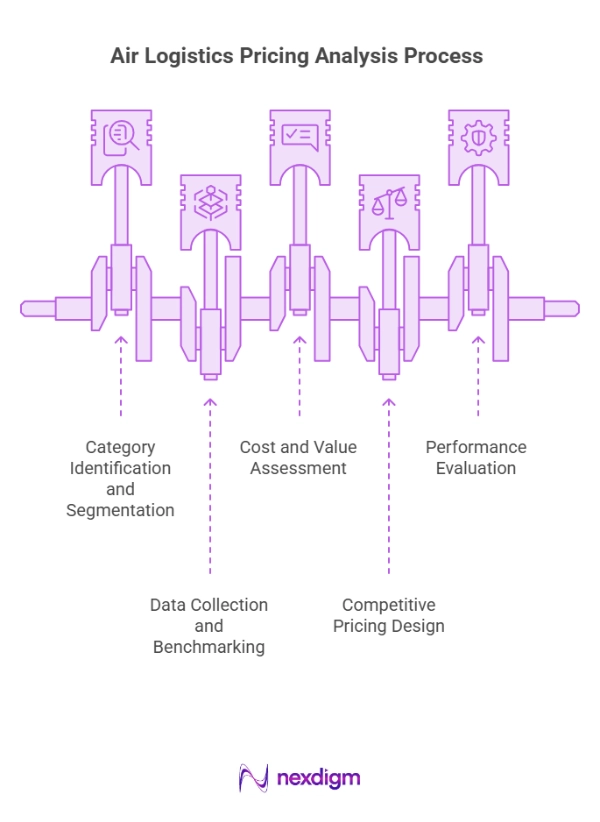
- Category Identification and Segmentation: Classify pharmaceuticals, electronics, perishables, aerospace components, and luxury goods based on urgency, value, handling complexity, risk exposure, and service expectations.
- Data Collection and Benchmarking: Gather competitor rates, internal pricing, surcharges, transit times, capacity trends, and contractual commitments to establish reliable benchmarks across cargo categories.
- Cost and Value Assessment: Evaluate operating costs, shipment criticality, customer willingness to pay, and service requirements to determine sustainable pricing thresholds and premium opportunities.
- Competitive Pricing Design: Develop differentiated rates, surcharges, and pricing structures by comparing market positioning, route economics, and category-specific service advantages across networks.
- Performance Evaluation: Track yield, margins, conversion rates, reliability, and capacity utilization to continuously refine benchmarks and improve category-level pricing performance.
How Nexdigm Supports Pricing Analysis and Benchmarking for High-Value Air Cargo
Nexdigm supports air cargo providers through data-driven pricing analysis, competitive benchmarking, category segmentation, and cost-to-serve assessment. Its expertise in high-value air cargo pricing, freight rate benchmarking, market intelligence, and revenue optimization helps businesses design differentiated rates for urgent shipments. This approach strengthens pricing competitiveness, protects margins, improves service value, and supports sustainable growth across specialized global logistics networks.
Nexdigm’s Strategic Model for Air Cargo Pricing Analysis and Positioning
Nexdigm’s strategic model combines category economics, customer value, competitive intelligence, and service differentiation to guide profitable pricing, stronger positioning, and sustainable growth across specialized air cargo segments worldwide. Features of the strategic model are:
- Cargo Category Ranking: Ranks shipment categories by urgency, product value, delay exposure, regulatory sensitivity, and operational complexity to support differentiated pricing and positioning decisions.
- Service Alignment: Connects pricing with guaranteed uplift, handling standards, temperature control, security, tracking visibility, and delivery commitments across specialized cargo offerings.
- Margin-Sensitivity Mapping: Identifies how fuel, handling, insurance, compliance, and disruption costs affect profitability across categories, helping establish defensible pricing floors and premium thresholds.
- Category Lifecycle Management: Adjusts pricing as cargo categories evolve through growth, maturity, disruption, or declining demand, ensuring continued relevance and sustainable commercial performance.
- Competitive Planning: Defines pricing actions for competitor discounts, capacity additions, route launches, service upgrades, and market exits to support faster commercial decision-making.
Nexdigm’s Case
Nexdigm helped an air cargo provider refine category pricing, competitive positioning, and premium-service benchmarks. Over nine months, the modeled initiative increased yield by 12%, improved quote conversion by 9%, and strengthened contribution margins by 8% across specialized, high-value cargo segments.
To take the next step, simply visit our Request a Consultation page and share your requirements with us.
Harsh Mittal
+91-8422857704