

Air cargo growth is increasingly exposing a different constraint: the infrastructure required to process freight once it reaches the airport. Global demand reached a record level in 2025, with cargo tonne-kilometres rising 3.4% year on year. In June 2026, demand was up another 8.5%, while available cargo capacity increased only 4.4%.
The gap matters because airport capacity is not simply a question of how many aircraft can land. Cargo terminals, warehouses, ramps, screening facilities, customs, truck access and specialised storage all determine how much freight an airport can actually process.
Cargo Growth Is Starting to Test Infrastructure Headroom
The pressure is particularly visible on important trade corridors. In 2025, Asia-Europe air cargo demand increased 10.3%, while intra-Asia demand rose 10.0%. Asia-Pacific airlines also recorded 8.4% annual demand growth for the year.
This creates a planning problem for airport operators. A terminal can have theoretical capacity on paper while operating much closer to its practical limit during peak periods. Once utilisation rises, relatively small increases in cargo volume can produce disproportionate increases in truck queues, handling time and warehouse dwell.
The Maldives’ Velana International Airport’s new cargo terminal increased annual capacity from 50,000 tonnes to 120,000 tonnes. By 2025, the airport was estimated to have handled approximately 69,000 tonnes, equivalent to about 58% of the terminal’s nameplate capacity. The lesson is less about the specific airport than the speed with which apparently large capacity additions can be absorbed when underlying demand continues to grow.
The Bottleneck Is Beyond the Runway
Adding aircraft movements does little if cargo cannot move efficiently through the ground operation.
Cargo yards can become congested when truck arrivals are concentrated around flight schedules. Limited ULD storage can restrict handling flexibility. Customs and security processes can extend dwell times, while insufficient labour or screening capacity can slow the movement of freight between aircraft and warehouse.
Industry research cited in the underlying market assessment indicates that ground-handling delays can exceed 18% during high-volume periods.
For airport investors, this changes the infrastructure question. The priority may be an additional cargo terminal, but it could equally be a truck staging area, automated handling system, screening facility or customs-processing improvement.
Cargo Mix Determines What Capacity Is Actually Needed
Tonnes alone also provide an incomplete view of infrastructure pressure.
Pharmaceuticals and biologics require temperature-controlled storage and rapid transfer. Perishables need similar time sensitivity, while electronics and luxury goods place greater emphasis on security and fast handling. Research used in the assessment estimates that more than 2.5 million tonnes of temperature-controlled cargo move through air logistics annually, increasing the importance of specialised cold-chain infrastructure.
Industrial cargo presents another requirement. Heavy or oversized components may need specialised equipment, larger handling areas and different warehouse configurations.
Consequently, two airports processing the same annual tonnage can have very different infrastructure requirements depending on their commodity mix.
Location Determines Where Pressure Becomes Commercially Significant
The surrounding catchment is equally important. Airports connected to manufacturing clusters, consumption centres, highways and logistics parks can capture additional cargo without creating excessive inland transport costs. Secondary airports may have attractive land availability but weaker road connectivity or limited specialist handling capabilities.
The assessment therefore needs to look beyond airport boundaries. A cargo terminal operating at 75% utilisation may still have expansion potential, while an airport with lower utilisation could become strategically constrained if its catchment is growing rapidly and there is little alternative capacity nearby.
The most useful question is therefore: where will the next capacity constraint emerge, and which investment actually removes it?
How Nexdigm Identifies Airport Infrastructure Investment Priorities
Nexdigm’s airport cargo infrastructure market analysis can connect projected cargo demand with the physical and economic constraints that determine whether an airport can absorb that growth.
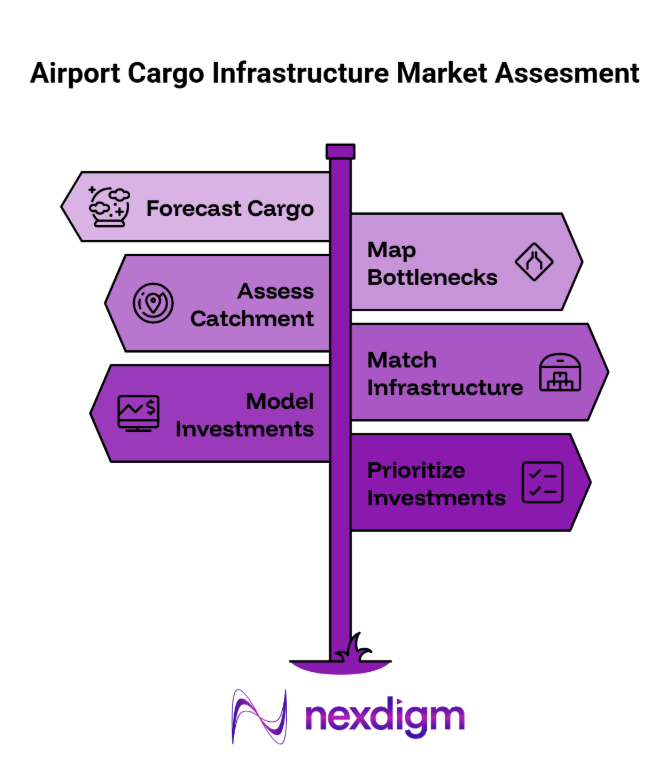
- Forecast cargo by lane and commodity: Estimate future tonnage using trade flows, manufacturing activity, e-commerce and commodity-specific growth. This establishes when existing capacity is likely to become insufficient.
- Map the operational bottleneck: Assess terminal throughput, warehouse utilisation, ULD storage, apron activity, screening, customs and truck movements to distinguish the actual constraint from the visible one.
- Assess the catchment: Map manufacturing clusters, consumption centres, freight corridors and compming of the constraint and economic return. This prevents large capital projects from being approved simply because headline cargo volumes are increasing.
How Nexdigm Prioritized Cargo Infrastructure Expansion
An Asian airport operator facing 20% annual cargo growth needed to determine whether a second terminal was necessary. Nexdigm modelled lane-level demand and terminal throughput and found that a 15,000 sq. m. cold-storage facility and apron reconfiguration could address the immediate constraint. The plan increased processing capacity by approximately 20%, reduced dwell time by more than 50% and deferred the second terminal investment by three years.
To take the next step, simply visit our Request a Consultation page and share your requirements with us.
Harsh Mittal
+91-8422857704