

Demand for alternative lending extends beyond credit-constrained borrowers to prime and commercial clients excluded by rigid banking processes. Traditional underwriting relies on multi-year histories, steady pay cycles, and physical collateral, which often disqualifies modern asset-light firms, gig workers, and cash-flow-driven merchants.
When immediate operational needs arise, speed and certainty often outweigh interest rates. A delayed bank approval can easily cost a business-critical discounts, orders, or contracts.
Who Is Actually Using Alternative Credit?
Alternative credit users are not limited to high-risk subprime borrowers. They include economically viable borrowers whose operating profiles do not fit conventional underwriting criteria.
Micro, small, and medium enterprises represent a major financing gap, with the Indian MSME credit shortfall estimated at approximately ₹30 lakh crore.
Many businesses operate with limited fixed assets, reinvest cash into inventory, and depend on informal trade credit, making them difficult to assess through collateral-led banking models.
Self-employed professionals and specialized knowledge workers can face a different problem.
Their revenues may be substantial but uneven, reflecting project milestones, contracts, or seasonal demand rather than a fixed monthly salary.
Gig and platform workers similarly receive income on weekly or on-demand schedules, while thin-file and new-to-credit consumers lack the repayment history required by traditional bureau-based scoring models.
Speed, Flexibility, and Data Are Rewriting the Lending Proposition
Alternative lenders address these gaps by combining automated underwriting with digital distribution and transaction-level data. Revenue-based financing platforms can connect to payment gateways, merchant acquiring accounts, and e-commerce platforms to assess sales volumes and structure repayments around actual revenue cycles.
Supply-chain finance platforms can connect enterprise resource planning systems, tax records, and buyer information to evaluate invoices and receivables.
This can allow a smaller supplier to obtain financing based partly on the strength of its commercial relationships rather than solely on its own collateral position.
Other models use consent-based account information to provide smaller working-capital facilities while continuously monitoring liquidity and repayment capacity.
Conducting an Alternative lending market study allows lenders and investors to identify borrower cohorts where better data can offset traditional collateral and documentation constraints without compromising portfolio economics.
- Micro-retail merchants: QR payment inflows and distributor reorder patterns can provide signals on cash-flow stability and operating continuity.
- Gig and platform workers: Platform tenure, activity continuity, and payment patterns can supplement inconsistent income documentation.
- Tier-2 and Tier-3 MSMEs: GST filings, e-way bills, vendor settlement cycles, and invoice records can provide visibility into working-capital velocity and supply-chain resilience.
Alternative Lending Still Has a Cost of Capital Problem
Operational flexibility does not eliminate the financial constraints facing non-bank lenders. Their funding structures can be more expensive than those of deposit-funded commercial banks, creating pressure on lending margins.
Customer acquisition is another structural challenge. Digital lenders compete for qualified borrowers across increasingly crowded online channels, increasing acquisition costs.
The business model therefore depends on strong retention, repeat borrowing, disciplined underwriting, and efficient servicing.
Risk selection becomes particularly important during periods of tighter bank credit.
Alternative lenders can receive applications from borrowers who are underserved because of documentation gaps, but they can also attract borrowers who have been rejected because of excessive leverage or weak repayment capacity.
A viable lending strategy needs to distinguish these populations rather than treating all bank-rejected borrowers as an opportunity.
Nexdigm’s Alternative Lending Opportunity Framework
Nexdigm evaluates non-bank lending opportunities by connecting the size of the credit gap with borrower economics, funding conditions, portfolio risk, regulation, and competitive intensity.
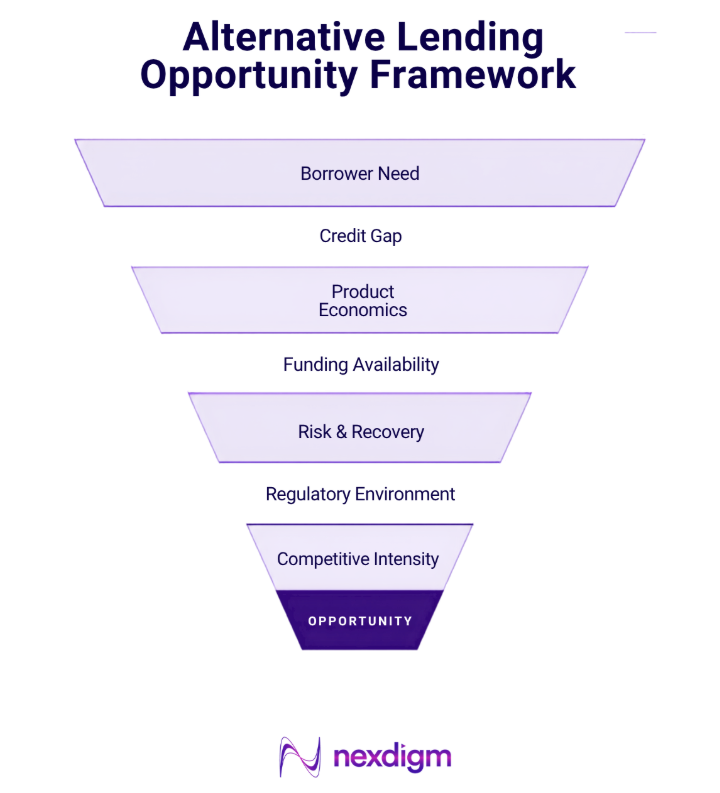
- Borrower Need: Assess underwriting latency, collateral requirements, ticket-size viability, and repayment flexibility relative to traditional banking.
- Credit Gap: Quantify the financing shortfall, potential substitution from informal credit, and the economic activity supported by the unmet demand.
- Product Economics: Model APRs, origination fees, acquisition costs, servicing expenses, loss provisions, and net interest margins.
- Funding Availability: Evaluate institutional debt appetite, co-lending structures, warehouse facilities, securitization markets, and wholesale funding costs.
- Risk & Recovery: Stress-test default trajectories, recovery curves, enforcement channels, and credit-enhancement structures.
- Regulatory Environment: Assess digital-lending requirements, interest-rate restrictions, capital rules, and collection-practice obligations.
- Competitive Intensity: Benchmark incumbent banks, non-bank lenders, embedded-finance models, and point-of-sale financing alternatives.
How Nexdigm Identifies the Bank-Adjacent Borrower
A mid-sized NBFC screened 25 borrower categories across eight growth clusters, identifying ₹22 billion ($264 million) in addressable demand across precision-engineering suppliers, cold-chain operators, and outpatient diagnostic clinics. Nexdigm helped align financing structures with their cash cycles, enabling a more targeted lending strategy.
To take the next step, simply visit our Request a Consultation page and share your requirements with us.
Harsh Mittal
+91-8422857704
[email protected]