

Supplier networks are being reassessed as businesses face simultaneous pressure from geopolitical disruption, raw-material shortages, and price volatility. Inverto’s 2026 Raw Materials Study, based on 354 decision-makers across Europe and APAC, found that 91% of businesses are experiencing supply-chain impacts from geopolitical developments, while 86% expect raw-material prices to increase over the next 12 months.
The response is increasingly focused on supplier diversification: 98% of companies have changed their sourcing strategies, with 46% reinforcing dual or multiple sourcing and 41% pursuing nearshoring. These shifts make alternative supplier identification increasingly important not simply for adding vendors, but for finding commercially competitive, capable, and geographically appropriate supply options that can strengthen procurement resilience.
Supplier Concentration and the Case for Diversification
Heavy dependence on a limited supplier base can increase exposure to price changes, production disruptions, capacity shortages, and regional shocks. Diversifying supply can provide greater flexibility, but adding vendors without assessing their capabilities may create unnecessary complexity. Procurement teams therefore need to balance supplier diversification with commercial attractiveness, operational reliability, and the ability to maintain consistent quality and service.
Building a Stronger Supplier Evaluation Lens
Supplier selection becomes more effective when procurement teams assess potential sources across multiple dimensions rather than relying primarily on quoted prices.
- Capability and Reliability: Examine production scale, technical expertise, quality performance, certifications, lead times, and capacity availability to determine whether suppliers can support sustained requirements.
- Market and Commercial Position: Evaluate cost structures, geographic footprint, competitive positioning, trade exposure, and market conditions to understand the supplier’s long-term commercial suitability.
A structured evaluation helps procurement teams build a shortlist of suppliers that can strengthen both sourcing competitiveness and supply resilience.
How Nexdigm Helps Expand the Supplier Landscape
Nexdigm helps businesses look beyond their existing supplier base to identify where credible alternatives may exist and what makes them commercially relevant. Its teams combine supplier research with market and industry intelligence to map potential sources across countries and supply markets.
Our alternative supplier identification assessment brings together supplier capabilities, production footprint, market presence, cost conditions, and geographic factors, giving procurement teams a clearer starting point for supplier screening and validation.
This helps turn a broad and fragmented supplier universe into a more focused pipeline of potential sourcing alternatives.
Nexdigm’s Alternative Supplier Identification Approach
Once potential suppliers are identified, Nexdigm helps businesses narrow the landscape by assessing which alternatives are most relevant to the sourcing requirement. The focus is on the following areas:
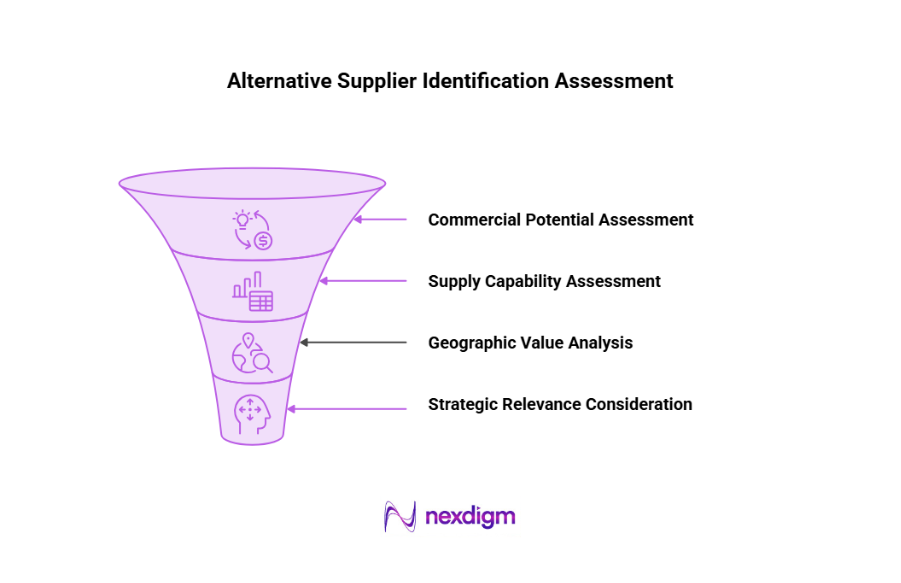
- Commercial Potential: Comparing pricing, cost structures, production economics, and logistics to identify suppliers with attractive sourcing potential.
- Supply Capability: Assessing capacity, product coverage, technical capabilities, quality requirements, and scalability to determine operational suitability.
- Geographic Value: Considering supplier location, trade access, logistics exposure, and geographic diversification when evaluating alternative sourcing markets.
- Strategic Relevance: Considering how each supplier could contribute to cost competitiveness, supply resilience, or reduced dependence on existing sources.
This prioritization helps procurement teams focus on supplier validation and due diligence on alternatives with the strongest overall sourcing potential.
How Nexdigm’s Supplier Prioritizing Approach Identifies Sourcing Potential
Identifying an alternative supplier is only valuable when the opportunity can translate into a commercially viable sourcing option. Nexdigm connects supplier intelligence with the following factors to assess where meaningful sourcing potential exists:
- Cost Opportunity: Compare supplier economics, input costs, logistics, and prevailing market prices to identify opportunities for improving sourcing competitiveness.
- Capacity Opportunity: Assess available production capacity, expansion plans, and scalability to determine whether suppliers can support additional or shifting volumes.
- Geographic Opportunity: Identify sourcing markets that can provide cost advantages, greater supplier choice, or reduced dependence on existing supply locations.
- Strategic Opportunity: Evaluate whether alternative suppliers can strengthen negotiating leverage, improve supply resilience, or support longer-term sourcing objectives.
This approach helps procurement teams move from finding potential suppliers to identifying the alternatives most likely to create tangible sourcing value.
Nexdigm’s Case
Nexdigm assessed supplier markets across 12 countries and 25+ potential suppliers, identifying eight commercially viable alternatives across priority categories. The assessment indicated a 15% potential sourcing-cost improvement among shortlisted options and identified three geographic markets with stronger diversification potential, supporting a more competitive and resilient supplier strategy.
To take the next step, simply visit our Request a Consultation page and share your requirements with us.
Harsh Mittal
+91-8422857704