

Aluminum is becoming increasingly important to automotive manufacturing as automakers pursue lightweighting, electrification, and greater material efficiency. The International Aluminium Institute estimates that global aluminum supply could increase from 104 million tonnes in 2021 to 148–174 million tonnes by 2050, depending on the scenario, with recycled aluminum expected to account for a growing share of future supply.
Automotive applications are also expanding beyond traditional castings into extrusions, sheet, forgings, chassis, suspension, and structural components. In China, automotive aluminum usage is forecast to rise from 3.8 million tonnes in 2018 to 9.1 million tonnes by 2030, representing an 8.9% CAGR. For automakers, this makes an aluminum sourcing strategy for automotive increasingly dependent on supplier capabilities, material grades, pricing, regional availability, and recycling options.
Aluminum Sourcing Is Becoming a Strategic Material Decision
For automakers, aluminum sourcing involves more than securing competitive metal prices. The right sourcing strategy needs to balance alloy and grade requirements, production capacity, quality consistency, logistics, regional supply, recycled content, and long-term supplier reliability. With automotive applications expanding and regional supply conditions changing, OEMs need greater visibility into where suitable material is produced, how suppliers compare, and which sourcing models can support future vehicle programs.
What Shapes an Effective Automotive Aluminum Strategy
A supplier’s suitability can vary by application, grade, geography, and production requirement. A practical sourcing assessment can therefore focus on three areas:
- Producer Capability: Assess smelting, casting, rolling, extrusion, forging, recycling, capacity, quality systems, and automotive experience to determine technical suitability.
- Material Economics: Compare aluminum prices, premiums, conversion costs, freight, commercial terms, recycled-content economics, and regional cost differences to understand total sourcing value.
- Regional Supply: Map production locations, logistics networks, local capacity, lead times, trade exposure, and supplier concentration to evaluate availability and supply resilience.
Together, these factors help automakers move beyond selecting the lowest-cost producer and identify suppliers that offer the right combination of quality, economics, availability, and long-term reliability.
Nexdigm’s Expertise in Offering Aluminum Sourcing Intelligence Services
Nexdigm can help automakers develop a clearer view of the aluminum supplier ecosystem by combining market intelligence, supplier research, procurement analysis, and industry-led assessment. The approach can assess the market across:
- Primary Producers: Identify major aluminum producers, smelters, refiners, and integrated suppliers across relevant regions.
- Material Capabilities: Map suppliers by alloys, grades, product forms, finishing capabilities, and automotive applications.
- Recycling Ecosystem: Evaluate recycled aluminum producers, scrap availability, recycling capabilities, and potential circular-sourcing opportunities.
- Regional Footprint: Assess manufacturing locations, logistics networks, local capacity, and proximity to automotive production facilities.
- Commercial Positioning: Compare supplier pricing, premiums, customer base, contracts, investments, and expansion plans.
This creates a supplier map aligned with the specific grades, product forms, and geographic requirements of an automaker.
Nexdigm’s Analysis of Automotive Aluminum Sourcing Options
Nexdigm can further evaluate mapped suppliers across technical, commercial, and strategic dimensions:
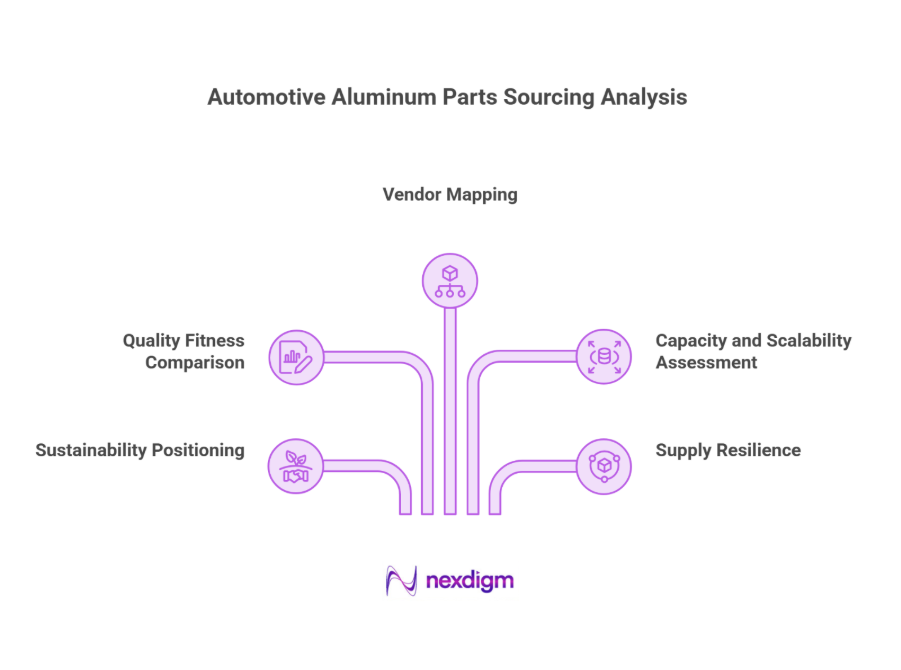
- Grade and Quality Fit: Compare alloy capabilities, specifications, certifications, consistency, and ability to meet automotive-grade requirements.
- Cost Competitiveness: Assess pricing structures, regional premiums, conversion economics, logistics, and potential volume advantages.
- Capacity and Scalability: Examine production capacity, utilization, expansion projects, and ability to support increasing OEM demand.
- Supply Resilience: Identify geographic concentration, raw-material dependencies, logistics exposure, and alternative sourcing options.
- Sustainability Positioning: Evaluate recycled content, energy intensity, emissions-related initiatives, and the supplier’s ability to support lower-carbon material requirements.
These insights can help automakers distinguish suppliers that are technically capable from those that also offer stronger commercial and strategic value.
How Experts at Nexdigm Turn Aluminum Sourcing Analysis Into Sourcing Strategy
The value of an aluminum sourcing strategy for automotive extends beyond supplier identification. Nexdigm’s analysis can help organizations translate market and supplier intelligence into:
- Supplier Shortlisting: Identify producers aligned with specific grades, applications, volumes, and geographic requirements.
- Sourcing Allocation: Determine how volumes can be distributed across suppliers or regions to balance cost and continuity.
- Localization: Evaluate regional producers and recycling partners to reduce logistics exposure and strengthen local supply.
- Negotiation Support: Use supplier and market benchmarks to identify commercial opportunities and strengthen procurement discussions.
- Risk Management: Highlight capacity, geographic, quality, pricing, and supply-chain dependencies before they affect vehicle production.
This forward-looking view can help automakers distinguish between suppliers that are competitive today and those positioned to support longer-term vehicle and manufacturing strategies.
Nexdigm’s Case
Nexdigm supported an automaker to evaluate 18 aluminum suppliers across grades, cost, capacity, quality, and regional availability. Nexdigm’s assessment identified 6 priority suppliers, highlighted 10 sourcing opportunities, and reduced supplier evaluation time by 28%, supporting more focused negotiations and regional sourcing decisions.
To take the next step, simply visit our Request a Consultation page and share your requirements with us.
Harsh Mittal
+91-8422857704