

Companies rarely lack information when evaluating expansion. Trade databases show import and export flows; industry reports estimate demand, competitor disclosures reveal strategic priorities, and economic indicators describe market conditions. The difficulty is determining which signals matter, how they interact, and what they imply for a commercial decision.
A market can report rising imports while becoming less attractive for a new entrant because prices are falling, suppliers are consolidating their positions or regulatory costs are increasing. Another market may show modest growth but offer an opening for a specialised product that existing suppliers struggle to provide. Decision intelligence connects these signals to a specific business choice.
Why Individual Data Points Rarely Explain the Opportunity
Market size, trade growth and competitor share are useful starting points, but each measures a different aspect of commercial potential. Import growth indicates that a market is purchasing more from abroad, although it does not establish whether demand is sustainable, whether domestic production is declining or whether a temporary inventory cycle is driving purchases.
The distinction between trade value and trade volume is particularly important. The World Trade Organization reported that world merchandise trade value increased by 15% year on year in the first half of 2026, while volume rose by 3.5%. Higher prices, including those for fuels and electronic components used in data centres, contributed to the difference. A company examining value growth alone could therefore overestimate the increase in underlying demand.
Competitive analysis adds another layer. A growing market may already be served by suppliers with scale advantages, established customer relationships or preferential access to distribution. Conversely, a market with several suppliers may still contain attractive segments where product quality, delivery reliability, or technical support remains inadequate.
The task is to interpret these indicators together rather than treat each as an independent reason to invest.
Connecting Market Signals to Commercial Decisions
Decision intelligence begins with a clearly defined question. A manufacturer deciding where to export needs different evidence from a distributor assessing a new product line or an investor evaluating an acquisition. The analysis should be designed around the decision; not around whichever datasets happen to be available.
Four analytical connections are particularly useful:
- Demand and supply: Compare import growth with domestic production, consumption patterns and the availability of substitutes.
- Competition and customer access: Assess supplier concentration, incumbent strengths, switching costs and the channels required to reach buyers.
- Trade and market access: Evaluate tariffs, product standards, customs procedures and the total cost of serving each destination.
- Economics and execution: Translate demand estimates into achievable sales, contribution margins, working-capital needs and investment requirements.
These connections help separate a promising market from one that merely looks attractive in a headline statistic.
Reading Trade Flows Alongside Competitive Behaviour
Trade data can reveal changes in sourcing relationships before those changes become obvious in company-level market estimates. The WTO’s 2026 trade outlook highlighted the growing importance of AI-enabling goods, which accounted for 14.8% of global merchandise trade in the first half of 2026. Their share had been approximately 7% to 8% between 2016 and 2023. The WTO also reported that the top ten traders accounted for around 85% of exports and 80% of imports in this category in 2025.
For businesses supplying electronics, components, industrial equipment or related services, these figures point to a market opportunity alongside a concentration risk. Demand may be expanding rapidly, but access to customers and supply chains can remain concentrated among a limited number of countries and established participants.
A useful analysis examines whether a supplier’s rising exports reflect stronger final demand, a shift in production location, higher unit prices or its role as an intermediary. It then tests whether the change creates a viable entry opportunity for the company being assessed.
From Evidence to a Defensible Recommendation
The phrase analysis intelligence describes the process of converting fragmented evidence into an actionable commercial judgement. It requires analysts to distinguish observed facts from inferred explanations and assumptions that still need validation.
For example, a rise in exports from a connector economy may indicate new manufacturing capacity, but it may also reflect goods passing through a logistics hub. Customs data alone cannot establish which companies are buying, why they are switching suppliers or whether the relationship will persist. Customer interviews, company disclosures, shipment intelligence where available, and local channel research can help test those explanations.
The output should make uncertainty visible. Management needs to know which conclusions are supported by several independent indicators, which depend on a single source, and which require primary research before investment.
What Management Should Resolve Before Committing Capital
A decision-ready assessment should answer the following questions:
- Is the market’s growth supported by durable demand or temporary price and inventory effects?
- Can the company reach customers whose requirements match its products and capabilities?
- Are apparent competitive gaps genuine, or do they reflect barriers that new entrants cannot economically overcome?
- Which assumptions have the greatest effect on expected returns?
- What evidence would justify proceeding, changing the entry model, or rejecting the opportunity?
A Decision Intelligence Framework for Market Entry
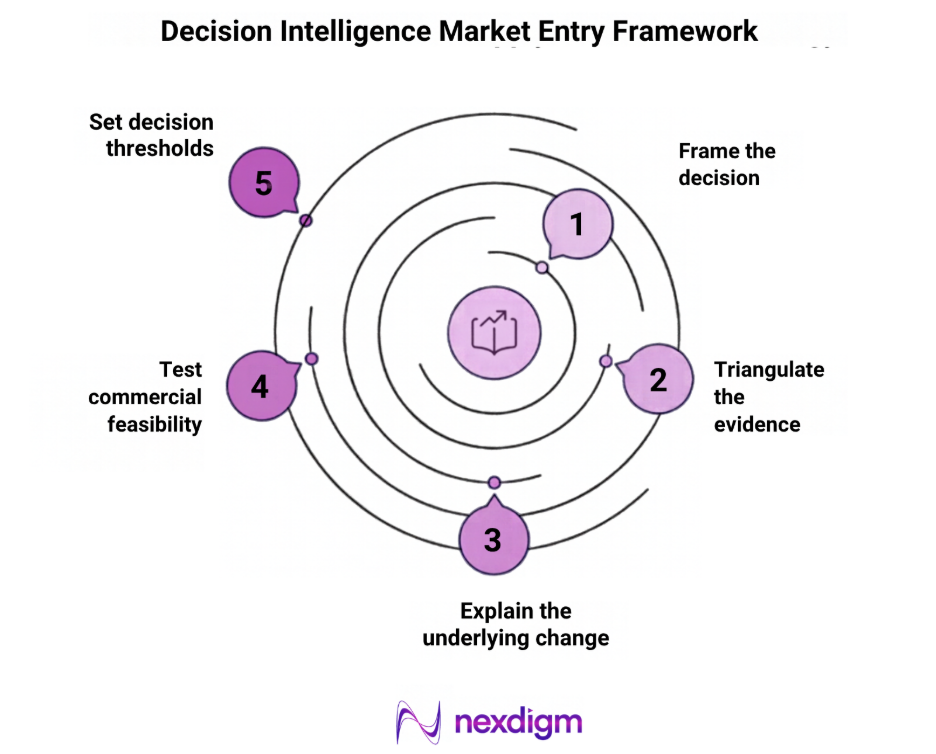
- Frame the decision: Specify the market, product, investment objective, and decision deadline.
- Triangulate the evidence: Combine trade flows, demand indicators, competitor positions, policy conditions, and customer research.
- Explain the underlying change: Separate volume growth, price movements, supplier substitution and intermediary trade.
- Test commercial feasibility: Model reachable demand, market access costs, competitive response and downside economics.
- Set decision thresholds: Define the evidence required to invest, pilot, investigate further or exit the assessment.
Nexdigm Case Study
A manufacturer evaluating four export markets combined trade-flow analysis with competitor mapping and channel economics. Two markets were removed after landed-cost and customer-access testing. The remaining options were prioritised for customer validation, with investment decisions linked to achievable margins and confirmed demand rather than headline import growth.
To take the next step, simply visit our Request a Consultation page and share your requirements with us.
Harsh Mittal
+91-8422857704