

Feed ingredients represent a major operating input for livestock and aquaculture businesses. Their cost, nutritional composition and availability influence animal growth, feed conversion, production economics and the reliability of downstream meat, dairy, poultry and fish supply.
For feed manufacturers and integrated producers, procurement involves a diverse range of materials: maize, soybean meal, oilseed cakes, rice bran, fishmeal, wheat by-products, vitamins, minerals, amino acids and specialty additives. These inputs come from different agricultural, industrial and international supply networks. A disruption in one ingredient can affect formulation costs and production schedules even when other materials remain readily available.
Feed Availability Is Not the Same as Feed Security
India’s feed and fodder market faces structural imbalances. Availability differs by region, season and ingredient category. Agricultural residues may be abundant in one state but difficult to transport economically to another. Protein-rich ingredients can face competition from food, export and industrial demand.
A government response to Parliament in July 2025 reported estimated deficits of 11.24% in green fodder, 23.4% in dry fodder and 28.9% in concentrate feed ingredients. These figures highlight the pressure on livestock feed systems and the importance of reliable ingredient sourcing. <Cite refs={[“turn718089search50”]} />
The issue extends beyond total volume. Feed manufacturers need ingredients with predictable nutritional composition. A supply of raw material that is available but inconsistent in protein, moisture, fibre or contamination levels may not be suitable for a standardised feed formulation.
Livestock and Aquaculture Buyers Face Different Sourcing Risks
Livestock feed procurement is closely connected to crop cycles and agricultural by-products. Maize, soybean meal, bran and oilseed cakes are influenced by harvest volumes, competing uses and regional transportation economics. Dairy and poultry feed manufacturers also require consistent access to minerals, vitamins and other additives.
Aquaculture feed sourcing introduces a different set of requirements.
Fishmeal, fish oil, plant proteins, binders, amino acids and functional additives must meet formulation and species-specific needs.
The rapid expansion of India’s fisheries sector increases the importance of understanding these supply relationships.
India’s fish production reached 197.75 lakh tonnes in 2024–25, compared with 95.79 lakh tonnes in 2013–14, according to government figures.
Higher production creates demand for feed, hatchery inputs and supporting infrastructure. It also increases competition for ingredients that meet nutritional and quality specifications.
Ingredient Quality Can Change the Economics of Feed Production
Two suppliers may offer the same ingredient name but deliver different nutritional value. Variations in protein content, digestibility, moisture, fibre, ash, fat and contamination levels can affect formulation efficiency.
For feed manufacturers, the practical consequence is a mismatch between the purchase price and the value obtained from the ingredient. A cheaper lot may require reformulation, additional testing or blending with higher-grade material. It may also increase wastage or affect finished feed performance.
Quality risks can arise at multiple stages: agricultural production, aggregation, storage, processing and transportation. Inadequate drying or storage can lead to fungal contamination, while poor handling can introduce foreign matter or compromise ingredient stability.
Supplier Concentration and Import Exposure Create Further Risks
Some feed ingredients are sourced from concentrated production regions or international markets. Dependence on a limited number of suppliers can expose manufacturers to price fluctuations, shipping delays, export restrictions and currency movements.
The risk is not limited to imported materials. Domestic suppliers may also depend on a narrow set of agricultural clusters or processing facilities. A manufacturer that relies on one large supplier for soybean meal, for example, may face a significant disruption if that supplier experiences a capacity or logistics problem.
What Buyers Should Do to Build a More Reliable Feed Ingredient Supply Base
A detailed animal feed ingredient supplier landscape assessment should map suppliers by ingredient, source geography, processing capability, nutritional specifications and market coverage. It should distinguish primary producers, commodity traders, processors, importers and specialised additive manufacturers.
Buyers should establish ingredient-level specifications before comparing commercial offers. Testing requirements should cover the nutritional and safety parameters relevant to each material. Supplier qualification should also examine traceability, storage practices, quality documentation, capacity and the ability to deliver during peak demand periods.
Commercial analysis should compare delivered cost and nutritional value rather than purchase price alone. Feed manufacturers should assess how ingredient variation affects formulation, conversion efficiency and finished product economics.
Nexdigm supports organisations through supplier mapping, ingredient market research, sourcing intelligence and commercial benchmarking. Its research can help feed manufacturers identify suppliers, understand regional availability, compare ingredient sources and assess exposure to supply concentration.
Feed Ingredient Supplier Assessment Framework
A structured supplier assessment should cover six areas:
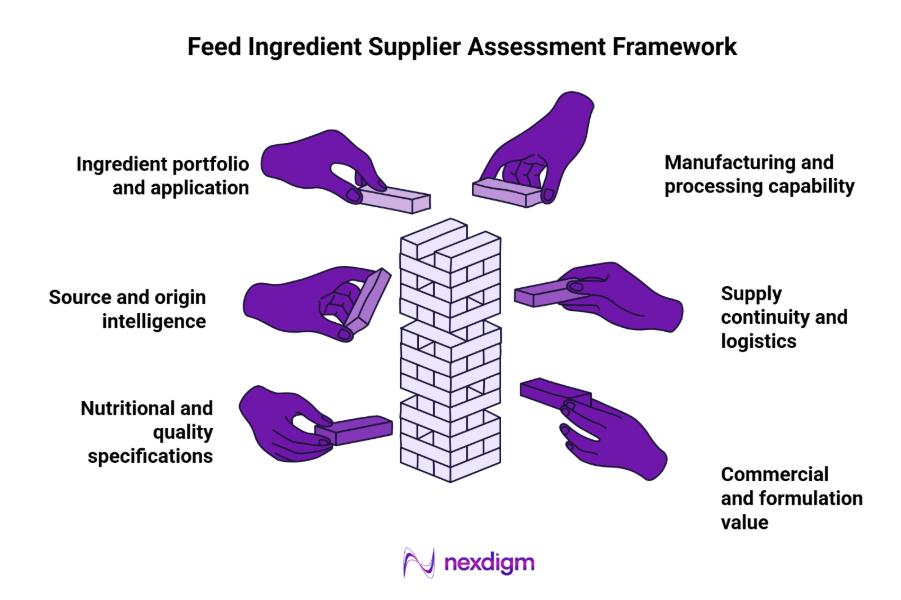
- Ingredient portfolio and application: Map suppliers by maize, oilseed meals, bran, fishmeal, plant proteins, minerals, amino acids, vitamins and specialty additives. Identify which livestock or aquaculture applications each ingredient supports.
- Source and origin intelligence: Trace ingredients to producing regions, processors, import origins and aggregation networks. Assess seasonality, competing demand and concentration in the upstream supply base.
- Nutritional and quality specifications: Compare protein, moisture, fibre, fat, ash, digestibility and other ingredient-specific parameters. Establish testing protocols for contaminants, mycotoxins and adulteration where relevant.
- Manufacturing and processing capability: Review crushing, extraction, drying, milling, blending and storage infrastructure. Assess capacity, utilisation, process consistency and the ability to meet repeat orders.
- Supply continuity and logistics: Examine inventory, transport arrangements, lead times, alternative sourcing locations and exposure to import or regional disruptions.
- Commercial and formulation value: Compare landed cost, usable nutrient value, minimum order quantities, payment terms and the effect of ingredient quality on feed formulation economics.
Nexdigm’s Case Study: Mapping Livestock and Aquaculture Feed Suppliers
Nexdigm mapped 46 feed ingredient suppliers across 8 ingredient categories, assessing sourcing origins, nutritional specifications, processing capability and regional coverage. The study identified 12 potential suppliers and highlighted concentration risks in 3 critical ingredient categories.
To take the next step, simply visit our Request a Consultation page and share your requirements with us.
Harsh Mittal
+91-8422857704