
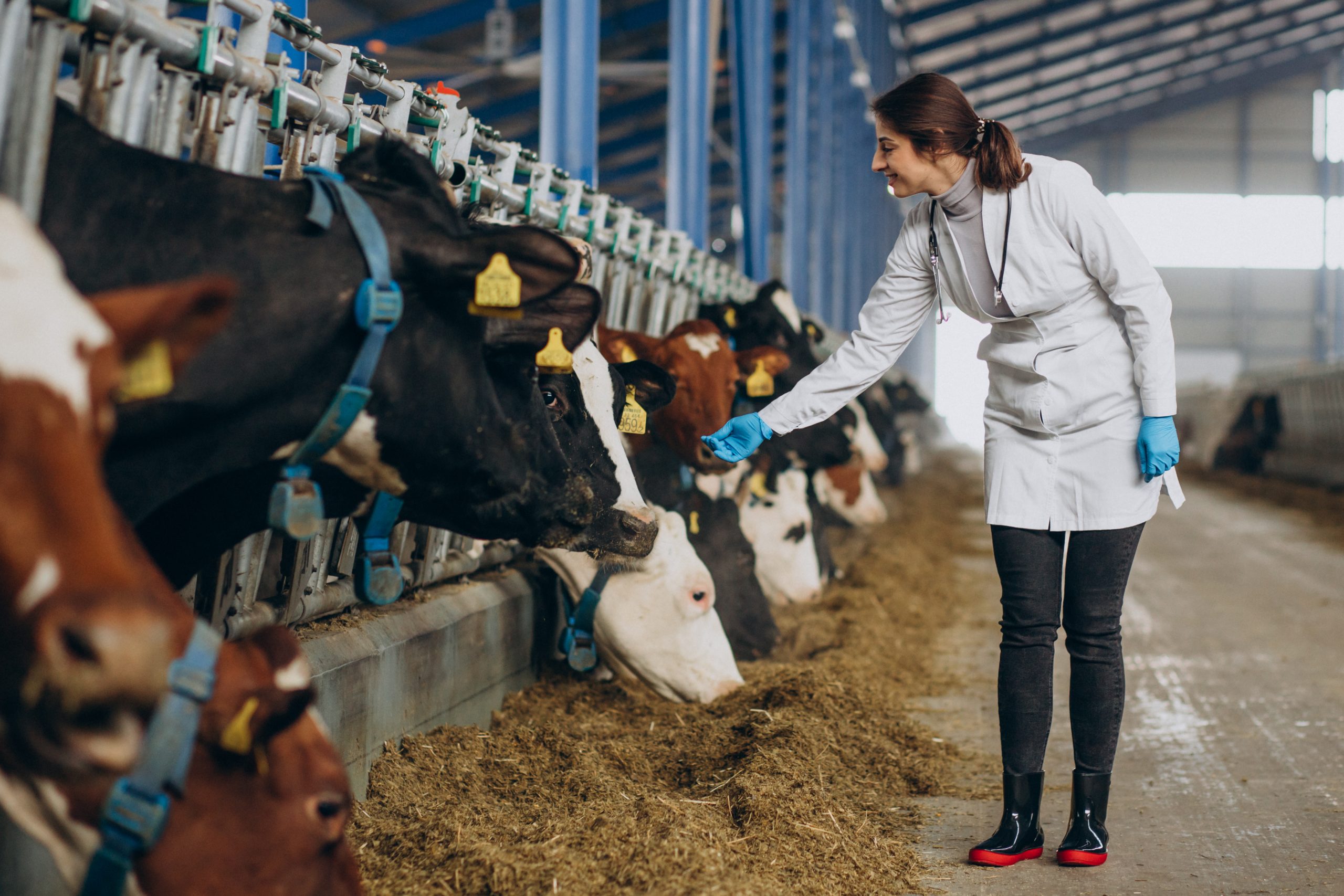
Animal feed demand is increasingly becoming a derived market. Growth in poultry, dairy, and aquaculture does not simply increase the number of animals being raised. It changes how much feed is required, which ingredients are consumed, where feed mills should be located, and how exposed producers are to commodity prices.
India’s compound feed market reached an estimated ₹1,186.3 billion in 2025, with poultry accounting for approximately 44.7% of commercial feed consumption. Aquafeed is also expanding rapidly, while dairy intensification is increasing demand for balanced cattle feed.
Start With the Animal, Not the Feed Mill
Feed demand should be built from the production system upward.
Broiler production requires rapid conversion of feed into live weight, with commercial FCR targets around 1.45–1.60 kg of feed per kilogram of gain. Layer systems have a different requirement, with feed efficiency assessed against egg output over a much longer production cycle.
Dairy cattle generate another demand pattern. Commercial cattle feed is influenced by lactation, milk yield, herd composition, and the transition from traditional feeding practices toward formulated rations.
Aquaculture introduces a separate feed equation, with species, stocking density, growth rates, and feed conversion determining consumption.
This means national feed demand can rise even when individual feed categories behave very differently.
Poultry Remains the Largest Ingredient Pull
Poultry’s scale makes it the most important driver of commercial feed demand.
Broiler and layer diets depend heavily on maize for energy and soybean meal for protein. Maize typically represents 55%–65% of broiler feed, while soybean meal contributes approximately 25%–30% of the feed’s protein base.
The implication is significant: poultry production growth creates indirect demand for agricultural commodities.
A feed company’s growth strategy therefore cannot be separated from maize and soybean availability, pricing, freight, and competing industrial demand.
Ethanol Has Changed the Maize Equation
The expansion of grain-based ethanol introduces a new competitor for feed manufacturers.
With the E20 blending programme supporting grain-based distillation, maize is increasingly being diverted toward ethanol production. The source research estimates that approximately 26% of India’s domestic maize harvest is directed toward ethanol fermentation.
This creates a direct procurement conflict. Feed manufacturers compete with distilleries for the same grain, while distilleries benefit from structured ethanol procurement arrangements.
When maize prices rise, the effect travels through the value chain into poultry production costs and ultimately into meat and egg economics.
Feed manufacturers therefore need to manage both biological formulation and industrial commodity competition.
The Ingredient Basket Is Becoming More Flexible
Pressure on traditional feed ingredients is encouraging greater use of alternative feedstocks.
Corn DDGS, broken rice, de-oiled mustard cake, and other by-products can provide partial substitutes depending on nutritional requirements, inclusion limits, price differentials, and enzyme availability.
This creates an opportunity for feed manufacturers to move from fixed formulations toward dynamic least-cost formulation.
The commercial advantage is not simply finding the cheapest ingredient. It is maintaining nutritional performance while switching between inputs as relative prices change.
Geography Matters Twice
Feed mills need proximity to both ingredients and animal-production clusters.
Major commercial milling centres such as Khanna and Sangrur serve northern dairy and layer markets, while Namakkal and Coimbatore support southern poultry production. Vijayawada and West Godavari connect feed production with coastal aquaculture and poultry operations.
The geographic mismatch between crop-growing regions and livestock clusters creates freight exposure. A feed mill can therefore have strong customer demand while still suffering from poor procurement economics.
Capacity expansion needs to account for both sides of the equation.
Feed Demand Is Becoming a Capacity and Risk Question
An animal feed market assessment should connect livestock production forecasts with feed conversion, ingredient requirements, alternative feedstock availability, plant utilization, freight economics, and commodity risk.
The strongest market may not be where animal numbers are highest. It may be where production growth, ingredient access, and feed-mill economics intersect.
Nexdigm’s Feed-Demand and Ingredient Vulnerability Framework
Nexdigm evaluates feed-market opportunities through five analytical lenses:
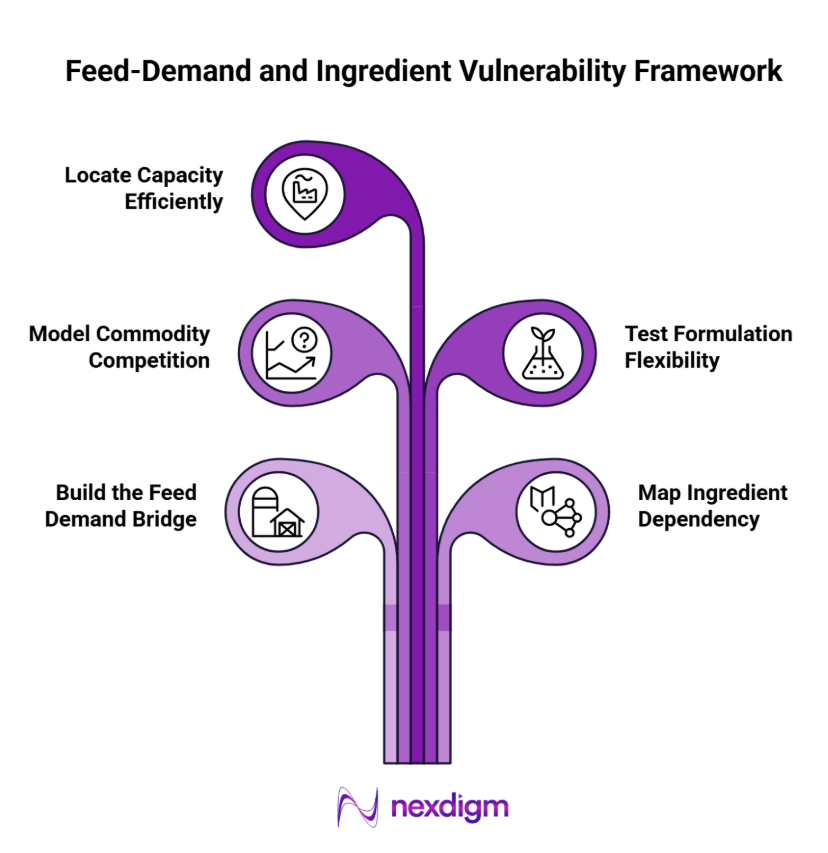
- Build the Feed Demand Bridge: Translate poultry, dairy, and aquaculture production forecasts into feed volumes using species-specific consumption and FCR assumptions.
- Map Ingredient Dependency: Quantify the contribution of maize, soybean meal, rice products, oilcakes, and alternative ingredients to each formulation and identify the largest cost exposures.
- Model Commodity Competition: Assess competing demand from ethanol, food processing, exports, and other industrial users to determine how ingredient availability and prices could evolve.
- Test Formulation Flexibility: Evaluate nutritional parity, substitution limits, enzyme requirements, and price thresholds to identify commercially viable alternatives to vulnerable feedstocks.
- Locate Capacity Efficiently: Overlay livestock density, ingredient supply, freight corridors, existing feed-mill capacity, and utilization to identify where additional production capacity can be economically deployed.
Case Study: Nexdigm’s Feed Formulation De-Risking
An animal nutrition company operating a 30,000 MT-per-month feed milling facility in Andhra Pradesh saw operating EBITDA decline by ₹1,400 per MT as local maize prices increased following competition from nearby grain-based ethanol plants.
Nexdigm redesigned the formulation architecture, introducing an enzymatic solution that enabled 12% corn DDGS inclusion sourced locally from grain distilleries, alongside a 20% substitution of dietary energy requirements with broken parboiled rice.
The reformulation reduced net raw-ingredient costs by ₹1,150 per MT while maintaining commercial broiler growth rates and feed-conversion performance across contract trial farms.
To take the next step, simply visit our Request a Consultation page and share your requirements with us.
Harsh Mittal
+91-8422857704