

Financial institutions increasingly depend on external technology providers to support customer screening, transaction monitoring, sanctions checks and customer due diligence. These systems process large volumes of sensitive information and influence decisions that can have direct regulatory and operational consequences. Selecting an anti-money laundering solution therefore requires more than evaluating software capabilities or comparing subscription costs.
An effective vendor assessment must establish whether the provider can identify suspicious activity accurately, maintain reliable screening processes, support regulatory reporting and adapt to changing financial crime risks.
Why AML Vendor Assessment Matters
Anti-money laundering obligations remain the responsibility of regulated financial institutions, even when screening and monitoring activities are supported by external providers.
In India, the Prevention of Money-Laundering Act, 2002, and the RBI’s Know Your Customer Directions establish requirements around customer identification, ongoing due diligence and transaction monitoring. These obligations make vendor performance an important component of institutional compliance.
A poorly configured screening platform can generate excessive false positives, overlook relevant matches or delay investigations. Similarly, unreliable transaction monitoring can create gaps in suspicious activity detection.
Institutions should therefore assess vendors against four critical dimensions:
- Screening accuracy: Ability to identify relevant individuals, entities and sanctions matches without generating excessive false positives.
- Monitoring effectiveness: Capacity to detect unusual transaction patterns through configurable rules and risk-based scenarios.
- Regulatory alignment: Support for applicable AML, KYC, sanctions and reporting requirements across operating jurisdictions.
- Operational reliability: System availability, processing speed, data security and incident response capabilities.
Evaluating Screening Accuracy and Monitoring Controls
Screening accuracy should be tested against representative customer and transaction datasets rather than vendor demonstrations alone.
Procurement teams should examine how the platform handles spelling variations, aliases, transliteration, incomplete records and changes to sanctions lists. These capabilities are particularly important for institutions dealing with international customers and cross-border transactions.
Transaction monitoring requires a separate assessment. Vendors should demonstrate how their platforms identify unusual activity across customer segments, transaction channels and geographic locations.
Important evaluation parameters include:
- False-positive rates: Determine how frequently legitimate transactions or customers are incorrectly flagged.
- Detection coverage: Assess whether monitoring scenarios address the institution’s actual financial crime risks.
- Alert prioritisation: Evaluate whether the system ranks alerts according to risk and urgency.
- Investigation workflows: Review case management, escalation, audit trails and evidence retention.
- Model governance: Understand how detection rules and machine-learning models are tested, validated and updated.
A low alert volume is not necessarily evidence of better performance. Procurement teams must establish whether reduced alerts reflect improved accuracy or missed suspicious activity.
Compliance, Data Security and Vendor Reliability
Vendor compliance assessments should consider the institution’s regulatory footprint. Requirements may differ across jurisdictions, particularly regarding customer information, sanctions screening, data retention and regulatory reporting.
Financial institutions should examine the provider’s data-processing arrangements, subcontractors, access controls and incident notification procedures.
Operational reliability is equally important. A screening platform outage can delay customer onboarding, payments and transaction approvals. Vendor due diligence should therefore include service availability records, disaster recovery arrangements, recovery time objectives and business continuity testing.
Institutions should also examine whether the vendor provides:
- Independent security assurance and audit reports.
- Documented vulnerability management procedures.
- Clear data ownership and deletion provisions.
- Defined service-level agreements.
- Regulatory audit and inspection support.
- Transparent change-management procedures.
AML Vendor Evaluation Framework
A structured anti-money laundering (AML) vendor risk consulting exercise can help institutions compare providers using consistent assessment criteria.
The evaluation should follow five stages:
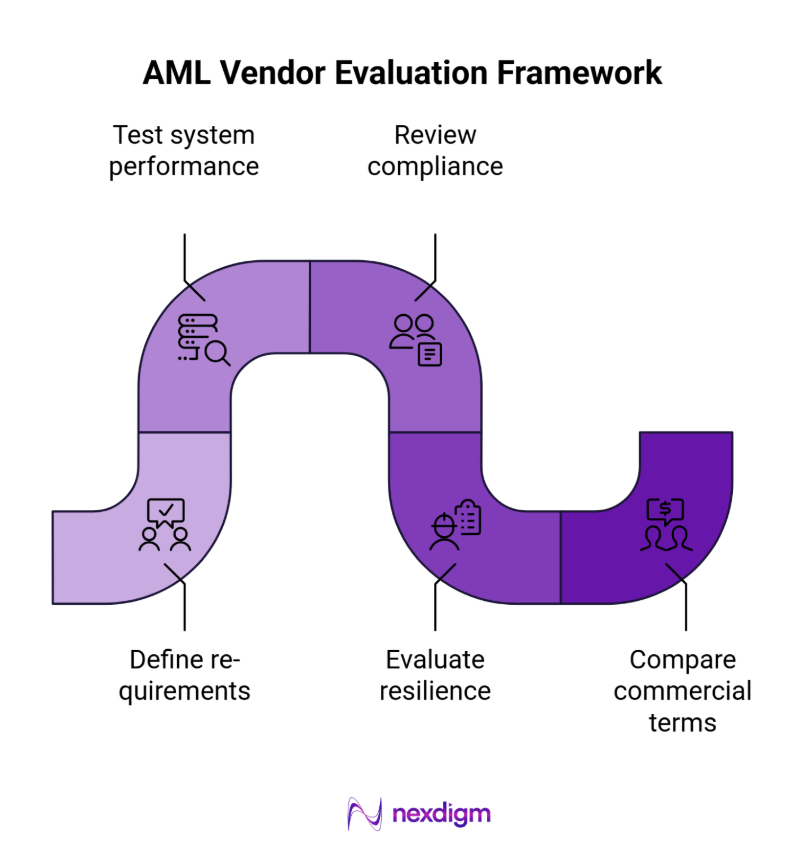
- Define requirements: Identify screening, monitoring, reporting and integration requirements.
- Test system performance: Evaluate detection accuracy using representative datasets and agreed testing scenarios.
- Review compliance: Assess regulatory coverage, data governance and audit documentation.
- Evaluate resilience: Examine uptime, recovery capabilities, cybersecurity and incident management.
- Compare commercial terms: Review implementation costs, licensing, scalability, support and exit provisions.
Nexdigm can support financial institutions through vendor research, due diligence, comparative assessments and procurement decision support. The objective is to help organisations understand differences in vendor capabilities and identify operational, compliance and financial risks before entering long-term agreements.
Nexdigm’s Case Study
Nexdigm assessed 8 AML technology vendors for a financial institution, comparing screening accuracy, false-positive rates, monitoring controls and compliance coverage. The assessment identified 3 vendors with significant control gaps, reduced the shortlist to 3 qualified providers and helped establish 5 performance benchmarks for vendor selection..
To take the next step, simply visit our Request a Consultation page and share your requirements with us.
Harsh Mittal
+91-8422857704