

Application programming interfaces have become central to how organisations connect enterprise systems, expose digital services and exchange information with external partners. They support everything from mobile applications and payment processing to supply chain integrations and cloud-based services. As API portfolios expand, managing individual interfaces through disconnected tools becomes increasingly difficult.
Why API Management Becomes an Enterprise Procurement Priority
An API programme can grow through multiple business initiatives. Different teams may develop interfaces for customer applications, partner integrations, internal systems and cloud services. Without consistent management, organisations can end up with duplicated APIs, inconsistent documentation, fragmented access controls and limited visibility into usage.
API management platforms address these challenges by providing capabilities such as API gateways, developer portals, traffic management, authentication, analytics and lifecycle governance. However, vendors differ in architecture, deployment flexibility, integration capabilities and pricing.
Some solutions are closely associated with particular cloud environments, while others support hybrid and multi-cloud deployments. Certain providers emphasise API design and developer experience, whereas others focus on gateway performance, security or enterprise integration. Procurement teams need to understand these distinctions before selecting a platform.
Comparing API Management Capabilities
Lifecycle management and developer experience
API management should cover more than publishing an endpoint. Organisations need tools to design, document, test, version, deploy and retire APIs.
Supplier assessment should examine support for API specifications, reusable design standards, automated testing and documentation management. Developer portals also matter, particularly when APIs are exposed to partners or external application developers. A well-designed portal can simplify onboarding, provide access to documentation and reduce support requirements.
Version management deserves close attention. Organisations should understand how vendors support backward compatibility, deprecation policies and communication with API consumers. Poor lifecycle management can disrupt dependent applications when interfaces change.
Governance and security
APIs can expose sensitive business data and operational capabilities. Security requirements should therefore be evaluated across authentication, authorisation, encryption, threat detection, rate limiting and access management.
Vendors should demonstrate how policies are applied consistently across APIs and environments. Procurement teams should also examine audit logging, key management, identity integration and support for security standards relevant to the organisation.
Governance extends beyond security. Large API portfolios require ownership models, naming conventions, documentation standards and approval processes. The platform should provide sufficient visibility for administrators to identify unapproved interfaces, duplicated services and APIs approaching retirement.
Performance and scalability
API performance can directly affect customer experience and the reliability of connected applications. Relevant metrics include latency, throughput, availability, traffic handling and the platform’s ability to manage sudden demand increases.
Testing should reflect the organisation’s expected traffic patterns rather than rely solely on vendor demonstrations. Teams should examine how the platform handles traffic spikes, failures, retries and regional deployments.
Architecture also influences performance. Some platforms operate primarily as managed cloud services, while others support self-hosted or hybrid deployments. Organisations with strict data residency, network architecture or operational requirements may need greater deployment control.
Integration and interoperability
API management platforms must fit into the wider technology environment. They may need to connect with cloud infrastructure, enterprise integration tools, identity providers, developer environments, monitoring platforms and existing gateways.
Procurement teams should evaluate support for open standards, automation pipelines, infrastructure-as-code practices and integration with software development workflows. They should also identify which capabilities require proprietary extensions or additional products.
The ability to manage APIs across different environments is particularly important for organisations operating hybrid or multi-cloud architectures. A platform that works well in one environment may introduce complexity when APIs need to be governed across several infrastructure providers.
Understanding the Commercial Model
API management costs are not always straightforward. Vendors may charge based on API calls, gateway capacity, environments, developers, data transfer or enterprise subscription tiers. Additional costs may arise from analytics, security features, premium support and deployment infrastructure.
A realistic cost assessment should model expected API traffic, growth scenarios and the number of environments requiring management. Organisations should also account for implementation, migration, training and ongoing administration.
Migration costs deserve attention when replacing an existing platform. API definitions, policies, developer subscriptions and monitoring configurations may need to be transferred or recreated. The effort can be substantial when an organisation operates a large and poorly documented API portfolio.
Assessing the Supplier Beyond Product Features
The vendor’s service capabilities can influence the success of an API management programme. Organisations should review implementation support, technical documentation, customer service, product roadmaps and regional availability.
They should also assess financial and operational stability, security practices and the supplier’s approach to product updates. Where APIs support critical customer or partner services, service commitments and escalation procedures need to be clearly defined.
A supplier comparison should ultimately connect technical capabilities with business priorities. An organisation focused on external developer ecosystems may prioritise portal functionality and onboarding, while a business modernising internal systems may place greater emphasis on integration, governance and deployment flexibility.
How Nexdigm Supports API Management Supplier Research
Nexdigm provides market research, vendor intelligence, supplier benchmarking and commercial analysis to support enterprise technology decisions. Its research can help organisations compare API management providers, evaluate platform positioning, assess pricing models and identify suppliers suited to their integration and governance requirements.
Organisations need platforms that support the full API lifecycle, from design and development to deployment, monitoring and retirement. An API management platform supplier comparison helps procurement and technology teams identify providers that can manage this environment while meeting requirements for security, performance, interoperability and cost.
API Management Platform Supplier Evaluation Framework
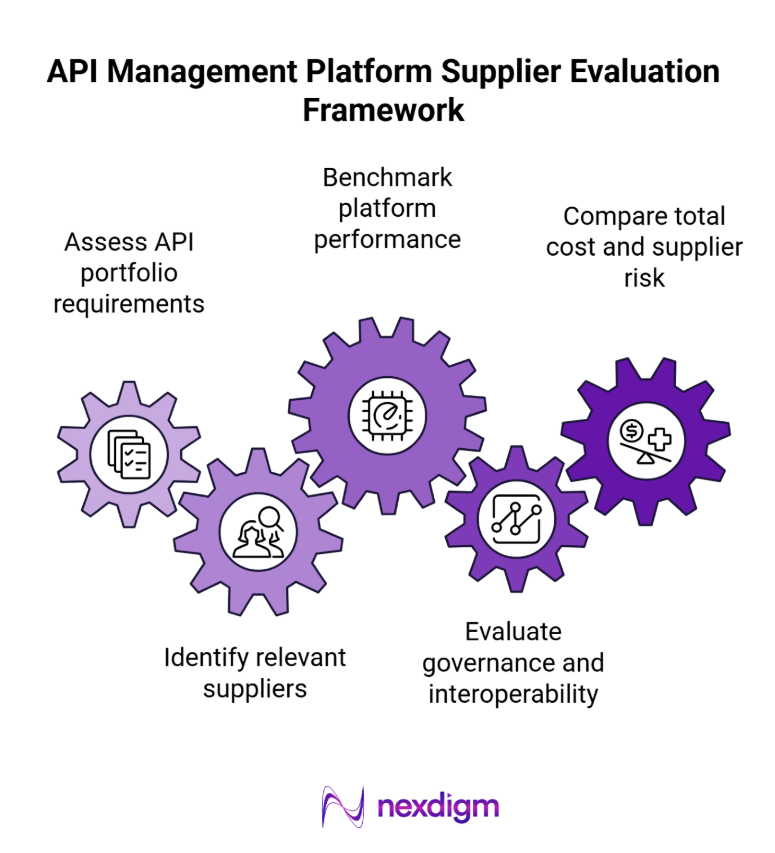
- Assess API portfolio requirements: Map API volumes, consumer groups, deployment environments, security needs and lifecycle maturity.
- Identify relevant suppliers: Segment providers by gateway architecture, lifecycle capabilities, cloud support and enterprise integration.
- Benchmark platform performance: Compare latency, throughput, scalability, availability and traffic management.
- Evaluate governance and interoperability: Review security controls, developer experience, standards support and cross-environment management.
- Compare total cost and supplier risk: Assess licensing, infrastructure, migration, support, product roadmap and contractual flexibility.
Nexdigm’s Case Study: Benchmarking API Management Suppliers
Nexdigm assessed 10 API management providers across five evaluation dimensions, compared pricing for three projected usage scenarios and reviewed integration capabilities across seven enterprise systems. The research shortlisted three suppliers for detailed technical and commercial evaluation.
To take the next step, simply visit our Request a Consultation page and share your requirements with us.
Harsh Mittal
+91-8422857704