

India’s pharmaceutical industry has a substantial API manufacturing base, but its sourcing decisions remain shaped by differences in molecule-level capacity, imported intermediates and access to regulated markets. For buyers, identifying a major API manufacturer is only the beginning. The more important question is whether that manufacturer can reliably produce the required molecule, meet the relevant quality and regulatory expectations, and supply the intended market at a commercially viable scale.
This distinction matters because API manufacturing is highly specialised. A company may have a large overall portfolio but limited capacity for a particular molecule. A smaller manufacturer may have deeper process expertise, but a narrower customer base or geographic reach. Supplier comparisons need to reflect these differences.
API Supply Concentration Makes Molecule-Level Research Essential
India’s dependence on imported APIs and key starting materials varies considerably by product. Government data released in 2026 put imports of APIs, bulk drugs and drug intermediates at approximately US$4.35 billion in FY2024–25, with China accounting for a substantial share. This concentration creates exposure to trade restrictions, production interruptions and changes in the availability of upstream chemical inputs.
However, national import figures do not explain the sourcing position of an individual molecule. Some APIs have several established manufacturers across different countries. Others depend on a limited number of production facilities or specialised intermediates. A buyer looking to diversify supply therefore needs to understand the actual manufacturing route and the number of commercially viable producers.
This requires mapping the supplier base beyond company names. Relevant questions include where the API is manufactured, whether the supplier produces its own key intermediates, and whether alternative sources have the technical and regulatory standing to serve the same market.
Production Scale Is Meaningful Only When It Matches the Required Molecule
A manufacturer’s total production capacity can create an impression of scale without revealing how much capacity is available for a specific API. Production technologies differ across chemical synthesis, fermentation, extraction, and other specialised processes. Capacity cannot simply be transferred between unrelated molecules.
A supplier assessment should distinguish between installed capacity, actual output and capacity potentially available to new customers. It should also consider batch sizes, production utilisation, facility configuration, and the time required to expand output.
India’s bulk-drug manufacturing incentives have supported new capacity for selected key starting materials, drug intermediates and APIs. These investments indicate efforts to strengthen domestic supply, but the existence of new capacity does not establish that every molecule is locally available at competitive prices. Product-level research remains necessary.
Regulatory Track Record Shapes Access to Pharmaceutical Markets
Regulatory standing influences whether an API supplier can serve the market for which a buyer is sourcing. A manufacturer supplying domestic customers may have a different approval and inspection profile from one supplying pharmaceutical companies in the United States or European Union.
The assessment should focus on the relevant manufacturing site and product. A company’s overall reputation cannot substitute for checking the facility that will actually manufacture the API. Buyers should review applicable GMP credentials, inspection history, product documentation, data integrity practices and experience supplying regulated markets.
Regulatory findings also need to be interpreted carefully. An inspection observation, warning letter or import restriction may relate to a specific facility, process or product. It should not automatically be treated as evidence about every operation conducted by the company.
For procurement teams, regulatory research helps establish which suppliers are commercially relevant and which require further investigation before qualification.
Market Reach and Product Specialisation Distinguish API Manufacturers
India’s API supplier landscape includes diversified pharmaceutical companies and specialist manufacturers such as Divi’s Laboratories, Aurobindo Pharma, Laurus Labs, Hikal and Neuland Laboratories. Their strengths differ across therapeutic categories, process chemistry, complex APIs, fermentation, and export markets.
A supplier’s market reach can be understood through its manufacturing locations, customer geography, export exposure, product registrations and relationships with finished-dose manufacturers. Its product specialisation is equally important. A company with established expertise in complex chemistry may be more relevant for a particular molecule than a larger manufacturer with a broader but less specialised portfolio.
A structured API supplier landscape analysis brings these factors together. It helps buyers understand where relevant production capacity is located, which manufacturers have experience with the required product category, and how concentrated the supply market may be.
Nexdigm’s procurement research can support API manufacturer identification, facility and product profiling, regional market comparisons and analysis of import dependencies. The resulting market intelligence helps procurement teams identify relevant suppliers before undertaking technical qualification and regulatory due diligence.
Critical API Supplier Assessment Framework
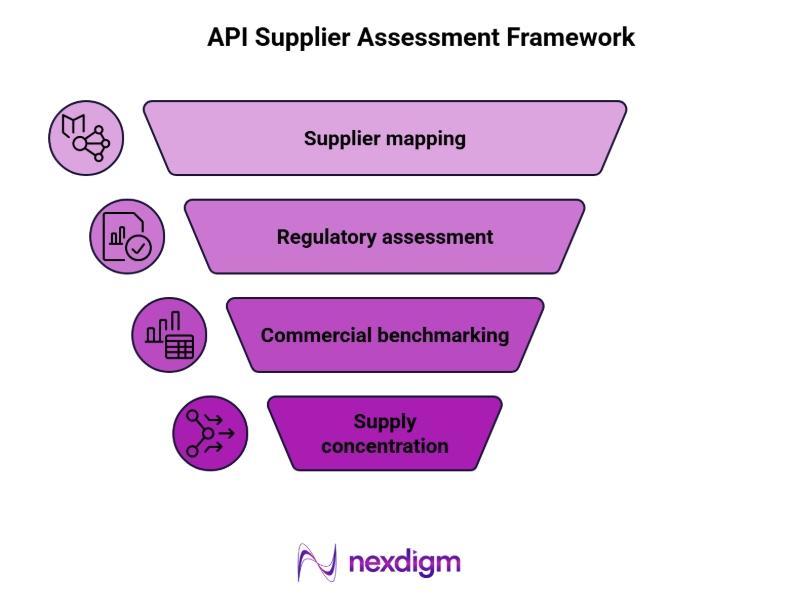
- Molecule and market definition: Establish the API, therapeutic application, quality specifications, required volume and destination-market requirements.
- Supplier and production mapping: Identify manufacturers by molecule, manufacturing process, facility location, capacity indicators and market presence.
- Regulatory-profile assessment: Examine relevant facility credentials, GMP status, inspection history and product documentation.
- Commercial and capacity benchmarking: Compare production scale, utilisation indicators, input dependencies, market reach and commercial positioning.
- Supply concentration and alternative-source analysis: Assess geographic dependence, upstream intermediates, manufacturing concentration and potential alternative suppliers.
Case Study: Mapping Critical API Manufacturers
A pharmaceutical company reviewing sourcing options for selected APIs needed to reduce dependence on concentrated supply markets. Nexdigm’s research mapped 22 manufacturers across 5 countries, compared product portfolios and facility footprints, and identified 6 suppliers for further molecule-specific and regulatory evaluation.
To take the next step, simply visit our Request a Consultation page and share your requirements with us.
Harsh Mittal
+91-8422857704