

Marine capture landings have remained broadly constrained at around 3.5–3.8 million metric tonnes, while inland freshwater aquaculture and coastal farming have become the primary sources of production growth. This transition is creating two very different commercial markets: export-oriented shrimp farming with high revenue potential but significant external risk, and freshwater aquaculture serving a rapidly expanding domestic protein market.
For investors and aquaculture companies, the opportunity lies in determining which species, geographies, and routes to market can support scalable economics.
Shrimp Remains the Export Engine, With Concentrated Risk
India’s coastal aquaculture industry is heavily concentrated around Pacific white shrimp, Litopenaeus vannamei.
The species has created a significant export ecosystem across Andhra Pradesh, Odisha, and Gujarat, supported by hatcheries, feed suppliers, processors, cold storage, and export infrastructure.
But concentration creates vulnerability. Disease outbreaks such as EHP and WSSV can disrupt farm productivity, while international trade measures can rapidly alter export economics. Exposure to the United States market adds another layer of uncertainty through trade duties and changing market-access conditions.
Shrimp offers significant value density, but its growth equation is closely tied to disease control and international market access.
Freshwater Aquaculture Has a Different Growth Engine
Freshwater farming is increasingly linked to domestic consumption rather than export dependence.
Rohu and Catla remain important Indian Major Carp species, while Pangasius and GIFT Tilapia offer opportunities for more intensive production systems.
These species benefit from access to domestic urban markets across Northern, Central, and Eastern India. They also require less capital than large-scale shrimp operations in many production models. This creates a potentially broader expansion pathway because demand does not depend exclusively on international seafood prices.
Species Economics Are Only Half the Opportunity
Species selection needs to be connected to the entire production system.
A commercially attractive species still requires reliable seed, suitable water conditions, feed availability, disease management, harvesting infrastructure, and a market willing to absorb the resulting volume.
GIFT Tilapia, for example, can support value-added fillet markets where processing and organized retail are available. Pangasius can fit volume-driven domestic markets. Rohu and Catla remain strongly linked to regional wholesale demand.
The best species therefore varies by geography and route to market.
Geography Is Dividing the Aquaculture Opportunity
Shrimp production is concentrated along India’s eastern and western coastlines, with Andhra Pradesh representing a major production cluster around Nellore, Krishna, and West Godavari.
Freshwater aquaculture is much more geographically dispersed. West Bengal, Bihar, Uttar Pradesh, and Chhattisgarh provide access to large domestic consumption centres, creating shorter supply chains for fresh fish.
This distinction matters because fish is highly perishable. A freshwater farm located close to a major urban market may achieve a different economic outcome from an equally productive farm that requires long-distance refrigerated distribution.
Market proximity can therefore be a productivity variable in its own right.
Processing Can Unlock a Second Demand Layer
Fresh fish markets remain important, but processing can expand the addressable market.
Skinless fillets, portioned products, frozen seafood, and ready-to-cook formats can connect aquaculture producers with modern retail, QSRs, hotels, and institutional foodservice.
This also changes the requirements for production. Processors need predictable size, quality, volumes, traceability, and harvesting schedules.
For aquaculture enterprises, integration between farming and processing can therefore create more predictable demand than reliance on spot wholesale markets.
Diversification Is Becoming a Strategic Question
An aquaculture market demand analysis should examine species concentration, domestic and export demand, disease exposure, seed availability, production economics, processing infrastructure, and market access together.
The next growth market may not be the species with the highest farm-gate price. It may be the one that combines scalable production with resilient demand and manageable operating risk.
Nexdigm’s Species-Market Diversification Framework
Nexdigm evaluates aquaculture growth opportunities across five decision dimensions:
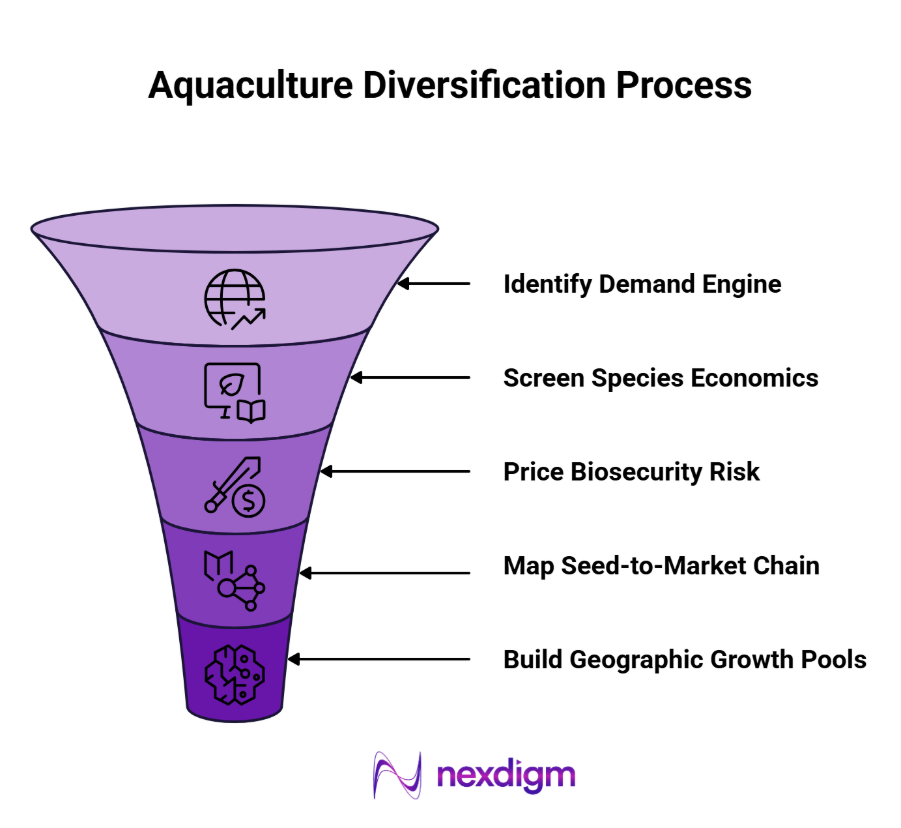
- Identify the Demand Engine: Separate export-driven and domestic demand by species, destination, consumption pattern, price realization, and channel growth to determine where future volumes can be absorbed.
- Screen Species Economics: Compare farm-gate realization, stocking requirements, feed costs, production cycles, capex, survival rates, and expected margins across species and farming systems.
- Price Biosecurity Risk: Evaluate disease prevalence, water quality, stocking practices, hatchery standards, and biosecurity infrastructure to understand the operational risk attached to each production cluster.
- Map the Seed-to-Market Chain: Assess hatchery capacity, seed availability, feed supply, collection networks, cold storage, processing capacity, and distribution infrastructure to identify scalable ecosystems.
- Build Geographic Growth Pools: Overlay production potential with urban demand, export gateways, processing clusters, logistics costs, and infrastructure to prioritize locations for expansion or diversification.
Case Study: Nexdigm’s Hatchery-to-Processing Species Diversification
A seafood processing and export house in Visakhapatnam faced margin pressure after US trade measures coincided with EHP-related harvest delays across its contracted shrimp ponds.
Nexdigm developed a diversification strategy that converted 120 hectares of coastal land toward intensive GIFT Tilapia production, supplemented by reservoir cage concessions. The company also commissioned a processing line for skinless, boneless fresh fillets targeting modern retail and QSR customers in Hyderabad and Bengaluru.
Within 24 months, non-shrimp domestic sales represented 28% of corporate turnover, reducing the company’s concentration in export shrimp and creating a second demand channel through domestic processed seafood.
To take the next step, simply visit our Request a Consultation page and share your requirements with us.
Harsh Mittal
+91-8422857704