
Extended reality is separating into two distinct commercial trajectories. Dedicated VR and mixed-reality headsets continue to serve high-value applications, while lightweight, AI-enabled smart glasses are moving closer to everyday use. IDC recorded 2.25 million display-less smart glasses shipments in Q1 2026, up 167% year over year, and expects the category to reach 13.6 million units in 2026 and 27.3 million by 2030.
The contrast with conventional VR is significant. Consumer VR headset shipments declined 18% year over year in Q2 2026, reflecting persistent barriers around device weight, comfort, price, and limited applications beyond gaming. The commercial opportunity is therefore becoming increasingly dependent on identifying where immersive or hands-free computing solves a measurable problem.
Smart Glasses Are Expanding the Addressable Market
The growth of smart glasses is partly driven by their form factor. Display-less devices can provide voice interaction, camera-based computer vision, and AI assistance without isolating users from their surroundings. Their lower hardware complexity also makes them more suitable for everyday wear than enclosed headsets.
IDC’s 2026–2030 projections point to continued expansion, with smart glasses shipments expected to nearly double from 13.6 million to 27.3 million units. Optical see-through AR is targeting more specialized applications, including industrial telemetry and precision assembly, while VR and MR headsets retain relevance in spatial computing, design, simulation, and other controlled environments.
This creates two distinct adoption models: lightweight devices designed around frequent interaction and specialized headsets justified by high-value workflows.
Enterprise Applications Have a Clearer Economic Case
Enterprise XR adoption is strongest where visual information can directly improve productivity, accuracy, training, or safety. Field-service technicians can use AR glasses to access repair instructions or connect with remote specialists while keeping both hands available. Manufacturers can overlay operational information onto machinery, while warehouses can use visual prompts to guide picking and navigation.
Training is another strong application. Industrial operators can simulate hazardous procedures without exposing workers or equipment to operational risk. Aerospace assembly, offshore operations, electrical maintenance, and other complex environments can benefit when repeated physical training is expensive or difficult to arrange.
Healthcare provides a separate opportunity through surgical visualization, clinical education, and spatial representations of medical data. The common commercial factor across these use cases is measurable operational impact rather than immersion itself.
From Digital Twins to Frontline Workflows
XR becomes more valuable when it is connected to existing enterprise systems. A digital twin can provide real-time information about equipment, while an AR interface can make that information accessible directly at the point of work.
A technician inspecting a machine, for example, could see temperature, pressure, maintenance history, and diagnostic instructions without moving between a physical asset and a separate terminal. Similar integration can connect XR devices with ERP, computerised maintenance management systems, product lifecycle management platforms, and warehouse systems.
The resulting value can be measured through operational metrics such as mean time to repair, picking accuracy, assembly errors, training duration, and equipment downtime. This gives enterprise buyers a stronger basis for deciding where XR should be deployed first.
Adoption Depends on the Economics of the Workflow
An AR VR technology market assessment needs to examine the economics of specific workflows rather than treating the XR market as a single opportunity. Hardware cost is only one component. Device management, software integration, connectivity, training, maintenance, and replacement cycles also affect total deployment cost.
The business case becomes stronger when a device addresses expensive labour or high-frequency errors. Field service, manufacturing, logistics, healthcare, and industrial training can justify higher device costs when improvements in productivity or accuracy produce measurable savings.
Consumer adoption follows a different logic. Devices need to be comfortable, socially acceptable, easy to use, and useful frequently enough to justify purchase. Smart glasses have an advantage here because they can blend into normal routines rather than requiring users to enter a separate virtual environment.
The Consumer and Enterprise Markets Are Converging Differently
The two markets are beginning to share underlying technologies, particularly cameras, computer vision, spatial computing, voice interfaces, and AI assistants. Their commercial requirements remain different.
Enterprise buyers prioritize reliability, security, device management, integration, and measurable ROI. Consumers prioritize comfort, design, battery life, price, and everyday usefulness. A product designed for one segment cannot automatically assume demand in the other.
For manufacturers and software providers, this makes segmentation critical. The most attractive opportunity may lie in specialized enterprise hardware, consumer smart glasses, vertical applications, or software connecting XR devices with existing operational systems.
Nexdigm XR Opportunity Assessment Framework
Nexdigm can evaluate XR opportunities through five decision areas:
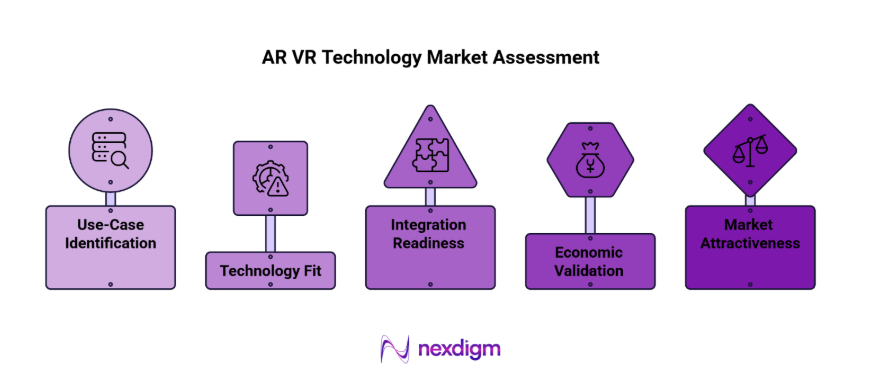
- Use-case identification: Locate workflows with high labour costs, error rates, training requirements, or safety exposure.
- Technology fit: Match VR, MR, optical see-through AR, and smart-glass formats to the operating environment.
- Integration readiness: Assess compatibility with ERP, CMMS, PLM, digital twin, warehouse, and clinical systems.
- Economic validation: Quantify productivity gains, error reduction, training savings, downtime reduction, and deployment costs.
- Market attractiveness: Compare customer demand, competitive intensity, pricing, adoption barriers, and scalable application segments.
Nexdigm XR Commercialization Lens
A 100-technician field-service deployment at an average hardware and software cost of $2,500 per seat would require $250,000 in initial investment. If AR-enabled workflows reduce mean time to repair by 25% and training time by 40%, the resulting labour and downtime savings can be translated into annual financial impact and payback period. This allows XR opportunities to be ranked by ROI, payback period, adoption potential, and scalability, rather than hardware demand alone.
To take the next step, simply visit our Request a Consultation page and share your requirements with us.
Harsh Mittal
+91-8422857704