

Entering a new asset management market requires more than identifying a growing pool of investable wealth. An asset manager needs to determine where wealth is forming, what investors are likely to buy, how products can differentiate, and which distribution channels can build AUM at an acceptable cost.The central challenge is reaching sufficient scale before fixed investment-management, technology, compliance, and distribution costs erode returns.
Start With the Wealth Pool, Not the Product
India’s mutual fund industry reached ₹73.73 lakh crore in AUM in March 2026, with SIP assets at ₹15.11 lakh crore. Yet wealth and investment activity remain unevenly distributed across markets.
Metropolitan centres remain important for institutional, HNI, and family-office capital, but they also have dense competition among established AMCs and distributors. B30 cities and secondary commercial centres can offer growing household savings, formalizing businesses, and increasing participation in market-linked investments.
The opportunity therefore lies in identifying where incremental investable flows are forming, rather than simply targeting markets with the highest existing AUM.
Existing Wealth Reveals the Conversion Opportunity
The composition of household wealth can indicate where an entrant can capture new assets. Physical assets such as property and gold remain significant, while bank deposits continue to attract investors prioritizing capital stability.
Different investor cohorts require different propositions:
- First-time investors may prefer diversified or lower-volatility strategies.
- Mass-affluent investors can provide longer-duration equity and SIP assets.
- HNIs and family offices may seek AIFs, private credit, or alternative strategies.
- Institutional investors typically prioritize liquidity, cost, and risk-adjusted performance.
This segmentation provides the basis for determining which wealth pools are commercially addressable.
Product Strategy Has to Match the Investor
An entrant competing against established AMCs needs a product proposition that offers a clear reason to switch or allocate new money.
Product selection should consider:
- Target investor segment
- Competitive product penetration
- Expected fee realization
- Regulatory expense limits
- Distribution attractiveness
- Expected holding period
- Differentiation and cross-sell potential
A strong investment strategy can still struggle commercially if distributors have limited incentive to recommend it or if the available fee pool cannot support acquisition costs.
Distribution Is the Route to AUM
Asset management has significant operating leverage, but that leverage emerges only after sufficient scale. Research, portfolio-management systems, compliance, technology, and governance create fixed costs that cannot be reduced proportionally at low AUM.
Distribution therefore becomes a central entry decision.
IFAs and MFDs provide local access and trust, particularly across secondary markets. Private banks and national wealth platforms provide access to HNI and institutional capital but typically impose stronger product and track-record requirements. Digital platforms can efficiently reach younger investors and SIP customers, although lower average balances make scale important.
A hybrid distribution model can combine local relationships with digital reach.
AUM Scale Determines Commercial Viability
An entry strategy needs a realistic path from initial distribution to operating break-even. The financial model should connect AUM growth with product mix, fee margins, distributor payouts, technology costs, personnel, compliance, and acquisition expenditure.
The research indicates that ₹15,000 crore–₹25,000 crore of equity-heavy AUM within 36–48 months can provide a useful benchmark when assessing the path to corporate break-even, although the actual threshold varies by product mix and fee realization.
Nexdigm’s Asset Management Market Entry Framework
Nexdigm structures an asset management market entry consulting engagement around five workstreams:
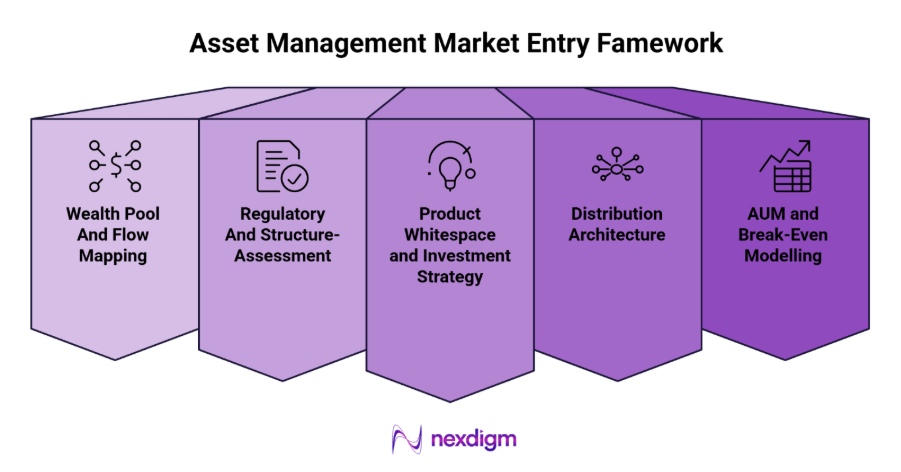
- Wealth Pool and Flow Mapping: Identify wealth accumulation, deposit growth, SIP activity, investor demographics, and existing investment penetration.
- Regulatory and Structure Assessment: Evaluate the appropriate AMC, PMS, or AIF structure, licensing requirements, governance, and fiduciary obligations.
- Product Whitespace and Investment Strategy: Identify underserved investor segments and determine the appropriate active, passive, thematic, or alternative product mix.
- Distribution Architecture: Assess IFAs, MFDs, private banks, digital platforms, and partnerships based on reach and AUM economics.
- AUM and Break-Even Modelling: Project AUM, fee compression, distribution costs, operating expenditure, capital requirements, and the timeline to break even.
The resulting roadmap establishes where to enter, whom to target, what to launch, which channels to prioritize, and how quickly AUM must scale.
How Nexdigm Identifies the Right Wealth Markets and Entry Model
An international asset manager with more than $35 billion in global assets evaluated entry into India’s mutual fund and PMS market, targeting ₹28,000 crore in domestic AUM within five years. Nexdigm assessed 14 urban and semi-urban markets, identifying tier-2 corridors with 26% annualized growth in retail equity SIPs and underserved distributor networks. A hybrid model targeting 3,000 active IFAs projected ₹30,200 crore AUM by Year 5 and operating break-even by month 39.
To take the next step, simply visit our Request a Consultation page and share your requirements with us.
Harsh Mittal
+91-8422857704