

The asset management opportunity is expanding alongside changes in where wealth is created, how households hold it, and how investors access financial products. Wealth creation is spreading beyond traditional financial centres as entrepreneurship, skilled employment, capital-market participation, and intergenerational transfers expand the pool of investable capital.
In emerging markets, households are also moving gradually from physical and low-yielding assets toward more liquid financial instruments. This creates opportunities for asset managers that can identify where new wealth is forming and match products and distribution models to investor needs.
Wealth Is Moving Across Products
The opportunity is not simply a larger pool of financial assets. It is also a shift in how existing wealth is allocated.
Bank deposits and physical real estate have historically represented substantial portions of household wealth in markets such as India. Mutual funds, listed equities, REITs, ETFs, and alternative investments are increasingly providing mechanisms for investors seeking liquidity, diversification, and potentially higher long-term returns.
This creates several areas of opportunity:
- Mutual fund SIPs and diversified equities for investors moving beyond traditional deposits.
- REITs and infrastructure investment trusts for investors seeking liquid exposure to property and infrastructure.
- Gold ETFs and other financial gold products for investors seeking liquidity without physical storage.
- PMS and alternative funds for wealthier investors seeking more sophisticated portfolio construction.
For asset managers, understanding these allocation shifts can be more valuable than simply measuring total household wealth.
Investable Wealth Is Spreading Beyond Major Financial Centres
The geography of wealth creation is also changing. Industrial expansion, infrastructure investment, entrepreneurship, and digital connectivity are creating new pools of investable capital in secondary and tertiary cities.
India’s mutual fund industry reached 5.9 crore unique investors by December 2025, with more than 3.5 crore coming from non-Tier-I and Tier-II cities. Monthly SIP contributions have also exceeded ₹28,000 crore, indicating sustained participation in capital-market products outside traditional metropolitan centres.
An asset management market opportunity analysis can help firms identify these emerging wealth clusters before distribution infrastructure becomes saturated, combining regional wealth indicators with investor behaviour and product demand.
Different Wealth Pools Require Different Strategies
The investable wealth pool is highly heterogeneous. A mass-retail investor may need low-ticket products and simple digital onboarding, while an emerging affluent household may require personalized allocation and tax-efficient solutions.
HNI and family-office segments introduce different requirements, including PMS, private markets, structured investments, succession planning, and direct co-investment opportunities.
Distribution therefore needs to evolve alongside the wealth segment:
- Mass retail: Digital onboarding, passive funds, micro-SIPs, and automated investment.
- Emerging affluent: Hybrid advisory, multi-asset strategies, and personalized allocation.
- HNI: Relationship-led advisory, PMS, corporate debt, and structured investments.
- Ultra-HNI and family offices: AIFs, private equity, venture debt, succession structures, and institutional-style opportunities.
The strongest opportunity may therefore sit where wealth is growing but specialized financial products and advisory infrastructure remain limited.
Nexdigm’s Asset Management Opportunity Framework
Nexdigm evaluates emerging asset management markets by connecting the size of the wealth pool with investor behaviour, product demand, competitive intensity, and distribution economics.
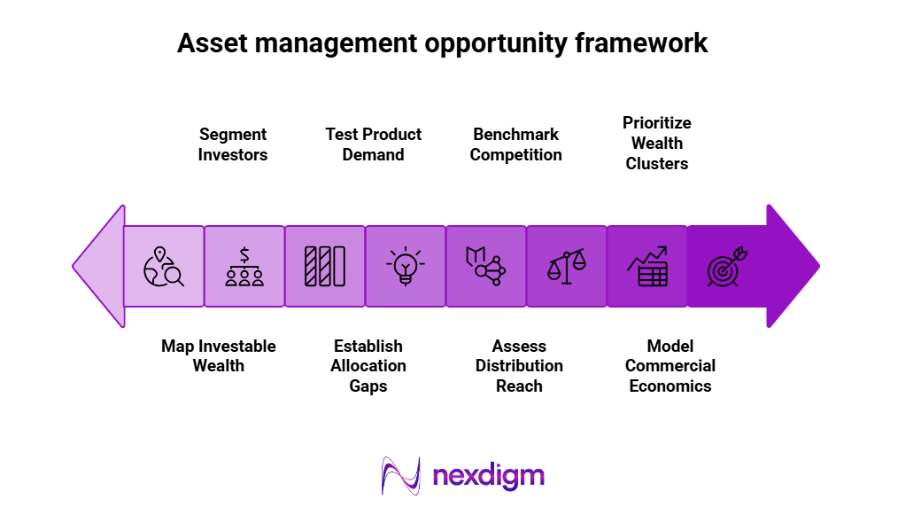
- Map Investable Wealth: Quantify liquid financial wealth, deposits, business liquidity events, property transactions, and other sources of deployable capital.
- Segment Investors: Classify households and businesses by investable wealth, financial sophistication, liquidity requirements, and investment objectives.
- Establish Allocation Gaps: Determine how much wealth remains concentrated in deposits, physical assets, direct equities, or other traditional holdings.
- Test Product Demand: Assess demand for equity, fixed income, passive products, multi-asset strategies, PMS, AIFs, and other alternatives.
- Assess Distribution Reach: Map IFAs, brokers, wealth managers, private banking networks, digital platforms, and their regional penetration.
- Benchmark Competition: Evaluate incumbent AUM, brand strength, distributor relationships, product breadth, and local presence.
- Model Commercial Economics: Assess fees, commissions, acquisition costs, expense ratios, retention, and expected AUM economics.
- Prioritize Wealth Clusters: Rank markets according to wealth creation, product gaps, competitive whitespace, distribution readiness, and long-term AUM potential.
This approach helps asset managers decide where to establish presence, which investor segments to target, and which products can capture emerging pools of wealth.
How Nexdigm Identifies the Next Wealth Pools
An asset management firm evaluated 20 secondary and tertiary cities across six wealth categories, combining property transactions, commercial activity, and banking deposits to identify emerging investment pools.
The analysis identified approximately ₹4.2 trillion ($50.4 billion) in liquid investable wealth across three manufacturing and agro-processing hubs, much of it concentrated in deposits and physical assets.
The firm subsequently established local distribution capabilities and launched targeted multi-asset and systematic investment products, generating a ₹2,800 crore ($336 million) in net new AUM within 18 months.
To take the next step, simply visit our Request a Consultation page and share your requirements with us.
Harsh Mittal
+91-8422857704
[email protected]