

Banks and financial institutions should evaluate ATM and POS suppliers as providers of connected technology and service ecosystems. Hardware specifications matter, but equipment performance also depends on software compatibility, network connectivity, maintenance arrangements, spare-parts availability and the supplier’s ability to support geographically distributed installations.
The requirements for ATMs and POS systems are different, even though both support customer transactions. ATMs involve cash handling, security, replenishment coordination and physical-site availability. POS systems must support merchant payment acceptance across varied business environments, transaction types and connectivity conditions. A supplier may be strong in one category without being equally competitive in the other.
ATM Suppliers: Hardware Performance and Cash Operations
ATM procurement involves more than selecting a machine with the required cash capacity. Banks need equipment suited to installation environments, transaction volumes, accessibility requirements and security arrangements.
Relevant hardware considerations include cash dispenser performance, deposit functionality where applicable, card and contactless interfaces, display systems, biometric options and physical security features. Equipment reliability should be assessed through maintenance history, component availability and the supplier’s ability to support different machine configurations.
Software is equally important. ATM operating systems, transaction applications, remote monitoring and integration with banking networks determine how the equipment functions within the wider banking environment.
Buyers should examine software support periods, patch management, compatibility with transaction switches and the availability of remote diagnostics. The ability to monitor cash levels, detect faults and manage software updates remotely can influence operating costs across large ATM fleets.
POS Suppliers: Supporting Diverse Merchant Requirements
POS suppliers serve a wider range of operating environments. A large retail chain may require integrated billing and inventory functions, while a small merchant may need a compact terminal with straightforward payment acceptance.
Banks and acquiring institutions have additional requirements involving terminal provisioning, merchant onboarding, transaction routing, remote configuration and service management.
Supplier comparisons should consider supported payment methods, device compatibility, connectivity options, software update processes and integration with acquiring systems. Hardware durability matters because terminals may operate in environments with varying power supply, network quality, temperature and usage intensity.
The supplier’s ability to support both traditional POS terminals and newer acceptance technologies should also be examined. QR-based payments, contactless transactions and mobile-enabled acceptance have changed the competitive landscape for merchant infrastructure.
Service Coverage Can Determine the Actual Value of a Supplier
An equipment supplier with attractive pricing may be unsuitable if its maintenance network is limited to major cities. Banks operating across smaller towns and rural locations need access to technicians, replacement components and escalation support across their deployment footprint.
For ATMs, downtime can affect cash availability and customer access. For POS systems, terminal failure can interrupt merchant sales and create transaction disputes. Service coverage should therefore be assessed against the actual geographic distribution of installations.
Key service indicators include response times, repair completion, first-time resolution, spare-parts availability, preventive maintenance schedules and escalation arrangements. Buyers should also distinguish between the manufacturer’s support commitments and those of local service partners.
Market Scale Makes Supplier Selection More Complex
India’s payment acceptance infrastructure has expanded substantially, but the composition of that infrastructure is changing. RBI data recorded approximately 2.6 lakh ATMs and more than 110 lakh POS terminals in March 2025. The same period showed a much larger footprint of UPI QR acceptance points.
For banks and suppliers, this creates different demand patterns. ATM procurement is increasingly linked to replacement, uptime and cash-management requirements, while POS opportunities are influenced by merchant expansion, payment-method adoption and the economics of terminal deployment.
The supplier market should consequently be segmented by equipment type, software capabilities, service model and customer category. A vendor with a large ATM installation base may not necessarily be the strongest option for merchant POS technology.
Where ATM and POS supplier evaluation services Add Value
A market-led assessment helps banks understand the available supplier base before issuing a tender or committing to a technology architecture. Nexdigm’s research can support this process through supplier identification, product and capability mapping, geographic coverage analysis and commercial benchmarking.
The assessment should distinguish between equipment manufacturers, software providers, system integrators and managed service partners. It should also identify where suppliers depend on subcontractors or third-party maintenance networks, since these relationships can affect service quality and continuity.
ATM and POS Supplier Evaluation Framework
A practical evaluation should follow the operational differences between the two categories:
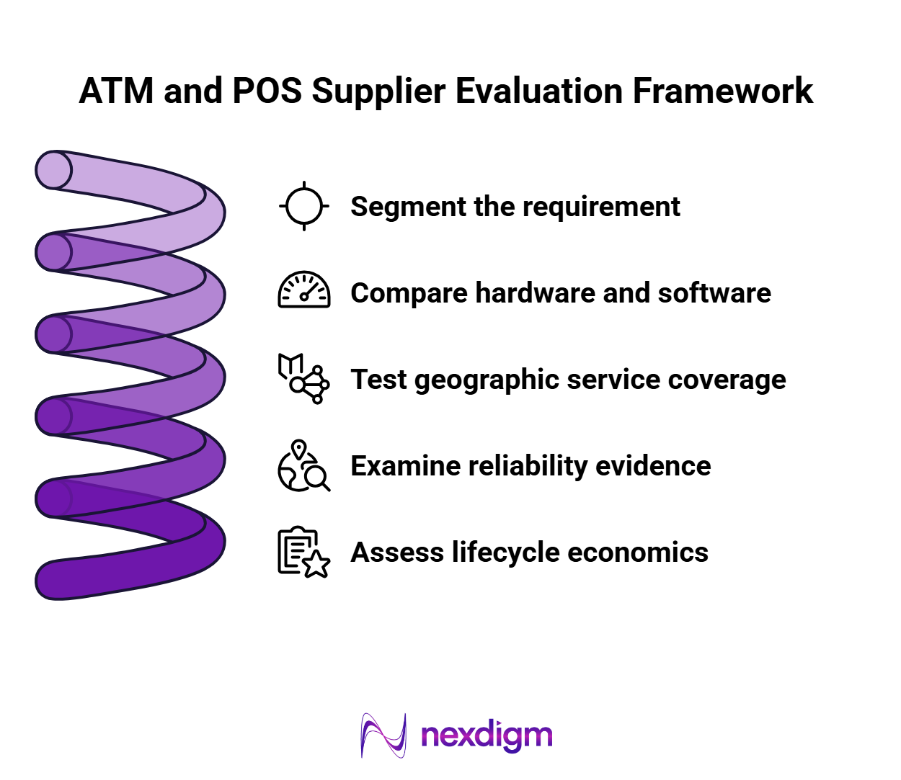
- Segment the requirement: Separate ATM and POS demand by equipment type, transaction volume, location profile and operating environment.
- Compare hardware and software: Review technical specifications, compatibility, functionality, support periods and integration with banking systems.
- Test geographic service coverage: Map installation locations against technician availability, maintenance facilities and spare-parts networks.
- Examine reliability evidence: Compare uptime definitions, repair performance, incident handling and remote monitoring capabilities.
- Assess lifecycle economics: Include acquisition, installation, connectivity, maintenance, software support and replacement costs in the comparison.
Case Study: ATM and POS Supplier Assessment
A regional bank reviewing its acceptance infrastructure assessed 12 ATM suppliers and 15 POS providers. The research compared device specifications, service footprints and software compatibility across 180 planned locations. It identified four ATM and five POS suppliers for detailed commercial and technical evaluation.
To take the next step, simply visit our Request a Consultation page and share your requirements with us.
Harsh Mittal
+91-8422857704