

ATM networks remain an important part of banking infrastructure, but procurement decisions are becoming more complex as financial institutions balance cash accessibility, operating costs, and digital transformation. According to Datos Insights, the global ATM installed base declined by 2% to approximately 2.9 million units in 2025. However, global ATM shipments increased by 1% to 293,400 units, with cash recyclers accounting for 60% of shipments.
These contrasting trends highlight the need for banks to reassess how they acquire, operate, and maintain ATM networks. ATM procurement benchmarking BFSI sector analysis can help institutions compare vendor offerings, evaluate service models, and identify commercially competitive procurement structures.
The Changing Economics of ATM Procurement
ATM procurement extends beyond the initial cost of acquiring machines. Banks must consider installation, software, connectivity, cash management, maintenance, security, and ongoing technical support. Decisions also involve choosing between direct ownership, outsourced operations, and ATM-as-a-Service arrangements. Each model carries different cost structures, service responsibilities, and operational dependencies, making comprehensive vendor and commercial comparisons essential.
Factors That Influence ATM Procurement Competitiveness
ATM procurement competitiveness depends on evaluating the total cost of ownership, service-level performance, and operating model flexibility. Banks need to compare equipment, installation, maintenance, and cash management costs while assessing uptime commitments, response times, and repair efficiency. They must also determine whether direct ownership, outsourcing, or ATM-as-a-Service offers the right balance of cost, control, and scalability.
How Nexdigm Identifies ATM Procurement Competitiveness
Evaluating ATM procurement competitiveness requires identifying where existing sourcing arrangements may be creating additional costs or limiting operational efficiency. Nexdigm can help BFSI organizations examine market and opportunities through:
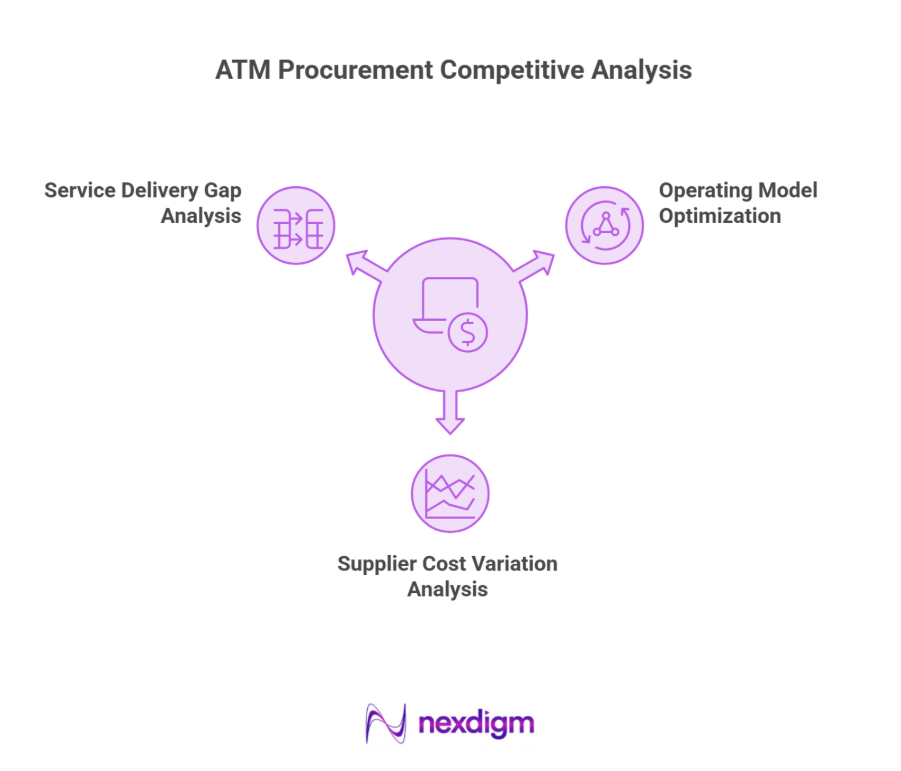
- Supplier Cost Variations: Compare vendor pricing across ATM equipment, maintenance, and managed services to identify potential cost differences and areas for further evaluation.
- Service Delivery Gaps: Assess differences in uptime, maintenance response, repair turnaround, and service coverage to identify opportunities for improving vendor performance.
- Operating Model Optimization: Examine ownership, outsourcing, and ATM-as-a-Service arrangements to identify sourcing structures that better align with operational and commercial requirements.
These insights help financial institutions prioritize procurement reviews, strengthen supplier evaluations, and identify opportunities to improve ATM network cost efficiency and competition.
Nexdigm’s Benchmarking Insights To Strengthen ATM Vendor Selection Process
Once procurement gaps and improvement areas have been identified, financial institutions need to evaluate which suppliers can deliver the right combination of cost efficiency and service reliability. Through ATM procurement benchmarking BFSI sector research, Nexdigm can support this process through:
- Vendor Capability Assessment: Evaluate manufacturers and service providers based on technology offerings, operational reach, maintenance capabilities, and industry experience.
- Comparative Supplier Evaluation: Compare shortlisted vendors across pricing, service commitments, contract terms, and delivery capabilities to understand their relative market positioning.
- Sourcing Decision Support: Use supplier intelligence and benchmarking findings to support vendor shortlisting, procurement planning, and commercial negotiations.
- Service Coverage Evaluation: Examine geographical reach, maintenance networks, technical support availability, and response capabilities across potential suppliers.
- Contract Performance Assessment: Review vendor obligations, service-level commitments, performance measures, and contractual terms to identify areas requiring improvement.
These insights enable BFSI organizations to make informed supplier choices, strengthen procurement negotiations, and align ATM sourcing decisions with long-term operational and commercial priorities.
Nexdigm’s Benchmarking Approach Leading to Procurement Negotiations
Nexdigm’s benchmarking insights can help BFSI organizations strengthen procurement negotiations across several commercial and operational areas. These include:
- Equipment Pricing: Establish competitive pricing benchmarks for ATM machines, cash recyclers, and associated hardware.
- Maintenance and Support Costs: Compare annual maintenance charges, spare-part costs, repair fees, and technical support expenses.
- Service-Level Agreements: Strengthen negotiations around uptime commitments, response times, resolution periods, and service performance penalties.
- Cash Management Services: Evaluate cash replenishment, transportation, handling, and related service charges to identify commercial improvement opportunities.
- Vendor Performance Commitments: Align supplier obligations, reporting requirements, and performance measures with institutional service expectations.
By providing market-backed comparisons across these areas, Nexdigm can help banks strengthen negotiation positions, improve contractual value, and secure more competitive ATM procurement arrangements.
Nexdigm’s Case
A BFSI organization engaged Nexdigm to benchmark 45 ATM suppliers across equipment, maintenance, and cash management. The assessment identified 21% potential cost savings, 16% improvement in service-level performance, and 13% scope for contract optimization. These insights supported stronger negotiations, improved supplier evaluation, and more competitive ATM procurement decisions.
To take the next step, simply visit our Request a Consultation page and share your requirements with us.
Harsh Mittal
+91-8422857704