

ATM expenditure is shaped by the cost of maintaining an entire network, rather than the price of purchasing individual machines. Hardware, cash replenishment, maintenance, connectivity, security, and field support all contribute to the cost of keeping terminals operational.
These expenses can vary substantially across locations. A high-traffic urban ATM may require frequent cash replenishment, while a low-volume terminal in a remote area may generate higher servicing costs because of travel distances and limited service coverage. Comparing both locations using a single average cost can conceal important differences.
Banks need to understand these operating conditions before deciding whether supplier pricing is competitive. Cost benchmarking provides a way to compare similar services, examine pricing variance, and identify the commercial assumptions behind existing contracts.
The ATM’s Location Changes Its Cost Structure
The economics of an ATM depend heavily on where it is installed and how customers use it.
Urban terminals may benefit from dense service networks and easier access to maintenance providers, but they can involve higher site and security costs. Rural and semi-urban locations may have lower transaction activity and longer replenishment routes. These differences influence cash management, maintenance frequency, connectivity, and service response requirements.
Transaction activity is another important factor. A high-volume terminal may require more frequent replenishment and maintenance, but it can spread fixed operating costs across a larger number of transactions. A low-volume terminal may have lower direct servicing requirements while remaining expensive to operate relative to its usage.
The ATM network therefore needs to be segmented before costs are compared. Geography, terminal type, transaction volume, age, and service scope should all inform the analysis.
Equipment and Maintenance Costs Need Separate Attention
ATM hardware expenditure depends on machine configuration and functionality. Standard cash dispensers, cash recyclers, deposit-enabled terminals, and machines with additional authentication features have different acquisition and maintenance requirements.
Banks should distinguish between outright purchases, leasing arrangements, and managed deployment models. Each has different implications for capital expenditure, replacement cycles, warranty coverage, and recurring service charges.
Maintenance agreements require similar scrutiny. Some cover preventive maintenance, spare parts, software updates, and fault resolution under a fixed fee. Others charge separately for replacement components, emergency visits, and non-standard repairs.
A low annual maintenance charge may therefore provide limited value if several essential services attract additional fees. The comparison should establish what is included in each contract and how providers price work outside the standard scope.
Cash Management and Connectivity Create Recurring Expenditure
Cash replenishment costs depend on withdrawal patterns, cash holding requirements, replenishment frequency, and route coverage. Providers may charge fixed fees, per-visit rates, or location-based prices. The commercial model needs to be examined alongside the bank’s actual ATM footprint.
Connectivity and monitoring introduce another set of costs. Telecommunications services, remote monitoring, surveillance systems, and security arrangements may be contracted separately or bundled into managed ATM services.
The scale and geographical spread of India’s ATM network make supplier coverage relevant to procurement decisions. Providers may have different capabilities across metropolitan, semi-urban, and rural locations. A supplier’s national presence does not necessarily mean that it can offer the same service coverage or response capability in every region.
Finding Where Pricing Variance Comes From
A useful ATM services procurement cost benchmarking consulting assessment should distinguish between genuine pricing differences and costs caused by different operating conditions.
For example, two providers may charge different maintenance rates because one includes spare parts and emergency visits while the other bills them separately. Similarly, cash replenishment prices may vary because of route density, cash handling requirements, or the number of visits included.
Benchmarking should compare services within similar location and equipment categories. This gives procurement teams a clearer understanding of which differences reflect scope and which may warrant further commercial review.
ATM Services Cost Benchmarking Framework
A structured assessment should examine:
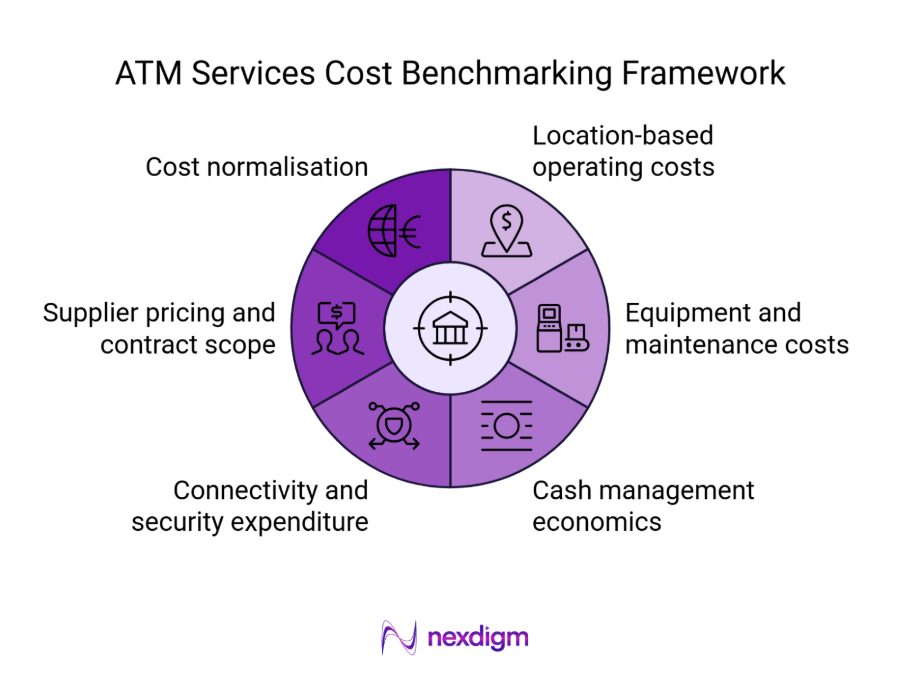
- Location-based operating costs: Compare urban, semi-urban, and rural ATMs based on replenishment frequency, service coverage, and travel requirements.
- Equipment and maintenance costs: Assess hardware prices, terminal age, spare parts, repair charges, and maintenance coverage.
- Cash management economics: Examine cash handling, replenishment cycles, withdrawal patterns, and per-visit charges.
- Connectivity and security expenditure: Compare network costs, monitoring services, surveillance arrangements, and security-related charges.
- Supplier pricing and contract scope: Identify differences in billing models, service inclusions, additional fees, and regional supplier capabilities.
- Cost normalisation: Compare similar terminal types and operating conditions to separate supplier pricing differences from location-related cost variations.
Nexdigm’s market research can support supplier profiling, regional market mapping, service capability comparisons, and commercial benchmarking. The resulting analysis helps banks understand cost differences before entering supplier discussions or planning future sourcing exercises.
Nexdigm’s Case: Location-Based Benchmarking Changed the Cost Comparison
A bank reviewing 3,600 ATM locations grouped terminals by geography, equipment type, and transaction activity. Comparing maintenance and cash replenishment arrangements across these categories revealed that several apparent pricing differences were linked to service scope and location coverage rather than the headline supplier rate.
To take the next step, simply visit our Request a Consultation page and share your requirements with us.
Harsh Mittal
+91-8422857704