

The automotive industry is undergoing one of the most significant transformations in its history. Electrification, supply chain realignment, digitalization, and changing consumer expectations are reshaping how vehicles are designed, manufactured, and serviced. While much attention is focused on vehicle manufacturers, the real shift is increasingly visible across the auto components ecosystem. This leads to a critical industry question: Where is value shifting in auto components, and which areas are positioned to benefit the most from evolving market dynamics?
A detailed Auto component market assessment indicates that value is progressively moving from traditional mechanical components toward technology-enabled systems, localized manufacturing networks, and high-growth aftermarket opportunities. At the same time, supplier relationships with OEMs are evolving as innovation and resilience become strategic priorities.
From a Nexdigm perspective, the future of the auto component industry will be defined not merely by production scale but by the ability to align with changing OEM requirements, localization trends, technological advancements, and lifecycle value creation.
Where Is Value Shifting?
The value shift in the automotive components sector is occurring across four major areas:
- Evolving OEM sourcing requirements
- Localization and supply chain resilience
- Technology-intensive components
- High-margin aftermarket opportunities
Companies that continue to rely solely on traditional manufacturing advantages may find growth increasingly challenging, while those that position themselves around innovation and ecosystem integration are likely to capture greater value.
A forward-looking Auto component market assessment suggests that competitive advantage is increasingly being driven by strategic adaptability rather than manufacturing capacity alone.
OEM Demand: A New Set of Expectations
Vehicle manufacturers are redefining supplier expectations. Historically, component sourcing decisions were largely driven by cost, quality, and delivery performance. Today, OEMs are prioritizing a broader set of criteria.
Emerging OEM Priorities
- Technology Capability: Suppliers are expected to support connected, electric, and software-enabled vehicles.
- Supply Chain Reliability: Manufacturers seek partners capable of maintaining continuity amid disruptions.
- Sustainability Performance: Environmental compliance and ESG metrics are becoming important evaluation criteria.
- Innovation Partnerships: OEMs increasingly prefer suppliers that contribute to product development rather than merely producing components.
As a result, supplier relationships are becoming more strategic and collaborative.
Nexdigm’s Support
At Nexdigm, market evaluations indicate that suppliers must evolve from component manufacturers into solution providers. Organizations should focus on:
- Product Diversification: Reducing dependence on limited product categories improves resilience.
- Customer Portfolio Expansion: Balanced exposure across OEMs can reduce business risks.
- Co-Development Capabilities: Participation in vehicle development programs creates stronger long-term partnerships.
- Manufacturing Agility: Flexibility is becoming a competitive advantage in rapidly changing markets.
A robust Auto component market assessment increasingly highlights supplier adaptability as a major determinant of future success.
Localization: The New Growth Imperative
Global supply chain disruptions have accelerated localization initiatives across automotive markets. Governments and manufacturers are increasingly focused on:
- Domestic manufacturing
- Regional sourcing
- Supply chain security
- Reduced import dependency
- Faster delivery timelines
This shift is creating opportunities for regional component manufacturers that can meet quality, scale, and compliance requirements.
Nexdigm’s Support
From a Nexdigm standpoint, localization represents a strategic business opportunity rather than a temporary operational adjustment. Key areas for evaluation include:
- Regional Manufacturing Expansion: Localized production can improve responsiveness and reduce logistics costs.
- Vendor Ecosystem Development: Strong local supplier networks enhance resilience.
- Incentive Utilization: Manufacturers should actively evaluate government incentives supporting domestic production.
- Trade Risk Mitigation: Regional sourcing can reduce exposure to geopolitical and international trade uncertainties.
Businesses that successfully align with localization priorities are likely to strengthen both competitiveness and profitability.
Technology Is Redefining Value Creation
Perhaps the most significant value migration is taking place in technology-driven components. As vehicles become increasingly electrified and connected, demand is growing for:
- Power electronics
- Sensors
- Advanced driver assistance systems (ADAS)
- Battery-related components
- Connectivity modules
- Software-integrated systems
Traditional mechanical parts remain important, but their share of value creation is gradually declining compared to technology-enabled solutions.
Nexdigm’s Support
At Nexdigm, industry analysis suggests that technology adoption is becoming one of the strongest differentiators within the component sector. A strategic Auto component market assessment reveals that companies investing in technology-driven product development are better positioned to capture future demand.
The Aftermarket Opportunity Is Growing Stronger
While OEM demand attracts significant attention, the aftermarket is emerging as a major source of value creation. Several factors are driving this growth:
- Expanding vehicle parc
- Longer vehicle ownership cycles
- Increasing maintenance requirements
- Rising demand for replacement components
- Growth of digital service platforms
Unlike OEM contracts, aftermarket businesses often provide stronger margins and broader customer access.
Nexdigm’s Support
Nexdigm’s market assessment approach identifies substantial opportunities within the aftermarket ecosystem.
- Spare Parts Expansion: Growing vehicle populations continue to generate replacement demand.
- Digital Distribution Channels: E-commerce is transforming aftermarket purchasing behavior.
- Predictive Maintenance Services: Data-driven maintenance solutions are increasing service efficiency.
- Brand-Led Aftermarket Strategies: Trusted component brands can command premium positioning and customer loyalty.
For many suppliers, aftermarket participation offers an attractive pathway to revenue diversification and margin improvement.
Where Are the Fastest-Growing Opportunities?
A modern Auto component market assessment highlights several high-potential growth segments:
EV Components
- Battery casings
- Thermal management systems
- Charging-related components
- Power electronics
Advanced Electronics
- Sensors
- Connectivity solutions
- Vehicle control modules
Lightweight Materials
- Advanced alloys
- Composite components
Smart Mobility Solutions
- Telematics systems
- Connected vehicle technologies
Aftermarket Services and Parts
- Replacement components
- Vehicle health monitoring solutions
These categories are expected to attract increasing investment as automotive technology continues to evolve.
The Nexdigm Framework for Assessing Auto Component Opportunities
As the automotive industry undergoes rapid transformation driven by electrification, connectivity, localization, and evolving customer expectations, identifying the most promising component segments requires a structured evaluation approach. Nexdigm recommends assessing auto component opportunities across four interconnected dimensions.
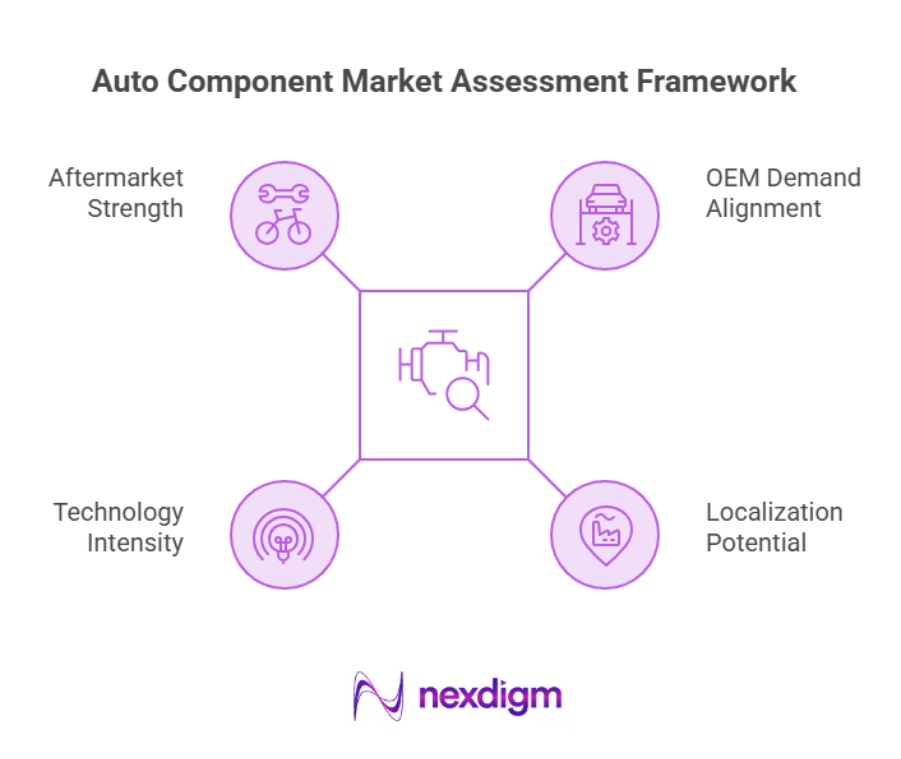
- OEM Demand Alignment: Evaluate whether the component addresses current and future OEM requirements, including electrification, safety, connectivity, performance, and regulatory compliance needs.
- Localization Potential: Assess opportunities for local manufacturing, supply chain integration, import substitution, and alignment with regional sourcing preferences and policies.
- Technology Intensity: Measure the level of innovation, engineering complexity, intellectual property value, and differentiation that can create long-term competitive advantages.
- Aftermarket Strength: Analyze replacement demand, product lifecycle, service requirements, distribution reach, and recurring revenue potential from aftermarket sales channels.
This framework enables organizations to move beyond short-term market trends and identify long-term growth drivers.
Future Outlook
The next phase of industry evolution will require component manufacturers to rethink their market positioning. Future leaders are likely to be organizations that:
- Invest in advanced technologies
- Build resilient local supply networks
- Strengthen OEM collaboration
- Expand aftermarket capabilities
- Develop innovation-driven product portfolios
The distinction between traditional parts manufacturers and technology providers will continue to narrow.
Nexdigm’s Case
Nexdigm supported an automotive player in assessing component opportunities as India’s industry turnover rose 12.7% YoY to ₹7.6 trillion in FY26, while OEM supplies grew 16.3%. The study mapped localization, technology, and aftermarket potential, identifying high-growth value pools and strengthening market priorities.
To take the next step, simply visit our Request a Consultation page and share your requirements with us.
Harsh Mittal
+91-8422857704